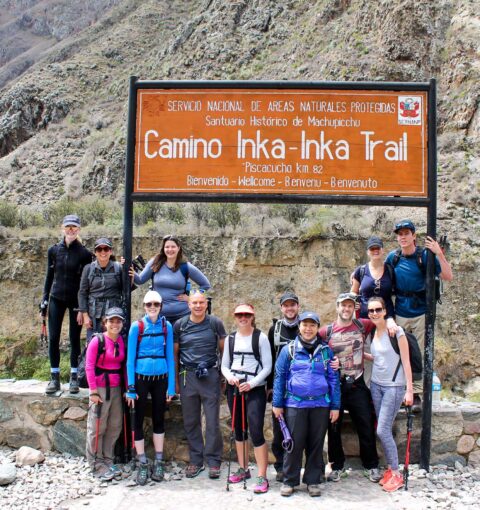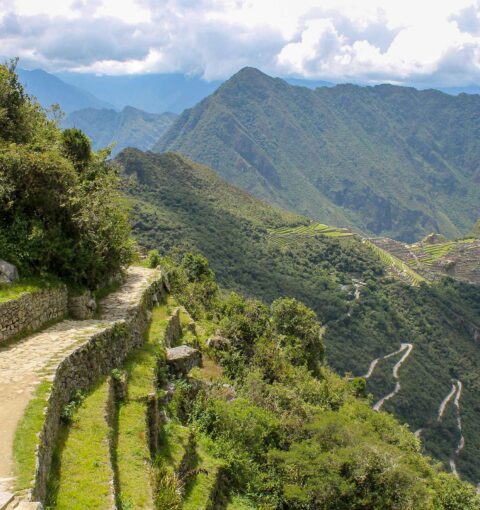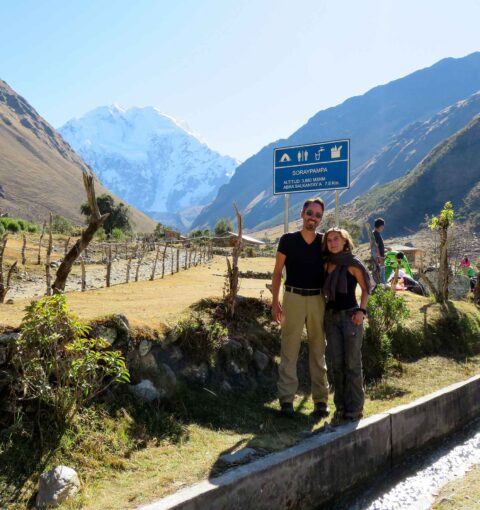

Many treks take you to Machu Picchu, but none like the Inca Trail. It is the most popular among travelers and the most famous American footpath. From Cusco, a 43-kilometer trail through forests, dense fog, ancient stone steps, and majestic views. At the end is the reward: the famous Sun Gate and its breathtaking views of the Inca City of Machu Picchu.
Beautiful mountains and landscapes of the Andes surround the Inca Trail. Throughout the days this adventure lasts, the Inca Trail is the only archaeological center it can reach. With a controlled capacity of visitors per month and year, no visitor wishes to walk it.
Machu Picchu communicated with the city of Cusco and the rest of the Inca empire through roads of excellent structure with an ergonomic design built in strict harmony with the natural environment and excellent aesthetics in their construction. Many trails are ledges on the edge of the abyss and surround beautiful landscapes with lush and varied flora and fauna. In some sections, the Inca Trail is carved directly into the rock. The Inca Trail to Machu Picchu is considered one of the most spectacular hiking routes on the planet and the best-known Inca trail.

The Inca Trail Trek is recognized worldwide by the most demanding hikers. This trek has everything necessary to be a challenging route. With the great reward of enjoying the environment and the fresh air, we are sure that enjoying this hike will be an excellent reward for all our travelers. The Inca Trail is the route that the ancient Incas traveled, and now you can do it with these packages that include everything you need.
Inca trails over the mountains, on the road with landscapes of Andean beauty that crosses, throughout the days that this adventure lasts, archaeological centers that can only be reached by it; that is the Inca Trail. With a controlled capacity of visitors per month and by year, no visitor wishes to walk it.
Machu Picchu communicated with the city of Cusco and the rest of the Inca empire through roads of excellent structure with an ergonomic design built in strict harmony with the natural environment and had excellent aesthetics in their construction. Many trails are ledges on the edge of the abyss and surround beautiful landscapes with lush and varied vegetation. In some sections, the road is carved directly into the rock. The Inca Trail to Machu Picchu is considered one of the most spectacular trekking routes on the planet and is the best-known of the Inca trails.
The excellent network of roads that connected the Inca Empire. The Inca Trail was the most sophisticated communication system that enabled managing resources and unifying the Inca Empire.
Traveling the Inca Trail today in Cusco is a challenging and satisfying experience. You will push yourself to the maximum, walking at different altitudes and enjoying beautiful landscapes for one or several days. Lares, Ausangate, and Salkantay are some routes that await you.
If you like hiking, you should walk the Inca Trail at least once.
WHO BUILT THE INCA TRAIL?
According to Peruvian archaeologists, stretches of this road network are about 2,000 years old and were built by ancient cultures.
Researchers indicate that the Inca Pachacutec, who created the Machu Picchu citadel, used these existing roads and built others, linking them into a network.
WHEN DOES THE INCA TRAIL CLOSE?
The Inca Trail to the Inca Citadel of Machu Picchu is closed in February each year as part of the regulations of this archaeological site and by the provision of the institutions responsible for its administration, such as the Ministry of Foreign Trade and Tourism, the INC, etc. Therefore, it is impossible to go on an excursion during this period.
WHEN IS THE BEST SEASON TO DO
THE INCA TRAIL?
The Cusco region has only two climatological seasons, which help us choose the best. The rainy season runs from November to March, and the dry season is between April and October. Hiding the Inca Trail in Machu Picchu during the dry season is advisable because we will have better views of the landscapes during the tour. However, coming to Machu Picchu in rainy weather also has its own advantages. As we said, you can not walk the Inca Trail in February.
HOW FAR IS THE INCA TRAIL?
The total distance of the Inca Trail is approximately 39.6 Km and starts at Km. 82 from a place called Q’oriwayrachina. You will visit archaeological complexes such as:
- Pulpituyoc
- Kusichaca
- Patallaca.
You will reach the highest point, 4,200 meters, crossing the Warmiwañusqa pass. This distance is calculated in the tour of 04 days and 03 nights. On the last day, you will arrive at the Inti Punku (Gate of the Sun) area, with an impressive view of the Inca citadel of Machu Picchu.
WHAT TO BRING FOR THE INCA TRAIL TREK?
You can imagine nature and adventure lovers who like to change the city’s noise for the beautiful singing of birds and the most beautiful landscapes. This Inca citadel of Machu Picchu hike by the Inca Trail will fulfill all your expectations. However, this type of trekking is not easy, especially for those who are not used to exercise or physical exertion. That said, the Inca Trail route exceeds 4000 m.a.s.l. in some areas, so we must take precautions, which Intupa Cusco will describe below.
- Trekking shoes
- Waterproof garments
- Wide-brimmed
- Towel and bathing suit; along the way, there are camping sites where showers are available
- It would help if you had underwear every day.
- A small blanket for the nights, because these are really
- Sunscreen and insect
- Fresh fruits, candies, and chocolates (they are suitable for accumulating energy)
- Money (local currency soles)
- Walking Flashlight and
- Sunglasses, lip balm
- A photographic
HOW TO PREPARE PHYSICALLY FOR THE INCA TRAIL?
Here are some tips to prepare before embarking on this fantastic adventure for those who plan to hike this impressive route.
This route will not be complicated for people in good physical condition and who practice some sport, although it involves walking for many hours on rough trails of rugged and flat terrain. However, people not accustomed to extreme physical exertion may experience minor fatigue and tiredness. Before undertaking this incredible route, the most important thing is to prepare your body physically, conditioning it for physical work.
Recommendations
- Hike: Walk for more than 2 to 3 hours daily to avoid discomfort on the Inca Trail route, such as excessive fatigue, since you will be walking approximately 5 to 6 hours daily.
- Up and downstairs: Practice going up and down to train for challenging hikes, because along the Inca Trail, there are stretches up steep mountains that can cause excessive fatigue and leg muscle pain. Especially if you plan to climb Huayna Picchu mountain or descend from the citadel of Machu Picchu to the town of Aguas Calientes, because both routes are incredibly steep with minimal incline
- Do breathing exercises: The Inca Trail starts at 2650 masl and reaches 4000 masl. Then, it is convenient to do breathing exercises to learn how to cope with altitude sickness. Breathing exercises will help you adapt quickly to the environment and breathe without difficulty, even in areas with low oxygen levels on the trek.
- Prepare your body for the physical effort: If you are not used to exercise, start practicing, as the activity on the trail generally involves walking throughout the day with short breaks. Therefore, do walking exercises and prepare your body to experience absolute pleasure on this magnificent Inca Trail.
- On the Inca Trail hike, you may experience some physical problems, such as fatigue, back pain, foot pain, headache, shortness of breath, and others, depending on your physical condition. Still, suppose you prepare yourself properly before embarking on this adventure. In that case, you can be confident that the only thing you will feel will be absolute pleasure and satisfaction. We have beautiful landscapes and archaeological complexes wrapped in a rich history that you will observe en route to the enigmatic Inca citadel, Machu Picchu.
CAN I take THE INCA TRAIL WITHOUT A GUIDE?
As the entrance to the Inca Trail is limited, only authorized tour agencies can enter and do the tour, so it is challenging to make the Inca Trail to Machupicchu without a tour guide.
HOW MANY DAYS IS THE INCA TRAIL?
The Inca Trail trek has a great variety of options, which we will list below:
- Sacred Valley & Short Inca Trail
- Inca Trail + Rainbow Mountain. + The Red Valley 3 Days
- Lares Trek + Inca Trail + Rainbow Mountain & Red Valley 4 Days
- Choquequirao + Short Inca Trail & Machu Picchu – 7 Days Trek
- Ancascocha Trek + Short Inca Trail & Machu Picchu – 6 Days
- Salkantay Trek + Short Inca Trail Machu Picchu – 6 Days
- Salkantay Trekking + Classic Inca Trail – 6 Days
- Inca Trail – 3 Days
WHAT ARE THE DIFFERENCES BETWEEN THE INCA TRAIL TREK AND THE SALKANTAY TREK?
We have a variety of routes to the Modern Wonder of Machu Picchu; we will show you the most important ones:
The Inca Trail is emblematic, thanks to its role in the Royal Roads system that connected the Inca Empire. Thanks to this, combined with the natural environment and the impressive finish at Machu Picchu, it is considered the number one hike in South America.
But we have an alternative: the Salkantay Trek, where you will enjoy beautiful landscapes surrounding the essential snow-capped mountains the Incas considered gods or Apus.
Below, we will list some Pros and Cons of the two tours:
Salkantay Trek
Pros of the Salkantay Trek:
The Salkantay Trek is famous for its scenery, which most guidebooks recommend, where you have a better chance of seeing larger mammals such as foxes, deer, chinchillas, and, with luck, even spectacled bears. We will also see a wide variety of plant species; a hike through the picturesque Andes takes you to the splendor of the glaciers, then down through lush valleys with coffee plantations, and then back to the high jungle.
On the circuit, it is 72% less crowded than the Inca Trail, with a daily average of 50 people compared to 180 people on the Inca Trail. This info means you will have much of the hike to yourself, and the campsites along the way do not get crowded, allowing you to immerse yourself in the landscape.
This information makes reservations easier, since we can find daily trips to Salkantay. It is just a matter of finding a group that leaves on the same day as you (unless you go independently or opt for a private tour), unlike the Inca Trail, where strict permit rules do not allow date changes or cancellations.
Cons of the Salkantay Trek:
Unlike the Inca Trail, you do not enter Machu Picchu through the Inti Punku Sun Gate. By spending the night in Aguas Calientes the night before, you can take the bus to the ruins or, if you wish to see Machu Picchu at sunrise, walk to see the morning. During your visit to Machu Picchu, you can walk to the Sun Gate in about half an hour. The Salkantay trek is almost twice as long and higher than the Inca Trail to Machu Picchu. This info means that it is physically more complicated than the Inca Trail. It is generally colder as well.
Campsite facilities along the trail are self-installed. Although you can bathe in the streams to brave the cold, there are no showers.
Although the Salkantay Trek also follows historical routes, the only ruins you will see are the citadel of Machu Picchu.
Inca Trail
Inca Trail Pros:
The Inca Trail is one of the most famous treks in the world, where hikers emerge from the jungle to the Sun Gate (Inti Punku), where Machu Picchu comes into view. From the gate, hikers descend to the citadel.
The Inca Trail features beautiful scenery, from snow-capped peaks to cloud forests and high-altitude jungles, and includes a variety of tiny historical ruins along the way. The most important of these is Wiñay Wayna, with abundant agricultural terraces.
Campsites along the trail include toilets that are cleaned every other day. For some, this is an advantage of the trek, although purist campers might prefer the more ‘wild’ feel of the Salkantay Trail.
Inca Trail Cons:
The Inca Trail is a trendy route. Permit limits keep crowds tolerable, but larger crowds reduce the chance of seeing large mammals. You will likely encounter other walkers and crowded campsites during the challenging ascent.
To hike the Inca Trail, you must go with an approved operator (Kondor Path Tours), who will purchase an Inca Trail permit on your behalf. Permits are limited to 500 per day, of which 300 are for guides, cooks, and porters. During much of the year, tickets are available, but you should purchase them for at least one or two months to ensure that you will find the desired date for the Inca Trail to Machu Picchu.
If you would like more information about these and other tours in the Peruvian Andes, please do not hesitate to contact our travel agency in Cusco for information, assistance, or excursions.
FROM WHAT AGE CAN YOU DO THE INCA TRAIL TREK?
The Inca Trail can be hiked by all adventure lovers in good physical condition who are willing to walk for 4 days, 2 to 8 hours per day, and sleep in tents during this time.
This hike has no age restriction; however, it is advisable to consider the travel of children under 08 years old, seniors, and people with heart problems.