Pumamarca Ruins Hike: Inca Trail to Ollantaytambo


A downhill Inca trail hike from the Pumamarca fortress, through Pata Pata, to Ollantaytambo.
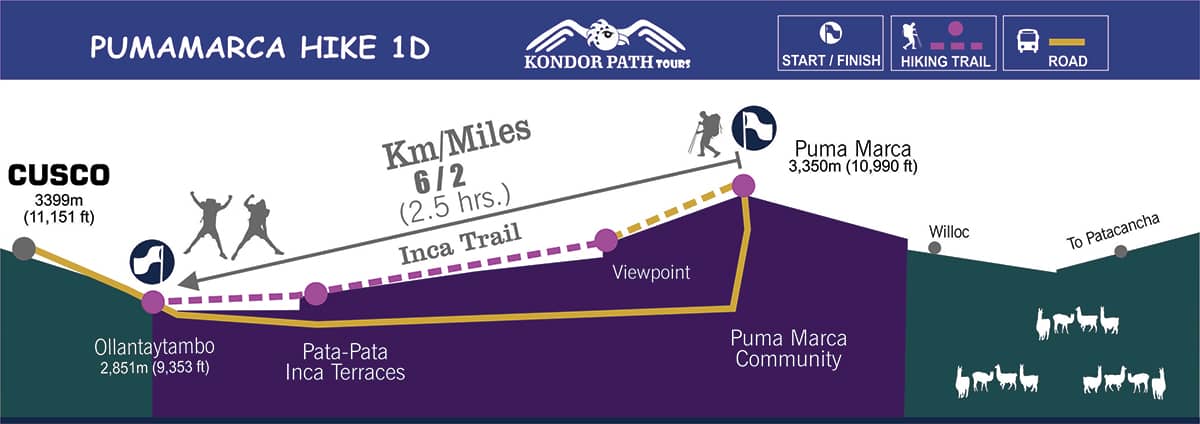
The Pumamarca Ruins Hike is a continuous, on-foot journey — not a series of stops, but a real 6 km hike along the original Inca trail that once connected the Pumamarca fortress to the valley below. The route starts at the Pumamarca ruins themselves, a military bastion that once guarded the Sacred Valley’s approach from the Amazon lowlands, then descends through the Pata Pata agricultural terraces before finishing in the town of Ollantaytambo.
Like the region’s other downhill hikes, the altitude logic here is straightforward: Pumamarca, the day’s highest point, is reached first — by vehicle from Cusco — meaning the physical effort of the hike itself happens on the way down, from roughly 3,350 m to Ollantaytambo at 2,851 m. That descent is what makes this a genuinely different kind of day than an uphill trek, even at a “moderate” difficulty rating.
| 💰 From | $42 USD per person (group of 10) |
| ⏱️ Duration | Full day (~3.5 hours hiking + transport) |
| 📏 Distance | ~6 km / 3.7 miles, mostly downhill |
| ⛰️ Altitude range | Pumamarca ~3,350 m down to Ollantaytambo 2,851 m |
| 🚶 Physical level | Moderate |
| 📅 Season | April–December |
| 👥 Group size | Private, 1-10 travelers (10+, contact us) |
| 🎂 Minimum age | 8+ with a guardian over 21 |





Most Ollantaytambo tours stop at the main fortress and market. This is a dedicated 6 km hike starting at the separate Pumamarca ruins, following the original Inca trail down through the Pata Pata terraces to Ollantaytambo.
That tour visits five sites (Ñaupa Iglesia, Qellorakay, Ollantaytambo, Pumamarca, and Pata Pata) with short walks between each. This is a single, continuous hike — just Pumamarca, the trail, and Pata Pata, on foot.
Almost entirely downhill — the trail drops from Pumamarca at roughly 3,350 m to Ollantaytambo at 2,851 m.
An Inca military bastion in the Patacancha Valley, used to control access between the Sacred Valley and the Amazon lowlands to the east — considerably less visited than Ollantaytambo’s main fortress.
Moderate — the terrain is uneven in places and the descent is steady, but no technical climbing or extreme fitness is required.
An Inca agricultural terrace system built across an entire mountainside, crossed directly on the descent toward Ollantaytambo.
Yes — since the hike ends in Ollantaytambo, a same-afternoon train to Aguas Calientes can be arranged, with Machu Picchu the following day. Contact us for pricing.
The recommended minimum age is 8, accompanied by a guardian over 21, given the distance and steady descent.
No — there are no shops along the trail, so bring your own snacks. Breakfast and lunch aren’t included in the tour price.
April through December offers the most reliable conditions for the descent.
It’s largely unrestored compared to sites like Ollantaytambo, which is part of its appeal — the ruins feel less curated and more like a genuine archaeological discovery.
No — the trail is well established and mostly downhill, making it accessible to travelers with a reasonable fitness level and no technical hiking background.
Signal is patchy in parts of the trail and more reliable once you reach Ollantaytambo itself.
Pumamarca doesn’t get the crowds that Ollantaytambo’s main fortress does — which is exactly what makes this hike worth doing. Rather than driving up to the ruins and walking a loop, as the Sacred Valley from Ollantaytambo tour does, this route treats Pumamarca as a starting point: a genuine Inca military outpost, still largely unrestored, that once controlled access between the Sacred Valley and the Amazon lowlands to the east.
From the ruins, the trail follows the original Inca path downhill, through the Pata Pata terraces — an entire mountainside reshaped for agriculture, still legible today as a system of stepped platforms. The hike ends in Ollantaytambo itself, with a panoramic view of the town’s famous fortress from a vantage point most visitors never reach on foot.
Because almost the entire route runs downhill, this is a genuinely different kind of day than the region’s uphill treks — similar in structure to the Chinchero to Urquillos Hike — a real hike, with real distance and real Inca history, without demanding the fitness level of a multi-day trek.
Both visit Pumamarca and the Pata Pata terraces, so it’s worth being clear about the difference. The Alternative Ollantaytambo Tour is a broader day trip — five separate sites (Ñaupa Iglesia, Qellorakay, Ollantaytambo’s main ruins, Pumamarca, and Pata Pata), reached with short walks between each. This hike is different: a single, continuous 6 km trek starting at Pumamarca, with no stops beyond the trail itself. If you want breadth across several sites, choose the Alternative Ollantaytambo Tour. If you want an actual hike, this is it.
The Pumamarca Ruins Hike follows the same altitude logic as the region’s other downhill routes: the highest point comes first, reached by vehicle rather than on foot, so the physical work of the day happens on the descent rather than the climb.
Pumamarca, at roughly 3,350 m, is where the hike begins — after a 1 hour 50 minute drive from Cusco that does the actual elevation gain. From there, every step of the trail moves toward lower ground, ending in Ollantaytambo at 2,851 m. That steady drop is what keeps this hike at a “moderate” rather than demanding difficulty, even over a real 6 km distance.


Your guide picks you up from your hotel at 7:00 AM, with a drive of approximately 1 hour 50 minutes via Izcuchaca, Pachar, and Ollantaytambo to reach the Pumamarca trailhead — the road itself does the day’s real elevation gain. A guided exploration of the Pumamarca fortress follows: plazas, enclosures, Inca trails, and agricultural terracing, once used to control entry between the Sacred Valley and the Amazon lowlands.
The hike begins at the ruins, following a section of the original Inca trail that connects Pumamarca to the valley floor near Ollantaytambo. A stop at the Pata Pata viewpoint offers sweeping views over the Inca terracing system built across the mountainside, before a walk directly through the terraces themselves. From there, the trail continues downhill toward the Patacancha River, with a final panoramic stop along the way for views of the Ollantaytambo fortress from a vantage point most visitors never reach on foot.
The hike ends in the town of Ollantaytambo, with time to explore before private transport carries you back to Cusco — or, for travelers continuing on to Machu Picchu, an optional same-afternoon train connection (see Section 9).
Day 1 stats

None

Moderate

6km (3.7 miles)

3.5 Hrs.

Puma Marca: 3,350m (10,990 ft)
Ollantaytambo: 2,851m (9,353 ft)
Want to explore ancient ruins in Peru? Check out the Trek Pumamarca Ollantaytambo, a magnificent site with much history and artifacts. Explore today!
The Pumamarca Ruins are ancient Incan ruins in the Sacred Valley of Peru, near Ollantaytambo.
The Incas built the Pumamarca Ruins as an agricultural and military center and likely used them as a resting place for travelers passing through the area.
The Pumamarca Ruins offer insight into the Incan culture and way of life and are a popular tourist attraction for visitors to the Sacred Valley.
The Pumamarca Ruins are located near Ollantaytambo and can be reached by car or foot via a scenic hike.
The visit to Pumamarca Ruins takes around 1-2 hours, depending on your interest level and the time you spend exploring the site.
Visitors should wear comfortable clothing and shoes suitable for walking on uneven terrain, as well as a hat and sunscreen to protect against the sun.
Yes, there is a small entry fee to enter the Pumamarca Ruins, which is used for the maintenance and preservation of the site.
While a guide is not necessary to visit the Pumamarca Ruins, having a knowledgeable guide can enhance your experience and provide valuable insights into the history and significance of the site.
Several hotels and guesthouses in the nearby town of Ollantaytambo offer a range of accommodations to suit different budgets and preferences.
Yes, the Pumamarca Ruins are considered safe for visitors, although it is always advisable to exercise caution and follow basic safety precautions when traveling in unfamiliar areas.
Several restaurants and cafes in the nearby town of Ollantaytambo offer a range of local and international cuisine.
Yes, visitors are allowed to take photographs at the Pumamarca Ruins. However, respecting the site and avoiding touching or moving artifacts or structures is essential.
The Pumamarca Ruins can be visited anytime, although many visitors prefer to go in the morning or late afternoon when the weather is cooler.
There are limited restroom facilities at the Pumamarca Ruins, although visitors are advised to bring their supplies and be prepared for basic facilities.
There are several other attractions and sites of historical and cultural significance in the Sacred Valley, including the town of Ollantaytambo, the Pisac Ruins, and the Moray archaeological site.
| Persons | Price (p/p) | |
| 1 | $ 237.00 USD | |
| 2 | $ 136.00 USD | |
| 3 | $ 101.00 USD | |
| 4 | $ 80.00 USD | |
| 5 | $ 69.00 USD | |
| 6 | $ 60.00 USD | |
| 7 | $ 53.00 USD | |
| 8 | $ 49.00 USD | |
| 9 | $ 45.00 USD | |
| 10 | $ 42.00 USD |
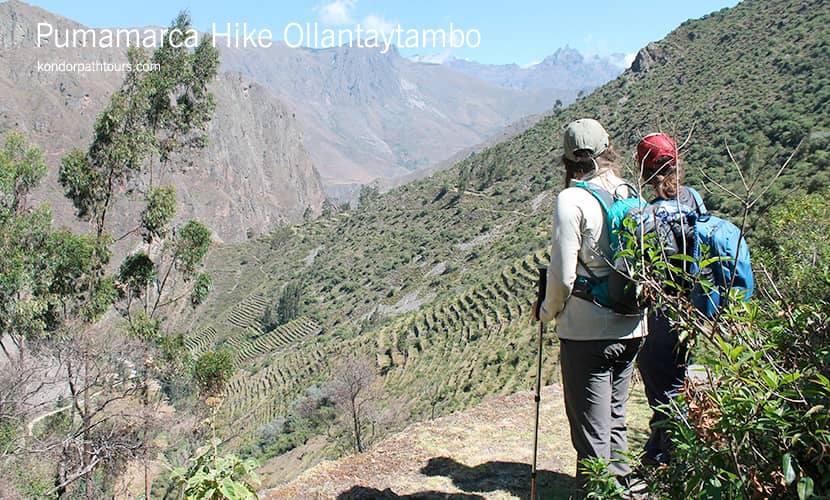
Trek Pumamarca Ollantaytambo
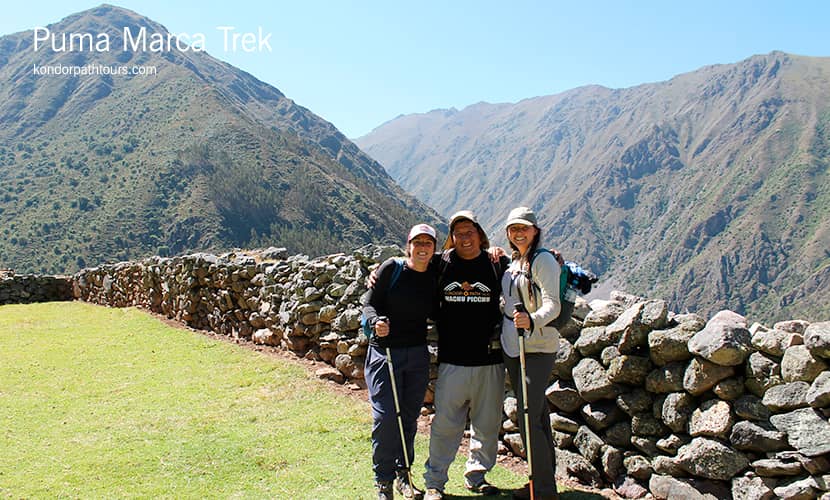
Trek Pumamarca Ollantaytambo

Trek Pumamarca Ollantaytambo