Classic 4-Day Inca Trail to Machu Picchu 2027


The world’s most famous trek: four days to Machu Picchu through the Sun Gate on foot.
The Classic 4 Day Inca Trail — the FLAGSHIP of the Kondor Path Inca Trail cluster + the ONLY trek on Earth following the original Inca pilgrim road, ending with sunrise arrival at Sun Gate.
1. THE original Inca pilgrim road ⭐ UNIQUE. No other trek on Earth follows this exact route — 43 km of hand-cut stone paths built more than 500 years ago and still intact. Original Inca tunnels + ceremonial sites + engineering marvels through cloud forest between Sacred Valley and Machu Picchu. Walking history.
2. Sun Gate (Inti Punku) sunrise arrival Day 4 ⭐ UNIQUE. Arrive at Machu Picchu exactly the way Inca pilgrims did 500+ years ago — through the ceremonial Sun Gate at sunrise. No train journey or alternative trek can recreate this experience. First sunlight over the Andes reveals Machu Picchu below — the single most iconic moment on any Peru trek.
3. Chaquicocha strategic quiet camp Day 2 ⭐. Unlike operators using crowded Pacaymayo, we continue to Chaquicocha — quieter + panoramic mountain views + shortens Day 3 hiking + peaceful overnight experience + strategic differentiator that improves your entire trek.
4. 6 archaeological sites accessible only by trail. Llaqtapata + Runkurakay + Sayacmarca + Phuyupatamarca + Wiñay Wayna + Machu Picchu — sites unreachable by train or road. MP Circuit 3-B (Royalty Route) + 2-hour guided tour on Day 4 covering Temple of the Sun, House of the Inca, Sacred Water Fountains, and Sacred Rock.
5. Ethical Quechua porter team + gourmet chef meals + direct DIRCETUR operator. Strict 20 kg weight cap for porters + above-minimum wages + full welfare standards + Peruvian labor law compliance. Fresh gourmet meals with vegetarian/vegan/gluten-free accommodated. Permits in YOUR name through our Ministry of Culture license — no middlemen or resellers.
| ⏱️ Duration | 4 days / 3 nights (all camping) |
| 🎯 Category | HIKING & CAMPING — FLAGSHIP ICONIC |
| 📅 Day 1 | Cusco → Km 82 → Wayllabamba → Ayapata Camp 3,300m |
| 📅 Day 2 ⭐ | Ayapata → Dead Woman’s Pass 4,215m → Runkurakay Pass 3,971m → Chaquicocha 3,600m ⭐ |
| 📅 Day 3 | Chaquicocha → Sayacmarca + Phuyupatamarca → Wiñay Wayna 2,650m |
| 📅 Day 4 ⭐ | Wiñay Wayna → Sun Gate sunrise ⭐ → MP Circuit 3-B + 2h guided tour → Cusco |
| 🕐 Day 1 pickup | 05:00 AM Cusco hotel |
| 🕐 Day 4 wake-up | 03:30 AM (Wiñay Wayna checkpoint opens 5:30 AM) |
| 🕐 Day 4 arrival in Cusco | ~20:30 |
| ⛺ Camping nights | 3 (Ayapata + Chaquicocha strategic + Wiñay Wayna) |
| ⛺ Chaquicocha Day 2 | ⭐ Strategic quieter camp vs crowded Pacaymayo |
| ☀️ Sun Gate Day 4 | Iconic sunrise arrival ⭐ |
| 🎫 MP Circuit | 3-B (Royalty Route) + 2h guided tour |
| 🚂 Return train | PeruRail Expedition + private transfer to Cusco ⭐ |
| ⛰️ Max altitude | Dead Woman’s Pass 4,215m Day 2 |
| ⛰️ Km 82 trailhead | 2,720m |
| ⛰️ Runkurakay Pass | 3,971m Day 2 |
| ⛰️ Phuyupatamarca | 3,680m Day 3 |
| ⛰️ Wiñay Wayna | 2,650m Day 3 |
| ⛰️ MP Ruins | 2,400m |
| 🥾 Total distance | ~45 km (43 km Inca Trail + ~2 km MP walking) |
| 🏛️ Archaeological sites | 6 (Llaqtapata + Runkurakay + Sayacmarca + Phuyupatamarca + Wiñay Wayna + MP) |
| 🎫 Inca Trail permit | Included (in your name) |
| 🎫 MP entrance | Included (Circuit 3-B) |
| 🎫 SERNANP conservation fee | INCLUDED NEW May 1, 2026 ⭐ |
| 🍽️ Meals included | 10 (3B + 3L + 3D + daily afternoon tea + snacks) |
| 🦙 Porters | Ethical Quechua team (20kg strict limit + 5kg personal duffel) |
| 🎯 Format | PRIVATE TOUR |
| 👥 Group size | 1-10 hikers |
| 🎓 Minimum age | 12+ with guardian over 21 (18+ unaccompanied) |
| 📅 Operating | March-January daily (closed February — trail maintenance) |
| 💪 Difficulty | Challenging (Level 3) |
| 🎓 Guide ratio | 1:8 + assistant for 9+ hikers |
| 📋 Regulation | RM Nº 000284-2025-MC compliant |
| 🕐 MP ticket window | 6:00-14:00 |
| 💲 From | $755 USD per person (group of 10) |





Few trips compare to the Classic 4-Day Inca Trail to Machu Picchu in 2027. – Walk the original Inca road — 43 km of hand-cut stone paths built over 500 years ago, still intact. – Cross Dead Woman’s Pass (Warmiwañusca, 4,215 m) — the highest and most photographed point of the trek. – Visit five exclusive archaeological sites — Llactapata, Runkurakay, Sayacmarca, Phuyupatamarca. – Arrive at Machu Picchu through the Sun Gate at sunrise on Day 4 — the only trek in the world that delivers. These are the moments that make the Inca Trail 4 Day 2027 worth it.
The Classic 4-Day Inca Trail to Machu Picchu 2027 is the FLAGSHIP tour of the Kondor Path Inca Trail cluster — the ONLY trek on Earth that follows the original Inca pilgrim road and ends with a sunrise Sun Gate arrival.
This IS the tour for:
Unlike operators using crowded Pacaymayo, Kondor Path continues to Chaquicocha at 3,600 m:
Inti Punku (Sun Gate) 2,720m — the ceremonial entrance designed by the Incas:
Circuit 3-B — the Inca Trail permit route + Royal exploration:
The Complete Classic 4-Day Inca Trail Experience — Beyond the Standard Description
Every trekking company describes the Classic Inca Trail the same way — “4 days, 43 km, Sun Gate arrival.” What they don’t tell you is what actually happens on the trail: the emotional moments, the physical challenges, the small details that make the difference between a good trek and an unforgettable one. Below is our honest, complete day-by-day breakdown based on hundreds of successful Kondor Path expeditions since 2015.
Pre-Trek Essential Briefing: The evening before departure (usually 6:00 PM at your hotel), your certified Inca Trail guide meets with the group for a 45-minute orientation covering itinerary details, packing verification, altitude preparation, meal preferences, dietary requirements, medical conditions review, and permit confirmation. This briefing is mandatory — plan your Cusco arrival accordingly.


“The Gentle Awakening — Following the Urubamba River Into Sacred Territory”
Your day begins in the pre-dawn silence of Cusco, when the city’s colonial streets are still empty, and the Andean sky glows faintly purple to the east. Your driver arrives at your hotel with your certified bilingual guide waiting to greet you personally — not just a driver dropping you at a bus terminal. Load your 5kg duffel bag (the maximum weight our porters will carry for you) and your daypack containing essentials for the day: water, snacks, camera, sunscreen, rain jacket, warm layer, headlamp.
Insider Tip: Pack your duffel bag the night before with everything you WON’T need during hiking hours — sleeping bag, evening clothes, camp shoes, extra socks, toiletries, journal. Your daypack should weigh 6-8 kg maximum — anything heavier becomes exhausting by hour 4 of Day 2.
The private van heads north out of Cusco toward the Sacred Valley of the Incas. As dawn breaks, you’ll watch the sky shift through indigo, pink, and gold over the eastern Andes. Your guide will introduce Inca history not from a script, but from lived experience — many of our guides are Quechua speakers whose grandparents worked these same lands.
What you’ll see: passing through Poroy village + descending the Chinchero plateau + spectacular first views of the Sacred Valley + Mount Chicón (5,530m) glacier catching first light + traditional Quechua villages waking up.
Arrive at Ollantaytambo, the last living Inca town on Earth — the only settlement still occupied continuously since Pachacuti’s reign in the 15th century. Cobblestone streets are paved with original Inca stones. Water still flows through Inca-engineered channels in the exact same paths designed 600 years ago.
Your breakfast stop happens at one of our trusted local family-run restaurants — hearty Andean fare with fresh Cusco bread, farm eggs, tropical fruits, quinoa porridge, and coca tea to prepare your body for the trek. This is your last hot meal before entering the trail — eat generously.
Insider Tip: Buy any last-minute essentials in Ollantaytambo — the last town before Km 82. Snacks, extra water, coca leaves (traditional Andean altitude aid), sun hat if forgotten. Prices double or triple past this point.
Continue by van along the sacred Urubamba River — the same river the Incas called “Willkamayu” (Sacred River) because they believed it was the earthly reflection of the Milky Way. During certain months, you can see the Milky Way arc directly overhead as the river flows below — a cosmic alignment the Incas encoded into their ceremonial planning.
The road turns to dirt as you approach Km 82. The name is literal — it’s the 82nd kilometer of the railway line between Cusco and Aguas Calientes. This is where organized civilization ends and where the ancient pilgrim path begins.
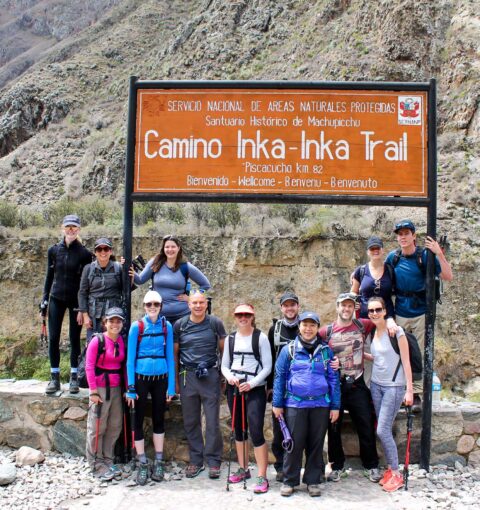
Arrive at the official trailhead checkpoint — the only legal entry point to the Classic Inca Trail. Here you’ll experience your first taste of trail logistics:
What happens:
Critical: NO passport = NO entry. Peru enforces this rigidly. If your passport is at home or expired, you cannot start the trek. There are no exceptions, negotiations, or bribes. Verify your passport is current + matches your booking name weeks before travel.
Your first step onto the original Inca Trail is across a modern suspension bridge over the roaring Urubamba River. Below, the sacred river carves through granite bedrock — the same river the Inca engineers redirected, channeled, and worshiped centuries ago. Take a moment here. Feel the transition. You’re leaving the world of vehicles + hotels + electricity + phones with signal, entering the world of stone paths + porters + campfires + stars.
The first three hours follow what Peruvians call “Inca flat” — gentle rolling terrain with modest ups and downs. Don’t be fooled by the term “flat” — this is high-altitude walking (2,700- 2,900 m), and the sun intensifies quickly. Your body needs time to adjust to the physical rhythm of trail life.
What you’ll see and experience:
🏔️ Mount Verónica (Waqaywillka) 5,860m ⭐ dominates the horizon to your left. Its Quechua name means “Sacred Tears” — legend tells of an Inca princess whose tears formed the glacier when she was forbidden to marry her true love. Local Quechua communities still consider the mountain an Apu (mountain spirit).
🌿 Ecology transition: You’ll walk through puna grassland (short golden grasses adapted to high altitude), spotting native flowers like q’antu (Inca sacred flower with tubular red blooms), mutuy (medicinal yellow blooms), and if lucky, orchids clinging to the rock walls. Your guide will identify native species Andean communities have used medicinally for 500+ years.
🐦 Wildlife opportunities: Andean caracaras (raptor birds), hummingbirds darting between flowers (Peru has more hummingbird species than any country on Earth — 130+), rufous-collared sparrows trilling from bushes, and occasionally vizcachas (wild chinchilla relatives) sunning on rocks.
📖 Historical context: The path you’re walking is not just an old road — it’s part of the Qhapaq Ñan (“Great Road”), a UNESCO World Heritage site since 2014. The Inca engineered 30,000+ km of paved roads across South America, connecting Ecuador to Chile. The 43 km of Classic Inca Trail you’ll walk is a ceremonial spur — a pilgrimage route reserved for royalty, priests, and chasquis (imperial messengers).
At approximately Km 87, your porter team has raced ahead of you and set up a complete field kitchen. Yes — while you were hiking, they carried tables, chairs, a dining tent, kitchen equipment, fresh produce, propane stoves, and set up a restaurant-quality dining experience in the middle of the Andes.
Your lunch typically includes:
What amazes hikers most: The quality of these trail meals exceeds many restaurant experiences in Cusco. Vegetarian, vegan, gluten-free, and allergy-friendly meals are prepared at no additional cost — our chef trained for years to accommodate international dietary needs without sacrificing flavor.
Insider Tip: Eat well but not to overfill — you have 2-3 more hours of hiking. Drink 1-2 cups of coca tea; the mild stimulant helps with altitude and provides energy without caffeine jitters.
After lunch, the trail continues along the Cusichaca River valley. The landscape shifts from open puna to increasingly forested slopes as you descend slightly to 2,850m before beginning a gentle ascent again.
Around mid-afternoon, you’ll reach one of the trek’s hidden gems: Llaqtapata (also called “Patallacta”), meaning “Town on the Hillside” in Quechua. This is a complete Inca agricultural settlement — massive terraced platforms cascading down the mountainside, ceremonial areas, residential quarters, and irrigation channels.
Why this matters: Llaqtapata was likely a support settlement for Machu Picchu — providing food, textiles, and supplies to the sacred citadel. When Spanish conquistador Manco Inca retreated from Cusco in 1536, he ordered Llaqtapata burned to prevent Spanish forces from finding it. Archaeological evidence still shows fire damage on some walls.
Photography opportunity: The terraces from above create geometric patterns that photograph magnificently in afternoon light. Your guide will point out the exact vantage points professional photographers use.
What most operators don’t tell you: The path splits here. Most tours rush past Llaqtapata to make camp before sunset. Kondor Path plans a 30-minute stop for guided exploration — your certified guide will explain the agricultural engineering, ceremonial functions, and connection to Machu Picchu that most trekkers never learn.
The trail rises through Wayllabamba — one of the few inhabited villages along the entire trek. About 20-30 Quechua families live here year-round, farming potatoes, corn, and quinoa on ancestral terraces. Children may run up to greet you (candy is not recommended — support our porters’ Quechua Foundation instead, which funds village education).
Cultural moment: You’ll see traditional Andean life continuing largely unchanged — women weaving on backstrap looms, guinea pigs (cuy) scurrying near kitchens, chicha (fermented corn beer) fermenting in clay pots. This is not staged tourism — this is the real Andes.
You arrive at your first campsite as afternoon sun casts long shadows across the valley. Your tents are already pitched. Your dining tent is set up with chairs. Your porters greet you with basins of warm water for washing hands and face — a small luxury that feels enormous after 6-7 hours on the trail.
Why Ayapata (not Wayllabamba)? Most standard operators camp at Wayllabamba (3,000m) at the end of Day 1. Kondor Path continues 300m higher to Ayapata for a strategic reason: this shortens Day 2’s brutal ascent to Dead Woman’s Pass by nearly an hour, giving your body more rest before the trek’s hardest section.
Traditional Andean welcome — a mug of hot coca tea (mate de coca) served with fresh popcorn as an afternoon snack. The coca leaves help with altitude adjustment; the sugar and salt in the popcorn replenish electrolytes lost while hiking. This becomes your favorite trekking ritual.
Your first dinner is a full three-course chef meal — soup + main + dessert — served in the dining tent by candlelight. Your guide formally introduces each member of your porter team, sharing their names, home villages, families, and years working the Inca Trail. Some of these men have walked the trail 400+ times over their careers.
A powerful moment: Take time to learn your porters’ names. Their work makes your experience possible. Many hikers say meeting the porters becomes one of their most memorable experiences of the entire Peru trip.
At 3,300m with zero light pollution, the night sky is spectacular. Your guide will point out:
Total Day 1: 12 km / 6- 7 h hiking · Elevation gain: 580m (from Km 82 at 2,720m to Ayapata at 3,300m) · Physical Level: Moderate

Lunch, Dinner

Moderate

12 km / 7.5 mi

6–7 hours

Km 82 (2,720 m) 8,924 feet
Tarayoc: 2,700m (8,858 ft)
Ayapata (3,300 m) 10,827 feet


“The Sacred Ascent — Crossing Two Andean Passes in One Legendary Day”
Warning: This is the trek’s most physically demanding day. It will also become one of the most memorable days of your life. The suffering is real; the reward is transcendent.
The Inca Trail’s most beloved tradition: your porter gently knocks on your tent, opens the flap, and delivers a steaming mug of coca tea directly to your sleeping bag. Outside, the temperature is 2-5°C (35-40°F). Inside, you sip warm tea while the sun begins to color the eastern ridges. This is trekking luxury at its finest.
Insider Tip: Drink the coca tea completely — the leaves’ alkaloids help open your bronchi and improve oxygen absorption before altitude effort. Andean cultures have used coca for 3,000+ years for exactly this purpose. It’s completely legal in Peru, Bolivia, and Argentina.
Full breakfast in the dining tent — usually pancakes or quinoa porridge + eggs + fresh fruit + bread + hot chocolate or coffee. Eat generously; you’ll burn 4,000-5,000 calories today. Vegetarian, vegan, and gluten-free options are always available.
Practical tip: Pack at least 3 liters of water for the day + high-energy snacks (chocolate, nuts, dried fruit, energy bars). Your porters cannot bring extra water midday.
You leave camp with morning shadows still covering the valley. The trail immediately begins climbing through cloud forest (an ecosystem called “bosque nublado“) — where humid Amazonian air rising from the eastern lowlands condenses against the Andes to form permanent mist. This zone is one of Earth’s most biodiverse habitats.
What you’ll see and experience:
🌳 Polylepis (Q’euña) trees ⭐ — the highest-elevation trees on Earth, only growing above 3,500m in the Andes. These twisted, ancient trees have papery, reddish bark that peels in layers, adapted to extreme UV and cold. Some individual trees are 200+ years old.
🐦 Andean cloud forest birds: watch for mountain caracaras, Andean guans, and if lucky, the elusive Andean cock-of-the-rock (Peru’s national bird — bright orange plumage).
🦋 Butterflies + hummingbirds: dozens of species dance through openings in the canopy. Photograph if you can — some of these species are found nowhere else on Earth.
This is the trek’s defining physical challenge. Over 3.5 hours, you’ll ascend approximately 1,200 vertical meters on original Inca stone stairways — hand-cut steps built by Inca engineers 600+ years ago and still perfectly functional. Every step is one your ancestors could take, on a path most humans will never walk.
What to expect physically:
Mental preparation: This climb will test you. There will be moments you want to quit. Every hiker who has ever attempted the trail has felt this. Remember: you are walking a sacred pilgrimage route. The Incas built this path with ceremonial intent — the physical effort is inseparable from the spiritual arrival at Machu Picchu.
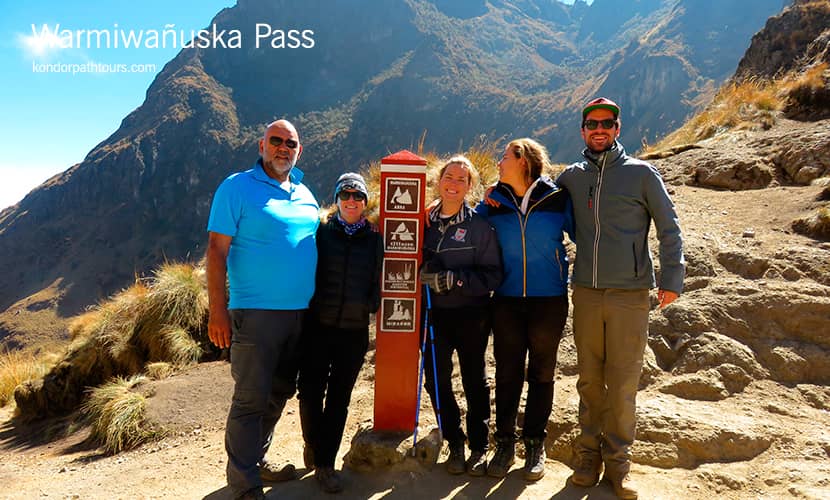
You crest the pass. Your body is exhausted. Your lungs are burning. And then you turn around and see it — the entire Andean landscape stretching in every direction, snow-capped peaks glittering under equatorial sun, the trail you just conquered snaking down the valley behind you.
This is the moment every trekker photographs. Every trekker cries a little (altitude tears + emotion tears mix). Every trekker realizes they just accomplished something they weren’t sure they could do.
Why “Dead Woman’s Pass”? From certain angles, the mountain ridge silhouette resembles a woman lying on her back — the head, chest, and legs of a sleeping (or dead) female form. Quechua name Warmiwañusca literally means “Dead Woman.”
Summit rituals:
You’ve conquered the pass — now the trail plunges down 600m into the beautiful Pacaymayo Valley. The descent is not easier than the ascent — your knees will feel every step of the original Inca stones. Use trekking poles (strongly recommended, rentable for $15 USD/pair) to reduce knee stress.
What you’ll see:
Your porters have raced ahead again — they’ve set up the dining tent, kitchen tent, fresh salads, and hot soup, awaiting your arrival. You’ve earned every calorie. Take your time — this is a well-deserved rest.
What amazes hikers: The porters carrying 20kg loads have already ascended AND descended Dead Woman’s Pass FASTER than you did with only a daypack. Their genetic adaptation to altitude (thousands of years of Andean ancestry), combined with lifelong physical conditioning, makes them among the most physically capable athletes on Earth.
Yes — a second high pass on the same day. This is what makes Day 2 truly demanding: after Dead Woman’s Pass, most people expect the hardest work is done. It’s not. Runkurakay Pass at 3,971m requires another 400m of ascent from the lunch spot.
However: this ascent is significantly easier than Dead Woman’s Pass because (a) you’re already acclimatized from the morning’s climb, (b) the gradient is more moderate, (c) the mental barrier has been broken.
Along the way:
🏛️ Runkurakay Archaeological Site ⭐ — a small circular Inca watchtower + control post. Its unique circular design is rare in Inca architecture (most sites are rectangular) — suggesting either astronomical or ceremonial significance. From this elevated position, Inca sentries could monitor movement through both valleys—an ancient checkpoint on the sacred pilgrimage road.
Historical context: This site was likely a wayside chapel where pilgrims making the journey to Machu Picchu would rest, pray, and receive blessings from resident priests. The circular design may represent the sun (Inti) or the cosmos itself.
Photography moment: Panoramic views of both valleys converging + mountain vistas.
Your final descent of the day leads to your strategically chosen second-night camp: Chaquicocha 3,600m.
Why Chaquicocha (not Pacaymayo like most operators)? ⭐ CRITICAL DIFFERENTIATOR
This single strategic choice is why our TripAdvisor reviews mention “amazing campsite” so frequently — most operators don’t invest in the extra logistics required to reach Chaquicocha.
Your porters welcome you with basins of warm water for washing (this feels transcendent after 10 hours of hiking), plus traditional coca tea and popcorn.
Tonight’s dinner is a special celebration meal — your porter team congratulates you on completing the hardest day. A three-course dinner with special dessert (often a freshly baked cake or flan). Your guide leads a brief reflection on the day’s accomplishments.
Emotional moment: Many hikers describe this dinner as their favorite meal of the entire trek. The combination of physical exhaustion + achievement + camaraderie + genuine hospitality creates a memory that lasts a lifetime.
Day 2 demands early sleep. Your body needs 8+ hours of recovery. Fall asleep to the sounds of the Andes — wind through the polylepis trees, distant streams, the occasional call of a nocturnal bird.
Total Day 2: 16 km / 8- 10 h hiking · Two high-altitude passes (4,215m + 3,971m) · Elevation gain 915m + elevation loss 615m · Physical Level: Challenging (most demanding day)
Breakfast, Lunch, Dinner
Challenging
16 km / 10 mi
8–10 hours
Ayapata (3,300 m) 10,827 feet
Chaquicocha (3,600 m) 11,811 feet
Pacaymayo Valley (3,600 m / 11,811 ft.)


“The Archaeological Cathedral Day — Walking Through Living Museums in the Cloud Forest”
Day 3 is the trek’s most photogenic day. If Day 2 tested your body, Day 3 rewards your soul. You’ll walk through multiple Inca archaeological sites, cross original stone tunnels carved by hand, and descend through orchid-filled cloud forest to your final campsite. This is also historically the most important day — you’re walking through the ceremonial approach zone to Machu Picchu.
The morning routine repeats — coca tea to tent, then breakfast in the dining tent. Today’s breakfast is heartier than Day 2’s because you’ll be hiking through archaeological sites where lunch stops are strategic (not always meal-friendly locations).
You leave camp under morning fog that typically shrouds the cloud forest until 9-10 AM. Walking through this mist creates an ethereal, almost mystical atmosphere — you’ll understand why the Incas considered this landscape sacred.
Immediately notice: The trail today is entirely original Inca stone paths — not restored, not rebuilt, but the actual stones placed by Inca laborers 600+ years ago. Some stones still bear tool marks from the bronze chisels used to shape them.
Your first archaeological encounter of the day is dramatic. Sayacmarca (“Inaccessible Town” in Quechua) sits on a rocky promontory with sheer cliffs on three sides—designed as a religious sanctuary, defensive stronghold, or aristocratic retreat.
What you’ll see:
Why this matters: Sayacmarca was likely an elite priest residence — a place where high-ranking religious figures could perform sacred ceremonies away from lower castes. The site’s isolation was intentional; only initiated priests + royalty were permitted to enter.
Photography: The sunlight breaking through morning mist over the ceremonial plaza creates otherworldly images. Your guide will position you at the best vantage points.
Sensory detail: You may hear the sound of water still flowing through 600-year-old channels — a sound the Inca priests heard during their own ceremonies. Close your eyes for a moment. Time collapses.
Between Sayacmarca and the next archaeological site, the trail passes through an original hand-carved Inca tunnel — a 20-meter passage carved directly through solid rock by Inca engineers using only bronze tools and hardwood wedges.
What amazes engineers: The tunnel is precisely angled for optimal solar illumination during specific dates (likely equinoxes). The floor is polished smooth by 600 years of foot traffic. The walls still bear original tool marks.
As you walk through, cool, damp air replaces sunlight. The temperature drops 5-10°C. Water drips softly. For 30 seconds, you’re inside a monument that has channeled pilgrims for 20+ generations. This is not restoration — this is the original stone.
The trail climbs gently for about an hour through cloud forest to reach Phuyupatamarca — “Town Above the Clouds” — the highest archaeological site on the Classic Inca Trail.
Why the name is literal: At 3,680m, this site frequently sits ABOVE the cloud layer that fills the valleys below. Standing here, you look DOWN onto white cloud oceans with mountain peaks emerging like islands. When the clouds break, you get your first panoramic view of the Machu Picchu mountain basin — the sacred valley containing the citadel itself, still hidden below the ridge to your east.
What you’ll see at the site:
The hydraulic engineering marvel: The six fountains are supplied by a spring 500 meters above the site. Inca engineers designed a completely gravity-fed irrigation system — no pumps, no mechanical parts, purely gravity and precise stone channels. The system has functioned without maintenance for 600+ years. Modern civil engineers travel from around the world to study this technology.
Ritual context: Pilgrims would stop here for ceremonial purification before descending toward Machu Picchu. The six fountains likely represented six ritual cleansings—physical and spiritual preparation for approaching the sacred citadel. Some archaeologists believe royalty performed elaborate purification rituals here spanning hours or days.
Photography: This is one of the trek’s premier photography locations. The combination of ancient fountains + cloud forests + panoramic mountain views + first Machu Picchu glimpses creates cinematic images.
Your porter team has prepared lunch at a scenic viewpoint near Phuyupatamarca. You’ll eat with panoramic Andean vistas — arguably the most spectacular lunch location on any trek in the Americas.
After lunch begins one of the trek’s most iconic sections: the “Thousand Steps” (Mil Escalones) — an original Inca stone stairway descending nearly 1,000 vertical meters through dense cloud forest in about 3 hours.
Physical warning: This descent is HARDER than the ascent for many people. The impact of 1,000+ downhill steps takes a toll on your knees. Trekking poles are essential for reducing joint stress. Take your time — there’s no rush. Falls on wet stones cause most trail injuries.
Ecological transformation: As you descend from 3,680m to 2,650m, you’ll pass through four distinct microclimates:
🌿 High cloud forest (3,680-3,400m): Polylepis + Andean bamboo + moss-covered rocks 🌺 . Middle cloud forest (3,400-3,000m): Orchid paradise — over 200 native orchid species documented on this stretch alone. Peru is the orchid’s genetic homeland. Look for tiny flowers on tree branches — many species smaller than your fingernail. 🌸 Lower cloud forest (3,000-2,700m): Bromeliads + tree ferns creating prehistoric-looking environments 🌴 Subtropical zone (2,700-2,650m): Warmer temperatures + increased humidity + first tropical species
Wildlife opportunities on descent:
Your final campsite is beside one of the Inca Trail’s most spectacular archaeological sites: Wiñay Wayna — “Forever Young” in Quechua, named after the local orchid species (Epidendrum secundum) that blooms year-round on the site.
What amazes first-time visitors: Wiñay Wayna’s agricultural terraces cascade down the mountainside for over 500 vertical meters, creating what looks like a green amphitheater carved from the mountain itself. The terraces are still functional — they could grow crops today with minimal maintenance.
Site components:
Historical significance: Wiñay Wayna was likely the final purification stop before pilgrims continued to Machu Picchu the next morning. The site’s location — the last major settlement before the Sun Gate — supports this interpretation.
Your camp is only a 5-minute walk from the archaeological site. You have 2-3 hours of free time before dinner — most hikers spend this exploring Wiñay Wayna independently, photographing the terraces, sitting quietly with the ancient stones, absorbing the accomplishment of what you’ve completed.
Insider Tip: Late afternoon light (16:30-17:30 PM) creates the most dramatic photography conditions at Wiñay Wayna. The setting sun angles across the terraces, highlighting their geometric perfection. Bring your camera; leave your ego. This is one of the trek’s iconic photo locations.
Tonight is the traditional farewell dinner — a special three-course meal celebrating your achievement. Your chef often prepares a small cake for the group. Your guide leads a moment to formally recognize the entire porter team — each porter shares his name, home village, family details, and receives your applause + tips.
The tipping moment: This is when you distribute tips to your porter team, chef, and assistant guide. Recommended amount: US$40-60 per hiker total (distributed among team). Your guide will explain the traditional distribution ratios.
Why tips matter enormously: Porter wages are legally mandated but modest by international standards. Your tips represent a significant portion of their annual income. Trekkers’ generosity directly funds education for porters’ children, healthcare for their families, and community development in mountain villages.
Sleep early — your Day 4 wake-up is 3:30 AM. Fall asleep to the sound of the Urubamba River far below the valley + occasional owl calls + wind through the cloud forest. Tomorrow, you walk through the Sun Gate.
Total Day 3: 10 km / 5-6h hiking · Elevation loss 950m (from 3,600m to 2,650m) · Physical Level: Moderate (mostly downhill but demanding on knees)
Breakfast, Lunch, Dinner
Demanding
10 km / 6.2 mi
5–6 hours
Chaquicocha (3,600 m) 11,811 feet
Wiñay Wayna (2,650 m) 8,694 feet
Phuyupatamarca 3,680 m (12,073 ft.)


“The Sacred Arrival — Walking Through the Sun Gate at Dawn”
Every hiker who has ever completed the Classic Inca Trail describes Day 4 as one of the most emotional experiences of their lives. This is the day 500+ years of Inca engineering, 4 days of physical effort, and a lifetime of dreaming converge in a single moment: standing at the Sun Gate as sunlight reveals Machu Picchu below.
Your porter knocks softly. You unzip your tent to complete blackness — no light pollution, no city glow, just stars. The Andean sky at 3 AM is spectacular — take 60 seconds to look up before rushing. This may be the darkest sky you’ll ever experience.
Practical: Pack your daypack the night before with everything you’ll need for Day 4:
Your chef has prepared a hot breakfast at 4 AM — bread + jam + fruit + coffee/tea + porridge. Eat what you can, even if you’re not hungry — you need energy for the walk and the emotional intensity of the morning.
While you finish breakfast, your porter team dismantles camp with lightning speed. This is your last morning with them — they must catch the 5:30 AM train from KM 104 back to their villages. Take 5 minutes for personal farewells + handshakes + thank-you moments + team photos with your porter team.
Emotional moment: Many hikers describe saying goodbye to their porters as unexpectedly moving. These men who quietly made your entire experience possible — carrying your gear, cooking your meals, setting up your camps, walking twice as far as you did with twice your load — deserve genuine gratitude.
You walk the final section from camp to the Wiñay Wayna checkpoint — the last permit control before Machu Picchu Sanctuary. The 15-minute walk in complete darkness requires headlamps + careful footing on wet stones.
The government control point opens at exactly 5:30 AM — not one minute earlier. Being first in line matters:
Kondor Path strategy: We consistently rank in the first 3 groups through the checkpoint — the extra 15 minutes standing in darkness pays off enormously in your Sun Gate experience.
For approximately 1 hour, you walk by headlamp through cloud forest along original Inca stone paths. The atmosphere is otherworldly:
Take moments to turn off your headlamp briefly and stand still. Listen. Feel. You’re walking a sacred pilgrimage path in the exact conditions Inca pilgrims walked it for centuries. This is a rare and precious experience.
The final 50 meters before the Sun Gate is legendary: a 50-step Inca stone staircase so steep that most hikers must use both hands and feet to climb — nicknamed the “Gringo Killer” (Matagringo) because of the number of tourists who arrive here exhausted and struggle to complete the final climb.
Physical reality: These stone steps are nearly vertical. Each step is 40- 60 cm high (much higher than modern building code). Hand placement matters. Your guide will pace the group carefully — this is not the moment to rush or fall.
Emotional reality: With every step you climb, you’re closer to the moment you’ve been anticipating for months (maybe years). Your heart rate elevates from both physical effort + anticipation. This is real. This is happening. You’re about to walk through the Sun Gate.
You crest the final step. You’re standing at Inti Punku — the “Sun Gate” — the ceremonial entrance to Machu Picchu designed by Inca engineers to frame the citadel + surrounding mountains as a single sacred vista.
The first moment: If you’re lucky (weather-dependent), morning mist is still dissipating below. The valley remains partially hidden. Then, gradually, the mist lifts and Machu Picchu emerges below — first the outer terraces, then the ceremonial buildings, then the entire citadel bathed in the first sunlight.
If clouds are heavy (common in rainy season): the mist may not fully clear until 8-9 AM. Even then, the atmospheric drama of clouds pouring over Machu Picchu creates images photographers spend years hoping to capture.
What you’ll feel: Every hiker describes different emotions — profound gratitude, disbelief that you’re actually here, tears (many, many tears), spiritual connection, achievement, humility. All are valid. Every trekker who has stood in this spot has shared them.
Take 20-30 minutes at the Sun Gate to fully absorb this moment. Photograph. Meditate. Cry if you need to. Hug your trekking companions. Thank your guide. This is the moment. You made it.
Ceremonial significance: The Incas designed the Sun Gate specifically for ceremonial arrival—pilgrims completed elaborate purification rituals, fasting, and prayer before being permitted to walk through this gate. The gate was oriented to align with the June solstice sunrise — a cosmic alignment celebrating Inti (the Sun God) at the year’s most powerful moment.
From the Sun Gate, a gentle 40-minute descent on original Inca stone paths brings you to the Guardian’s House — the iconic elevated viewpoint that produces the classic postcard photograph of Machu Picchu.
The classic photo: The angle from Guardian’s House captures Machu Picchu’s complete layout — sacred plaza + agricultural terraces + Wayna Picchu mountain rising dramatically behind. This is THE Machu Picchu image you’ve seen a thousand times. Now you’re taking it.
Photography tips:
Your certified guide leads a comprehensive 2-hour guided tour through Circuit 3-B — the official route for Classic Inca Trail hikers according to 2027 regulations.
What you’ll experience (each site with historical + architectural + ceremonial context):
🏛️ Temple of the Sun ⭐ The most sacred structure in Machu Picchu — an elliptical tower built around a natural rock outcrop. Two trapezoidal windows align precisely with the June solstice sunrise (the tower’s most sacred day) and the December solstice sunrise (its complementary date). Inside, the sacred rock served as an altar where Inca priests performed sunrise ceremonies. The chamber below is called the Royal Tomb — likely where the mummies of high Inca nobility were preserved for ceremonial festivals.
🏛️ House of the Inca ⭐ The most refined residential structure in Machu Picchu — believed to be the personal residence of Emperor Pachacuti himself when he visited the sacred citadel. The stonework precision here exceeds all other buildings — massive granite blocks weighing tons, cut so precisely they fit together without mortar; walls that have survived 600 years of earthquakes without cracking.
🏛️ Sacred Water Fountains ⭐ A series of 16 ritual water fountains cascading through the citadel — supplied by a natural spring on Machu Picchu Mountain via an Inca-engineered channel over 1 km long. The fountains still flow today, exactly as they did 600 years ago. The first fountain (closest to the spring) was reserved for the Emperor’s ritual bathing. Progressive fountains served descending castes of nobility, priests, and skilled artisans.
🏛️ Sacred Rock ⭐ A massive natural granite outcrop whose shape mirrors the mountain Yanantin visible behind it — an example of Inca “huaca” (sacred place) philosophy where natural features were incorporated into ceremonial architecture. Placing your hands on the Sacred Rock is traditional — many visitors describe feeling energy transfer.
🏛️ Sacred Plaza + Temple of Three Windows: The ceremonial heart of Machu Picchu — where sunrise ceremonies + coronation rituals + agricultural festivals were performed. The three trapezoidal windows in the Temple represent the three levels of the Inca cosmos (Uku Pacha = underworld, Kay Pacha = present world, Hanan Pacha = heavenly realm).
Insider knowledge your guide will share:
Historical context: Machu Picchu was built by Pachacuti (reigned 1438-1471) as a royal estate + religious sanctuary + astronomical observatory + agricultural experimentation station. Its function combined multiple purposes—not merely a citadel or fortress, as Hiram Bingham originally believed. Modern research suggests Machu Picchu was used seasonally by Inca royalty for approximately 80-100 years before being abandoned during the Spanish conquest (never discovered by Spanish forces).
After the tour concludes, your certified guide’s official role ends. Take time for:
You have flexibility here. Some hikers immediately head down to Aguas Calientes; others linger 30-60 minutes for additional photography. Note: Peru regulations enforce a one-way circuit exit — once you leave, you cannot re-enter without a new ticket.
Optional add-ons (require separate permits + advance booking):
A 25-minute bus descends the switchback road from Machu Picchu to Aguas Calientes (also called Machu Picchu Pueblo). The road is included in your tour.
You have approximately 2.5 hours of free time in Aguas Calientes. Recommended activities:
🍽️ Lunch (NOT included in tour — plan to spend US$15-30):
♨️ Hot Springs (Aguas Calientes = “hot waters”):
🛍️ Souvenir shopping:
Your PeruRail Expedition train departure from Aguas Calientes ⭐:
Optional upgrades (advance booking required):
Your private Kondor Path vehicle meets you at Ollantaytambo station — no waiting for bus schedules, no shared transport with strangers. 2-hour scenic drive back to Cusco via the Sacred Valley + Chinchero + Poroy.
En route reflection: Most hikers describe this drive as a peaceful moment for processing the experience. The Sacred Valley scenery in evening light provides a beautiful visual backdrop for your thoughts.
End of Classic 4-Day FLAGSHIP Inca Trail Adventure
Tonight’s recommendation: After 4 days of trail food and physical exertion, treat yourself to a special dinner at one of Cusco’s fine restaurants:
Sleep matters: You’ll sleep 12+ hours tonight. Your body needs deep recovery after 4 days of physical output.
Total Day 4: 6 km trekking + 2h guided tour · Total elevation change: 320m descent · Physical Level: Moderate (celebratory day)
| Category | Statistic |
|---|---|
| ⏱️ Total duration | 4 days / 3 nights |
| 🥾 Total distance walked | ~45 km (43 km Inca Trail + ~2 km around MP) |
| 🕐 Total hiking hours | ~22 hours over 4 days |
| 🏔️ Total elevation gain | ~1,500 meters cumulative ascent |
| 📉 Total elevation loss | ~1,800 meters cumulative descent |
| ⛰️ Maximum altitude | Dead Woman’s Pass 4,215m (Day 2) |
| ⛰️ Minimum altitude | Machu Picchu Ruins 2,400m (Day 4) |
| ⛺ Camping nights | 3 (Ayapata 3,300m + Chaquicocha 3,600m + Wiñay Wayna 2,650m) |
| 🏛️ Archaeological sites visited | 6 (Llaqtapata + Runkurakay + Sayacmarca + Phuyupatamarca + Wiñay Wayna + Machu Picchu) |
| 🏔️ Mountain passes crossed | 3 (Dead Woman’s 4,215m + Runkurakay 3,971m + Phuyupatamarca 3,680m) |
| 🎫 MP Circuit + guided tour | Circuit 3-B (Royalty Route) + 2h certified guided tour |
| 🚂 Return train | PeruRail Expedition + private transfer |
| 🍽️ Meals included | 10 (3B + 3L + 3D + daily afternoon tea + snacks) |
| ☕ Coca tea services | Daily wake-up in tent + afternoon service |
| 💪 Physical difficulty | Challenging (Level 3) — Day 2 most demanding |
| 🌡️ Temperature range | -5°C (nights at Chaquicocha) to 25°C (midday at Wiñay Wayna) |
| 🎓 Team members | 1 certified guide + 5-8 Quechua porters + 1 chef |
| 📸 Photography opportunities | 100+ Instagram-worthy moments |
“I trained for months and was still surprised by Day 2. But the sunrise at the Sun Gate made every step worth it. I would do this trek 100 times if I could.” — Anonymous trekker
“The porters were the heroes of this experience. I’ve never seen human beings work as hard with such dignity and pride.” — Anonymous trekker
“Chaquicocha campsite alone justifies choosing Kondor Path. Waking up above the clouds with 360° mountain views was surreal.” — Anonymous trekker
“Our guide made the archaeological sites come alive. This wasn’t just a trek — it was a walking history lesson through the sacred heart of the Inca empire.” — Anonymous trekker
Most Inca Trail marketing focuses on postcard-perfect moments — Sun Gate arrival, spectacular vistas, “life-changing experience” clichés. Here’s the honest reality:
The physical challenge is real. Day 2 will push you to your limits. There will be moments when you will want to quit. Every single hiker feels this. Push through — the arrival at Machu Picchu makes every step meaningful.
The porters are the real heroes. Your entire experience is only possible because 8 Quechua men carry 60kg+ of equipment up and down mountains at altitudes that would incapacitate most people. Respect them. Learn their names. Tip them generously.
The archaeological sites are sacred. Do not climb on walls. Do not remove any stones or objects. Do not touch delicate carvings. You are walking through a UNESCO World Heritage site and 600+ years of history.
The weather is unpredictable. Even in the dry season (May-September), afternoon rain is common. Pack a rain jacket. Even in the rainy season, sunshine is possible. Layer strategically.
The altitude affects everyone. Even the fittest athletes struggle at 4,215m. Cusco acclimatization (2-3 days minimum before trek) is not optional — it’s essential.
The emotional impact is transformative. Something happens on this trek that you cannot predict, cannot fully explain, and will not forget. Most hikers describe it as one of the most meaningful experiences of their lives.
Every operator sells the same 4 days / 43 km trek. Here’s what makes ours different:
1. Chaquicocha Camp Day 2 ⭐ — Not Pacaymayo like most operators. Strategic, higher-altitude, quieter camp with panoramic views.
2. Ayapata Camp Day 1 — 300m higher than standard Wayllabamba camp. Shortens Day 2’s brutal ascent.
3. Dual guide expertise — Certified bilingual guide + assistant guide for groups of 9+ hikers.
4. Ethical Quechua porter team — 20kg strict weight limit + above-minimum wages + full thermal gear + medical insurance + Quechua Foundation contributions.
5. Chef-quality meals — Gourmet Andean cuisine with vegetarian/vegan/gluten-free/allergy-friendly accommodations at no additional cost.
6. SERNANP conservation fee INCLUDED — NEW mandatory 2027 fee absorbed by our pricing.
7. RM Nº 000284-2025-MC compliant — Latest Peru Ministry of Culture regulations fully implemented.
8. Private transfer Ollantaytambo → Cusco Day 4 — No shared bus with strangers after 4 days on the trail.
9. TripAdvisor 5.0 rated — Hundreds of verified reviews from satisfied hikers.
10. Direct DIRCETUR operator — No middlemen. Permits issued in YOUR name through our Ministry of Culture license.
11. WhatsApp 24/7 support — Real humans respond within minutes, not automated bots.
12. Cusco-based team since 2015 — Local expertise + Quechua community relationships + earned trail knowledge.
Ready to walk one of the world’s greatest treks?
From $755 USD per person (group of 10) · Booking 6- 8 months ahead is recommended for high season · [BOOK NOW] or WhatsApp our specialist for personalized advice.
Breakfast
Moderate
6 km / 3.7 mi
2 Hrs Hike + 2 Hrs Tour
Wiñay Wayna (2,650 m / 8,694 ft.)
Machu Picchu Ruins (2,400 m / 7,874 ft.)
Sun Gate (2,720 m) 8,924 feet
Permits & Official Documentation
Professional Team
Transportation
Camping & Equipment
Meals — 10 Included
Safety Equipment
Equipment Rentals (optional):
Personal:
Optional Add-Ons (Extra Cost):
Clothing & Footwear Essentials:
Essential Mountain Gear: 5. Daypack — comfortable 20-30L 6. Trekking poles — rubber tips required (Inca Trail regulations) 7. Headlamp — spare batteries or rechargeable 8. Water system — reusable bottles or hydration bladder
Documentation & Personal Protection: 9. Original passport — MUST match Inca Trail permit reservation 10. Sun protection — sunscreen SPF 45+ + UV lip balm + sunglasses + insect repellent 11. Cash — small Peruvian soles denominations for tips + drinks + snacks
Classic 4-Day Inca Trail is CHALLENGING (Level 3):
Physical preparation (2-3 months before):
Altitude preparation:
Suitable for:
NOT suitable for:
Everything you need to know about the Classic 4-Day Inca Trail — the world’s most famous trek, ending with a sunrise arrival at Machu Picchu through the Sun Gate. Below are the most up-to-date answers for 2027, including the new permit allocation, the 6:00 to 14:00 ticket time window for Machu Picchu, Resolución Ministerial Nº 000284-2025-MC, the SERNANP conservation fee effective May 1, 2026, porter welfare standards, training tips, and detailed logistics.
The Classic 4-Day Inca Trail is a permit-only trek of about 43 km (26 miles) that follows original Inca stone pathways through diverse Andean ecosystems, archaeological sites, and mountain passes, ending at Machu Picchu through the Sun Gate at sunrise. Widely regarded as one of the world’s greatest hikes, the route combines history, culture, breathtaking scenery an unforgettable experience of reaching the Lost City of the Incas on foot.
Both treks reach Machu Picchu through the Sun Gate, but the experiences are very different. The Short Inca Trail 2 Days covers only 12 km, includes one hotel night in Aguas Calientes, and reaches Sun Gate in the afternoon. The Classic 4-Day covers the complete historic route + includes 3 nights camping + crosses multiple mountain passes + visits several archaeological sites inaccessible by road + arrives at Machu Picchu at sunrise on Day 4.
Arriving at Inti Punku (Sun Gate) at sunrise is the defining moment of the Classic Inca Trail. As dawn breaks over the Andes, Machu Picchu gradually appears below, framed by surrounding mountains and cloud forest. The Incas designed this ceremonial entrance, and it remains exclusive to Inca Trail hikers. No train journey or alternative trek can recreate this experience.
Yes. Every hiker must have an official government permit issued in their name. Permits are linked to your passport and cannot be transferred or modified once issued. Only licensed tour operators can secure permits, and availability is limited year-round. 500 permits per day total — roughly 200 slots for hikers (the rest for guides + porters + cooks).
NEW MANDATORY from May 1, 2026 — the SERNANP conservation fee supports Peru’s national parks system and Inca Trail preservation. INCLUDED in our tour price — no additional cost to travelers. SERNANP charges the fee separately, but we include it as part of our operator responsibility.
Latest Peru Ministry of Culture regulation governing Machu Picchu access + Inca Trail operations in 2027. Includes updated circuit configurations, ticket time windows (6:00-14:00), permit issuance procedures, and porter welfare standards. All our operations comply fully with RM Nº 000284-2025-MC.
For the dry season (May-September), we recommend 6-8 months in advance. Popular dates often sell out shortly after permits become available. Shoulder season departures generally require 4-5 months of advance planning, while rainy season departures usually require 2-3 months.
The Classic Inca Trail is considered Challenging (Level 3). Daily hikes range from 6 to 10 hours and include steep ascents, descents, and high-altitude trekking. The most demanding section is the climb to Dead Woman’s Pass at 4,215 m (13,828 ft). Good fitness, acclimatization in Cusco, and prior hiking experience are strongly recommended.
Begin training at least 2-3 months before departure. Focus on cardiovascular exercise, leg strength, stair climbing, and long hikes with a loaded backpack. Walking uphill for several hours while carrying a daypack is one of the best ways to prepare.
Your tour includes official permits + Machu Picchu Circuit 3-B entrance ticket + SERNANP conservation fee + professional bilingual guides + ethical Quechua porters + camping equipment + 10 meals during trek + private transportation + PeruRail Expedition return train + private transfer Ollantaytambo to Cusco + all operational logistics.
Items not included typically include sleeping bag rental ($25) + trekking poles rental ($15) + travel insurance + tips ($40-60 suggested) + personal expenses + optional mountain permits (+$95) + train upgrades (Vistadome +$65 or Hiram Bingham +$495) + meals after Machu Picchu on Day 4.
You camp for 3 nights in authorized Inca Trail campsites: Ayapata 3,300m + Chaquicocha 3,600m ⭐ (strategic quieter alternative to crowded Pacaymayo) + Wiñay Wayna 2,650m. Our team provides high-quality 4-season expedition tents (4-person tents shared by only 2 hikers), sleeping mats, dining facilities, and a dedicated campsite crew.
Strategic differentiator ⭐. Unlike many operators that spend the second night at the crowded Pacaymayo campsite, Kondor Path Tours continues to Chaquicocha at 3,600 m — a quieter, more scenic campsite surrounded by panoramic mountain views. This strategic location:
Porters transport camping equipment, food supplies, shared gear, and your 5kg personal duffel bag. Kondor Path Tours follows strict ethical porter standards:
Meals freshly prepared by professional trekking chefs include:
Yes. Peruvian regulations require all Inca Trail hikers to be accompanied by a certified guide. Independent hiking is not permitted. Certified bilingual English-speaking guides, 1:8 ratio + assistant guide for groups of 9+ hikers.
Yes — both mountains are available as optional upgrades and require separate permits ($95 each). Availability is limited, so reserve permits well in advance of your travel date.
The dry season May-September offers the most stable weather + clearest mountain views. April + October provide excellent conditions with fewer hikers. The rainy season (Nov-Jan) and March offer greener landscapes and quieter trails.
The Inca Trail closes every February for maintenance, conservation work, and ecological recovery. This annual closure helps preserve the trail and its archaeological heritage for future generations.
You carry a daypack containing personal essentials, while a porter carries your 5kg duffel bag and camping gear. Your main suitcase remains safely stored at your hotel in Cusco until your return.
Our guides are trained to handle emergencies and will assess the safest evacuation option based on your location. We strongly recommend travel insurance that includes trekking and high-altitude coverage.
Discounts may be available for students with valid identification, children, and certain South American citizens. Please contact us before booking to verify eligibility.
Yes, but we generally recommend it for children aged 12+ with hiking experience and good physical fitness. Younger children may find altitude and multi-day hiking challenging. Minimum age 12 with a guardian over 21.
Because Inca Trail permits are non-refundable once issued, our cancellation policy is stricter than for standard tours. We strongly recommend purchasing comprehensive travel insurance before booking.
As an officially licensed direct operator, we secure permits through our own authorization, provide direct communication, employ experienced local guides and porters, and eliminate intermediary markups often added by third-party resellers (typically 25-60% higher pricing).
The Classic Inca Trail is the only route that follows the original Inca road system and arrives at Machu Picchu through the Sun Gate. Alternative treks offer different landscapes and experiences, but none replicate the historical significance and ceremonial arrival of the Classic Inca Trail.
Essential equipment includes a 4-season sleeping bag, waterproof hiking boots, layered clothing, rain gear, sun protection, a headlamp, reusable water bottles, personal medication, and an original passport (must match permit). We provide a complete packing list after booking.
Machu Picchu ticket window: 6:00-14:00 — regulated by Peru Ministry of Culture 2027 regulations. Your Circuit 3-B entrance is valid within this time window on Day 4 of your trek.
2-hour guided tour on Circuit 3-B (Royalty Route) covering Temple of the Sun + House of the Inca + Sacred Water Fountains + Sacred Rock. Led by your certified Inca Trail guide.
No — Machu Picchu requires a re-entry ticket for additional exploration. The standard 4-day tour includes a single Circuit 3-B entrance. For an extended MP experience, consider the 5-Day Inca Trail RELAXED, which includes a full MP Day 5 dedicated to exploration.
| Persons | Price (p/p) | |
| 1 | $ 2 279.00 USD | |
| 2 | $ 1 405.00 USD | |
| 3 | $ 1 160.00 USD | |
| 4 | $ 1 030.00 USD | |
| 5 | $ 925.00 USD | |
| 6 | $ 860.00 USD | |
| 7 | $ 828.00 USD | |
| 8 | $ 790.00 USD | |
| 9 | $ 783.00 USD | |
| 10 | $ 755.00 USD |

Classic Inca Trail 4 Days
Inca Trail 4 Days

Classic Inca Trail 4 Days