
Machu Picchu 5 Day Comprehensive Tour


Cusco, the Sacred Valley, Machu Picchu, and Rainbow Mountain — the complete 5-day introduction to Peru.
The 5 Day Machu Picchu Tour from Cusco is carefully sequenced: you visit the five iconic destinations every traveler comes to Peru for: Cusco’s imperial capital, the Sacred Valley with Pisac and Ollantaytambo, the Machu Picchu sanctuary, the surreal Rainbow Mountain (Vinicunca, 5,100 m) — with horseback ascent for comfort at altitude — and the engineering wonders of Maras Moray and the Salineras salt mines.
🏛️ Moray Inca Agricultural Terraces (3,500m / 11,483 ft) — the Incas’ agricultural research laboratory. Three massive circular depressions carved into the earth, creating microclimates between the top terrace and the bottom (temperature difference up to 15°C / 27°F). The Incas used these to experiment with crop cultivation at different altitudes + domesticate wild plant varieties. Over 60% of modern Peruvian potato varieties trace their domestication to Moray-type agricultural laboratories.
🧂 Salineras de Maras (3,380m / 11,089 ft) — approximately 5,000 pre-Inca terraced salt evaporation pools cascading down a mountainside, still actively worked by local families using traditional pre-Columbian salt extraction methods. Not reconstructed, not a museum — a living agricultural site that predates the Inca Empire. Underground salt springs feed the pools; sun evaporation produces the pink salt still exported globally.
🧵 Chinchero Optional Stop (3,762m / 12,343 ft, time permitting) — traditional Andean weaving village with Inca-colonial church + textile cooperative demonstrating pre-Columbian weaving techniques using natural dyes from Andean plants. Not a touristy showcase — a genuine working community where weaving is still an intergenerational family practice.
Day 5 is physically Easy 🥾. After the intense Day 4 Rainbow Mountain (5,100 m), Day 5 is deliberately gentler. Moray requires only moderate walking around the circular terraces. Salineras involves walking on narrow pathways between salt pools (balance required, not strenuous). Chinchero, if visited, is similar. Perfect recovery day before Day 5 evening departure.
What this tour IS:
| ⏱️ Duration | 5 days / 4 nights (Cusco n1 + n3 + n4 + Aguas Calientes n2) |
| 🎯 Category | 5-Day Comprehensive Multi-Attraction + Maras Moray Extension ⭐ |
| 🎯 Voice | 5-DAY COMPREHENSIVE + MARAS MORAY EXTENSION DAY |
| 👥 Format | PRIVATE TOUR (1-10 travelers, 11+ contact) |
| 📍 Starting | Cusco hotel OR airport pickup Day 1 09:00 |
| 🏁 Ending | Cusco hotel OR airport drop-off Day 5 (variable, by flight time) |
| 💪 Physical | Moderate (Rainbow 5,100m descent, Day 5 Easy) |
| ⛰️ Starting Cusco | 3,350m / 10,991 ft |
| ⛰️ Day 1 peak Sacsayhuamán | 3,765m / 12,352 ft |
| ⛰️ Day 2 Pisac | 3,650m / 11,975 ft (⚠️ briefly above Cusco) |
| ⛰️ Day 2 Ollantaytambo | 2,792m / 9,160 ft |
| ⛰️ Day 2 night: Aguas Calientes | 2,040m / 6,693 ft (lowest) |
| ⛰️ Day 3 Machu Picchu | 2,400m / 7,874 ft |
| ⛰️ Day 4 Llactoc trailhead | 4,900m / 16,076 ft |
| ⛰️ Day 4 HIGHEST Vinicunca | 5,100m / 16,732 ft ⭐ |
| ⛰️ Day 5 Moray | 3,500m / 11,483 ft |
| ⛰️ Day 5 Maras Salineras | 3,380m / 11,090 ft |
| ⛰️ Day 5 Chinchero (optional) | 3,762m / 12,342 ft |
| 🎓 Age | 7+ with guardian over 21+ (18+ unaccompanied) |
| 📅 Operating | Year-round DAILY (except Dec 25) with April-November OPTIMAL |
| 🚂 Train | PeruRail Expedition 603 (D2) + 74P (D3) |
| 🚌 Shuttle | Consettur round-trip MP |
| 🚐 Transport | PRIVATE vehicles ALL 5 days + first-aid + Day 4 oxygen |
| 🍽️ Meals | 2 buffet lunches (Urubamba D2 + Quiquijana D4) |
| 🎓 Guide | English-speaking local bilingual throughout |
| 🎫 Entrance fees | ALL 5 attractions INCLUDED (Boleto Turístico Integral + Qoricancha + Cathedral + MP SERNANP + Rainbow community + Salineras) |
| 🐴 Rainbow ascent | 55-min horse with Quechua handler INCLUDED |
| 🏨 Hotels | NOT included — 4 nights (Cusco n1+n3+n4 + Aguas Calientes n2) client-selected |
| ✈️ Transfers | Cusco airport pickup D1 + drop-off D5 (if arranged) |
| 💰 From | $542 USD per person, group of 10 |
| 💵 Solo pricing | $1,512 USD |
| 📊 vs 4-Day Express | +$29 for a group of 10 for an extra Day 5: Maras Moray |


This complete 5-day regional vacation from Cusco packs 5 days full of history and landscape – Cusco City Tour — Qoricancha (Inca Sun Temple), Cusco Cathedral – A full Sacred Valley day: the Taray viewpoint, Pisac ruins, and its artisan market – Machu Picchu 2-hour guided tour on Circuit 2 — the Temple of the Sun, agricultural terraces – Rainbow Mountain with horseback ascent — the horse handles the demanding climb at 5. The 5 Day Machu Picchu Tour from Cusco, distilled into its best moments.
Designed for travelers seeking deeper cultural immersion rather than luxury upgrades, this 5-Day Machu Picchu and Cusco Circuit offers a complete journey through Peru’s most iconic Inca sites and the Sacred Valley. Structured with a smart, progressive acclimatization pace, the itinerary balances high-altitude adventure with gentle cultural exploration. After conquering the challenging trek to Rainbow Mountain (5,100m / 16,732 ft) on Day 4, Day 5 rewards you with a relaxed, scenic finale at a comfortable elevation of 3,500m (11,483 ft)—allowing you to explore the ancient circular agricultural terraces of Moray and the historic Maras Salt Mines (Salineras) without any strenuous hiking.
| Traveler’s actual need | Right tour |
|---|---|
| 5 Cusco attractions + 5 days + Maras Moray | This tour ✅ |
| 4 Cusco attractions + 4 days (no Maras Moray) | 4-Day Express |
| 1-day MP only | MP Full-Day |
| SV + MP + no Rainbow + no Maras | SV + MP 2-Day |
| Cultural depth over multi-attraction | MP Cultural Immersion 3-Day |
| TRUE LUXURY tier | Belmond Hiram Bingham⭐ |
| Age 60+ with hotels + meals INCLUDED | Senior MP 5-Day |
| Family-optimized age 8+ | Family MP 5-Day |
| Wheelchair users | Accessible MP 4-Day |
| Palccoyo softer rainbow + MP + Maras | MP + Moray + Maras + Palccoyo 3-Day |
| Standalone Maras Moray only | Maras Moray Half-Day |
The Complete 5-Day Progressive Acclimatization + Maras Moray Extension Experience


A civilized hour. While Express travelers on Day 1 have already begun sightseeing, our Comprehensive travelers meet their guide at 09:00 AM precisely — after a full breakfast at your Cusco hotel, after coca tea, after allowing your body to adjust to the altitude. Day 5 is coming; no reason to rush Day 1.
Your guide — a certified local Andean born within Cusco’s historic district — introduces herself in your hotel lobby. Driver, Mario or Felipe (we rotate), waits with a pristine private vehicle. This isn’t a tourist bus; it is your private day.
Qoricancha means “Golden Enclosure” in Quechua. Before the Spanish conquest in 1532, this temple complex had walls plated with hammered gold sheets weighing an estimated 1,500 kilograms. The sun’s reflection off these walls was reportedly visible from miles across the Cusco valley.
What the Spanish did when they arrived: melted the gold into bars (shipped to Spain), toppled the temple’s upper structure, and in 1534 ordered the Santo Domingo convent built directly on top of the ancient Inca foundations. The result standing today is Peru’s most dramatic colonial-indigenous architectural fusion — colonial baroque above, Inca ashlar masonry below.
Your extended tour (not the 15-minute walkthrough Express tours allow) explores:
Your guide takes unhurried time here. The Express tour gives this site 25 minutes. We give it 90-120 minutes. The difference between seeing Qoricancha and understanding Qoricancha.
The Cathedral’s 95-year construction (1559-1654) consumed three generations of indigenous craftsmen conscripted by Spanish colonial authority. Built on the foundations of the Viracocha Inca palace, the Cathedral occupies the exact ceremonial space the Spanish needed to physically overlay Inca religious authority.
Highlights your Comprehensive guide spends real time on (Express tours skim these):
The “Last Supper” by Marcos Zapata (1753) — Cuzco School master. Note Christ serving cuy (guinea pig) instead of lamb; the drink in the chalice appears to be chicha de jora (Andean fermented corn beverage). This isn’t accidental tourist curiosity; indigenous artists subtly inserted Andean cosmology into enforced Catholic imagery — an act of quiet cultural resistance.
El Señor de los Temblores (“Lord of the Earthquakes”) — Cusco’s patron saint, a dark-skinned Christ figure crowned with silver. In 1650, during Cusco’s catastrophic earthquake, people paraded the image through the streets; the earthquake reportedly stopped. The image is processed annually during Holy Week; devotion is intense and politically significant (indigenous Catholicism distinct from Spanish Catholicism).
The main altar — approximately 1,250 kilograms of silver worked into religious ornamentation. The silver came from Potosí, where millions of indigenous workers died in the mines during colonial extraction.
Chapel of the Trinity — tucked to the right of the main altar, contains the oldest surviving painting in Cusco (16th century, pre-Marcos Zapata era).
Free time on Plaza de Armas. Guide recommends Chicha restaurant (Gastón Acurio’s Cusco location, modern Peruvian), Pacha Papa in San Blas (traditional cuisine in Andean courtyard), or Café Perla (lighter options, altitude-friendly). Not included — budget $15-30/person depending on choice.
With Day 5 ahead, we spend an extra 60 minutes on the ruins circuit vs. Express pace. Your guide builds narrative connections between the four sites rather than treating them as independent stops:
🏛️ Sacsayhuamán (3,765m) — The Puma’s Head
Legend holds Cusco was laid out in the shape of a puma; Sacsayhuamán forms the puma’s head. Three defensive zigzag walls rise above the city, built with stones so massive that the largest weighs about 200 tons — moved from a quarry 22 kilometers away using techniques engineers still debate today.
The three towers that once crowned Sacsayhuamán: Muyucmarca, Sallacmarca, and Paucarmarca. Destroyed by Spanish systematic demolition 1536-1570. The stones were used to build colonial Cusco; walk through the historic district and you’re walking past Sacsayhuamán’s dismembered body.
During Pachacutec’s reign (1438-1471), this site served as both a ceremonial complex and a strategic fortress. During the 1536 siege of Cusco, Inca general Manco Inca used Sacsayhuamán to nearly expel the Spanish — only Francisco Pizarro’s cavalry reinforcements prevented Inca victory.
🏛️ Q’enqo — The Zigzag of the Dead
A smaller site but spiritually significant.

None

Moderate

A light walk

5 to 25 minutes

Cusco: 3,350m (10,990 ft)
Sacsayhuaman: 3,500m (11,482 ft)
Tambomachay: 3,765m (12,352 ft)


08:00 pickup — thirty minutes later than Express. Reason: breakfast matters, and you’ll be below Cusco altitude by lunchtime. Enjoy your hotel’s full breakfast buffet. Pack your Aguas Calientes overnight bag (nights 2+).
Taray lookout — the first panoramic reveal of the Sacred Valley from above. The Urubamba River (locals still call it Willkanuta — “sacred river” in Quechua) carves through the valley 500 meters below. The Incas understood this river as the terrestrial reflection of the Milky Way — same curve, same orientation, flowing with corresponding seasonal patterns.
Why the Sacred Valley was sacred: optimal elevation (lower than Cusco, warmer microclimate) + fertile alluvial soil deposited over millennia + direct access to Antisuyo jungle. This was the Inca Empire’s agricultural heartland + royal estate zone. Pachacutec built his personal retreat here (Ollantaytambo); his successors built theirs (Pisac, Chinchero).
Photography — the Urubamba curves photogenically at Taray; morning light angles are optimal between 09:00-10:30.
Pisac complex sprawls across a mountain ridge 600 meters above the valley floor. Not a single site — four interconnected zones:
Agricultural sector (lower) — 48 cascading terraces retaining fertile soil carried uphill by generations of Inca engineers. Each terrace creates its own microclimate; crops at the bottom reach maturity while crops at the top are still growing. The sophistication rivals modern vertical farming.
Residential sector (middle) — doorway niches, water channels, residential foundations. Pisac housed royal estate workers (not Inca nobility — that would be Ollantaytambo).
Ceremonial sector (upper) — the heart of Pisac’s spiritual function:
Military sector (highest) — defensive walls, lookout points, tombs carved into cliff faces (the holes visible on opposite mountainside = Pisac’s necropolis, before Spanish grave-robbing).
At 3,650m, Pisac briefly places you higher than Cusco. Honest disclosure: do not sprint between sites. Walk at Andean pace (locals call it “paso quechua” — slow, deliberate). Your guide sets the pace; follow it.
Pisac market — originally Sunday-only (the day campesinos descended from surrounding mountains to trade), now operating daily for tourism. What to look for (your guide knows the difference):
Authentic alpaca — soft to the touch, slightly uneven texture (handloom), label should say “100% baby alpaca” or “100% alpaca.” Price indicator: a genuine alpaca scarf costs $30-80; a $10 “alpaca” scarf is an acrylic blend.
Authentic weaving — natural dyes produce muted earth tones (not neon colors). Vicuña fiber (ultra-rare, Peru’s finest wool) runs $200-600 for small items — authentic only.
Silver — “925 silver” stamped means sterling (92.5% silver). Peruvian silver is often paired with Andean semi-precious stones (chrysocolla, sodalite, Peruvian opal).
Bargaining culture: start at 60-70% of asking price, settle around 75-85%. Vendors expect negotiation; refusing to bargain is considered strange.
Extended lunch at Urubamba restaurant. Not a rushed 45-minute Express stop — 90 minutes to properly enjoy traditional Peruvian buffet (ceviche + lomo saltado + aji de gallina + quinoa dishes + Andean soups + fresh tropical fruits + chicha morada) + 1 non-alcoholic drink included.
Urubamba town sits at 2,870m — altitude already 480m below Cusco starting point. You should feel the difference: breathing easier, headache fading, appetite returning.
Ollantaytambo — Peru’s only continuously inhabited Inca town. The streets you walk today follow the original Inca urban grid; the stone walls lining them are original Inca ashlar masonry; the water channels beside them have functioned uninterrupted for 550+ years.
The fortress above the town — where our guided tour focuses:
Six massive monoliths of the Sun Temple — each weighing approximately 50 tons. Quarried from Cachicata, across the valley, requiring the Inca engineers to:
Pink granite stones, so precisely fitted, the joints are still invisible. Modern engineers have attempted to replicate this transport and failed.
The Face of Viracocha — look across the valley to the opposite cliff. Natural rock formation resembling a bearded face wearing a crown. The Incas interpreted this as the physical manifestation of Viracocha (creator god); the fortress orientation aligns with the face.
Site of Manco Inca’s 1537 defeat of Hernando Pizarro — the only time Inca forces decisively defeated Spanish cavalry in open battle. Inca engineers flooded the plain below using Ollantaytambo’s hydraulic systems, bogging Spanish horses. Spanish retreat was humiliating; they returned with reinforcements and burned Ollantaytambo village.
15:30-15:37 PM — Walk from the fortress to the adjacent train station and prepare for boarding.
15:37 PM — Board PeruRail Expedition 603.
The 85-minute train journey takes you progressively lower:
Panoramic windows on Expedition-class ships allow full landscape viewing. Dramatic sections: tunnels through solid rock, bridges over Urubamba rapids, glimpses of distant snow peaks (Verónica Mountain 5,893m visible on clear days).
Check in to your pre-booked Aguas Calientes hotel (night 2 of 4). This is the lowest altitude you’ll experience on the entire tour. Many travelers notice immediate relief — headaches dissipate, appetite surges, sleep comes easier.
Evening Options:
Day 2 stats:
Buffet lunch
Easy
A light walks
5 to 35 minutes
Cusco: 3,350m (10,990 ft)
Machu Picchu Pueblo: 2,040m (6,693 ft)
Pisac Ruins: 3,650 m (11,975 ft.)


Earlier breakfast than Day 2 at your Aguas Calientes hotel. Pack your daypack:
Short walk from Aguas Calientes hotels to Consettur shuttle terminal (5-10 minutes depending on hotel location).
Board the Consettur shuttle bus. 25-minute ride up the 8-kilometer switchback road (12 switchbacks total), climbing from Aguas Calientes 2,040m to Machu Picchu gate 2,400m.
The road itself has history: built in 1948 after Hiram Bingham’s 1911 rediscovery, named Carretera Hiram Bingham — the only vehicle access to the citadel.
Reach the sanctuary gate at 08:00 — strategic timing. Earlier Express groups departed at 06:30-07:30; the first wave of tourists is already inside. We enter during the second wave — the citadel still cool, mist often still clearing from the morning.
Passport check at entry (hence the passport requirement). Ticket scan. Backpack size verification. Then you cross into one of the Earth’s most significant archaeological sites.
Extended 2.5-hour guided tour (vs standard 2-hour Express pace). The additional 30 minutes means your guide can pause longer at viewpoints, explain cultural context in depth, and allow photography time without rushing.
Circuit 2 Classic Route stops in sequence:
🌄 Guardian’s House Viewpoint
The iconic photo. The viewpoint everyone remembers. Reality: this is where Hiram Bingham first photographed the ruins in 1911; his composition angle became the archetypal Machu Picchu image reproduced millions of times.
Your guide positions you for optimal angles:
Linger here. The Express pace rushes through; the Comprehensive pace allows 15-20 minutes at this viewpoint. Photography requires patience; the mist breaks, the light shifts, the perfect frame appears.
🌾 Agricultural Terraces Descent
Wind down through the agricultural sector — the terraces that fed the citadel’s residents. 40+ terraces at varying elevations, each creating its own microclimate. Primary crops: corn (lower terraces, warmer), potato varieties (middle, cooler), quinoa + amaranth (higher, coldest).
Your guide points out:
🏛️ Temple of the Sun (Torreón)
Semi-circular temple — one of only two curved stone structures the Incas built (the other being Qoricancha’s apse). Astronomical alignment:
The stonework precision here surpasses even Qoricancha. Your guide shows you a specific stone: a block fitted into irregularly-shaped neighbors with impossibly precise joints. Spanish chroniclers wrote that even a knife blade could not fit between the stones. Still true today, 600+ years later.
🏛️ Sacred Plaza + Temple of Three Windows
The ceremonial heart of Machu Picchu. Three temples surround an open plaza:
Temple of the Three Windows — three trapezoidal windows facing east, aligned to sunrise. Chronicler Garcilaso de la Vega wrote that the three windows symbolized the three brothers of Inca creation mythology (Ayar Manco, Ayar Cachi, Ayar Uchu) emerging from caves at the dawn of time.
Principal Temple — three massive walls with 11 niches each. Earthquake damage visible on one wall; the Incas never completed repairs before Spanish conquest.
Priest’s House — residential quarters for the Machu Picchu religious staff.
🏛️ Intihuatana (“Hitching Post of the Sun”)
One of the most spiritually significant surviving sites in Peru. The Intihuatana is a sacred astronomical instrument carved from a single block of granite. Its four corners align with the cardinal directions. The central protrusion casts no shadow at precisely noon on the two solstice days — hence “hitching post of the sun” (the sun is briefly “tied” to the stone).
Spanish conquistadors systematically destroyed every Intihuatana they found across the Inca empire — they interpreted these as idolatry worthy of eradication. Machu Picchu’s Intihuatana survived only because Machu Picchu itself was never located by the Spanish.
Climb to the Intihuatana platform: narrow stone steps, worth the effort. No touching the stone (protected since a beer commercial crew damaged it in 2000).
🪨 Sacred Rock
Large natural stone carved to mirror the mountain behind it (Yanantin Mountain across the valley). The Incas understood sacred rocks as “apu” dwellings (mountain spirits) — the carved stone made the apu physically present at the ceremonial site.
Your guide places her hand on the stone and invites you to do the same. Many travelers report feeling warmth regardless of ambient temperature. Make of that what you will.
💧 Water Fountains
16 ceremonial water fountains cascade from the upper reservoir to the lower residential sector. The water still flows — same source, same channels, 600+ years uninterrupted.
Each fountain served different functions: ritual purification, drinking water, agricultural irrigation, decorative display. The Inca hydraulic engineering at Machu Picchu is arguably more sophisticated than the architecture it supports.
Exit through MP gate (final glimpse of citadel on the way out — your guide pauses for one last photograph).
Shuttle bus down to Aguas Calientes (25 minutes). Note: you cannot re-enter MP with the same ticket. If you want more time, pre-arrange an extended visit (+$95 for a second entrance ticket) during booking.
Three hours of unstructured time before the 14:55 return train. Options:
Lunch — recommend Toto’s House (fresh river trout + traditional Andean dishes), Chullpi (sophisticated Peruvian), or Pizzeria Keros (if craving comfort food). Budget $15-30.
Machu Picchu Museum — small but excellent, 20-minute walk from town center along the Vilcanota riverbank. Entry S/22. Covers MP archaeology, Hiram Bingham expedition artifacts, Inca material culture. If you have genuine archaeological interest, worthwhile.
Hot Springs — the town’s namesake thermal baths. S/20 entrance. If you skipped Day 2 evening or want post-MP relaxation.
Mercado Artesanal — artisan market along the train tracks (literally — vendors set up between the station and the river). Last chance for souvenirs before Cusco.
Riverbank Walk — the Urubamba River rushes alongside Aguas Calientes. Peaceful 30-minute walk downstream reveals cloud forest ecology.
Board PeruRail Expedition 74P at 14:55. Return journey: Aguas Calientes 14:55 → Ollantaytambo 16:31 (96 minutes).
Your private driver waits at Ollantaytambo station. 2-hour drive to Cusco through the Sacred Valley in the afternoon light (different photography opportunities than the morning route).
Arrive at your Cusco hotel at approximately 18:30. This is night 3 of 4 at your Cusco hotel.
Evening dinner recommendation: Cicciolina (upscale Peruvian-Mediterranean), MAP Café (inside the Pre-Columbian Art Museum), Pachapapa (traditional Andean in Plaza San Blas). Budget: $25-60 per person, depending on choice.
Early bedtime (22:00): Day 4 pickup is 05:00 AM. Rainbow Mountain demands rested energy.
Day 3 stats:
None
Easy
A light walk
2-hour guided tour
Machu Picchu Pueblo: 2,065m (6,774 ft)
Aguas Calientes: 2,065 m (6,774 ft.)
Machu Picchu Ruins: 2,400 m (7,874 ft.)


05:00 AM alarm; your private driver waits in your hotel lobby by 05:00. Dress in layers before pickup — the vehicle will be chilled, and the mountains colder.
Day 4 attire — critical:
In your daypack:
Route: Cusco → Checacupe (small Andean town, approx 1-hour drive) → Pitumarca (approx 2-hour drive) → Llactoc trailhead (3 hours total).
En-route breakfast stop at a traditional Andean village restaurant in Checacupe or Pitumarca. Not included in tour — budget $5-8 for a simple breakfast (eggs, bread, coca tea, hot chocolate).
Window landscape: traditional Andean villages, agricultural fields at various elevations, llama + alpaca herds, snow-capped peaks appearing in the distance. This drive is itself an experience — not merely transport.
Llactoc — small Andean settlement at 4,900m altitude. You immediately feel the altitude: breathing is noticeably effortful, hearts beat faster, walking even 20 meters requires a consciously slower pace.
Quechua horse handlers (always local Quechua community members — their horses, their income) introduce you to your horse. Helmet fitting. Horse behavior briefing: don’t surprise the horse, don’t pull reins hard, let the handler lead.
Oxygen tank carried by your guide — available immediately if any traveler shows altitude distress signs.
Mount with handler assistance. The horse is small but strong — bred for Andean altitude work. Your handler will walk beside the horse the entire ascent, maintaining control of the reins.
Ascent route climbs from 4,900m to approximately 5,050m (base of final summit climb). 55 minutes of patient horse-paced travel through:
Your handler points out:
Dismount at the horse corral (~5,050m). Your handler takes the horse back down; you continue on foot.
Walking from 5,050m to 5,100m. This is where altitude truly makes itself known. Your heart pounds. Your breath comes in short pulls. Each step requires conscious effort.
Pace: deliberately slow. Count your breaths. Rest if needed. No shame in rest stops; altitude affects everyone differently.
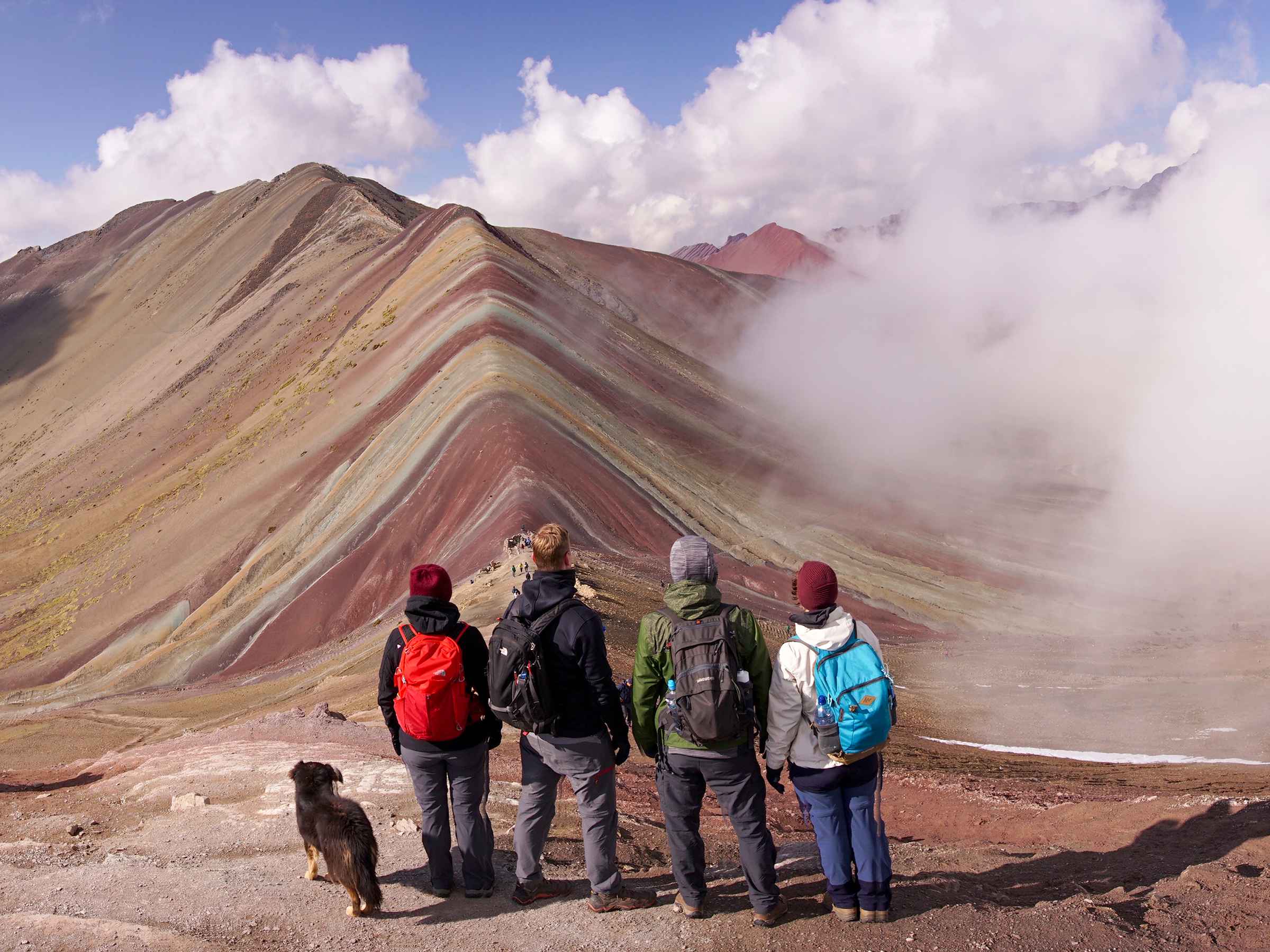
Vinicunca — “the Rainbow Mountain” in Quechua. The colored stripes:
🟥 Red/pink stripe — iron oxide (rust). Formed when iron-bearing minerals weathered in an oxygen-rich environment over millions of years.
🟨 Yellow/mustard stripe — iron sulfide + limonite. Formed in an oxygen-poor sedimentary environment.
🟩 Green stripe — chlorite (clay mineral) + ferro-magnesium silicates. Formed in a metamorphic process under heat + pressure.
🟫 Brown/beige stripe — manganese + iron oxide combination. Darker weathering patterns.
⬜ White stripe — calcium carbonate (limestone origin). Marine sedimentary origin — this mountain was on the ocean floor before Andean uplift.
🟪 Purple/violet stripe (occasional) — goethite + specific iron compounds.
All visible on one mountainside = the result of 70+ million years of geological evolution compressed into visible stratigraphy.
Photography time (30-45 minutes at summit):
40 minutes walking down to Llactoc trailhead. Cardiovascularly easier than ascent but harder on knees (walking poles essential).
Pay attention to footing: trail descends through loose rock + occasionally mud. Your guide walks ahead, setting the pace; follow.
Vehicle departs Llactoc by 11:45. 1-hour drive to Quiquijana for lunch.
Quiquijana buffet lunch INCLUDED — traditional Peruvian + international options + 1 non-alcoholic drink. Welcome calories after altitude exertion.
2.5-hour drive Quiquijana → Cusco. Different afternoon light reveals the landscape differently than the morning drive. Many travelers nap during return — altitude + physical exertion catches up.
Arrive your Cusco hotel approximately 15:30-16:00. This is night 4 of 4 at your Cusco hotel.
Evening recovery:
Day 4 stats:
Buffet lunch
Moderate
7km (4.3 miles)
45 minutes by horse
Llactoq: 4,900m (16,076 ft)
Llactoq: 4,900m (16,076 ft)
Rainbow Pass: 5,100m (16,732 ft)


This day sets this tour apart from the 4-Day Express. Until now, you could have booked everything as Express. Today is yours alone.
Day 5 philosophy: unhurried archaeological conclusion. After Day 4’s altitude intensity, Day 5 is deliberately gentle. Moderate walking at manageable altitudes. Deep interpretation of two of the Cusco region’s most unique sites.
Later start — 09:00 — because you’ve earned the sleep after Day 4 Rainbow Mountain. Full breakfast at your Cusco hotel; pack your daypack lightly: camera + water + light layers + Peruvian soles for optional salt + textile purchases.
1-hour drive Cusco → Chinchero highlands → Moray. Different landscape than Sacred Valley route — higher plateau agricultural land, less tourist traffic, more traditional Andean rural life.
Window landscape: endless potato fields (Peru has 4,000+ potato varieties — some growing in these fields haven’t changed since Inca cultivation), traditional adobe village houses, llama + alpaca herds, children in traditional dress heading to school.
Moray — one of the Inca Empire’s most intellectually sophisticated sites. Not a city, not a fortress, not a temple — an agricultural research institution.
What you see: three massive circular depressions carved into the earth. Each depression contains concentric terraced levels descending to the center. The largest circle measures approximately 30 meters deep + 120 meters in diameter.
What the Incas did here:
Microclimate engineering — the temperature difference between the top terrace rim and the bottom center is approximately 15°C / 27°F. Walking from top to bottom is equivalent to descending 1,500m through climate zones. Different crops thrive at different levels.
Agricultural experimentation — the Incas tested crop varieties at different simulated altitudes without actually relocating crops. They could test a corn variety from 2,000m altitude at Moray’s bottom terrace (climate equivalent to 2,000m) and the same seed at the top (equivalent to 3,500m).
Varietal domestication — modern geneticists trace 60%+ of Peru’s current native potato varieties to Moray-type agricultural laboratory sites. The Incas essentially ran parallel genetic trials at Moray.
Soil composition analysis — different terraces contain different soil mixtures (importing fertile topsoil from various regions). Modern archaeologists continue analyzing soil cores from Moray to understand Inca agricultural experimentation.
Still-functional water channels — look for the carved stone channels bringing irrigation water from upper springs to the terraces. Still carrying water.
Your guide tour walks the perimeter of the main circle (unhurried, 90-120 minutes total at Moray). Photography from the rim is spectacular (circular geometry + mountain backdrop).
Climbing down into the terraces — permitted on designated paths. Not required but adds an experiential dimension. Feel the temperature change as you descend; it’s genuinely perceptible within minutes.
Short drive Moray → Maras village (~15 minutes). Lunch at Maras village restaurant — recommend Mil Centro (if open; upscale Virgilio Martínez project) or local family-run restaurants ($8-15 per person). Not included in tour price.
Short drive from Maras village to Salineras entrance. The first view is breathtaking: a mountainside covered in about 5,000 white salt pools, cascading down the slope in staggered terraces.
What you’re seeing:
Pre-Inca origins — Salineras predates the Inca Empire. The underground salt spring that feeds these pools has flowed for millennia; local pre-Inca cultures (Chanapata, Qotakalli civilizations) began harvesting salt here perhaps 2,000+ years ago.
The salt source — an underground spring — emerges from the mountainside, carrying water with about 5x normal salinity (compared to seawater). The spring is naturally present; the terraced pool system is human-engineered over centuries.
The extraction process (still practiced today):
The economic reality — approximately 300-400 local families own individual pools, inherited across generations. The Maras community strictly regulates family ownership. Each family maintains its own pools, harvests its own salt, and sells its production.
Pink Maras salt has become a Peruvian specialty exported worldwide. High-end restaurants worldwide (Noma, El Bulli alumni, Virgilio Martínez’s restaurants) feature Maras pink salt. The brand matters: “Pink Himalayan salt” and “Maras pink salt” are different (Himalayan is mined from mountains; Maras is spring-evaporated).
Walking the Salineras:
Optional salt purchase at the entrance market: small bags $3-15 depending on grade. Supports local families directly. Our guide recommends buying from the small market at the site entrance (the salt-producing families sell there) rather than Cusco markets (where Maras salt is marked up 3-5x).
Depending on your flight departure time + Salineras pacing, Day 5 may include Chinchero or proceed directly to Cusco airport.
If visited — Chinchero is a traditional Andean weaving village at 3,762m altitude:
The Inca-colonial church — built on the foundations of Topa Inca’s palace (the son of Pachacutec). Spanish colonial baroque upper structure + Inca ashlar masonry lower foundations. Interior frescoes and religious art accessible on open days.
Textile cooperative demonstration — traditional Andean weaving demonstration using:
Direct purchase from weavers — supports families directly, bypasses tourist market markups.
Return from Chinchero (or Maras) to Cusco. Drop-off at:
5-Day Comprehensive Tour concludes on Day 5 evening at your chosen drop-off location. If airport: coordinate flight timing at booking so pickup matches your schedule. If hotel: your trip continues independently.
Day 5 stats:
| Category | Statistic |
|---|---|
| ⏱️ Total duration | 5 days / 4 nights |
| 🎯 Voice | 5-Day Comprehensive + Maras Moray Extension (unhurried pace) |
| 📍 Starting/Ending | Cusco (round-trip) |
| ⛰️ Starting altitude | Cusco 3,350m |
| ⛰️ HIGHEST altitude | Vinicunca 5,100m (Day 4) |
| ⛰️ LOWEST altitude | Aguas Calientes 2,040m (Day 2) |
| 🚂 Train services | PeruRail Expedition 603 + 74P |
| 🚌 Shuttle | Consettur round-trip MP |
| 🏨 Nights not included | 4 (Cusco n1+n3+n4 + Aguas Calientes n2) |
| 🍽️ Meals included | 2 buffet lunches (Urubamba D2 + Quiquijana D4) |
| 🎫 Attractions covered | 5 (Cusco + SV + MP + Rainbow + Maras Moray) |
| 💪 Physical difficulty | Moderate (Day 4: Rainbow determinant, Day 5: Easy) |
| 💰 vs 4-Day Express | +$29 group 10 for extra Day 5 Maras Moray |
1B
Easy
Short walks
5 to 35 minutes
Cusco: 3,350m (10,990 ft)
Inca Salt Flats: 3,385m (11,105 ft)
Chinchero Ruins: 3,800m (12,467 ft)
Guide + Transport
Train Services
Entrance Fees INCLUDED ⭐ (all 5 attractions)
Rainbow Mountain Specifics (Day 4)
Meals INCLUDED (2 buffet lunches)
Other
Hotels (4 nights, client-selected)
Meals Not Included
Flights + Transportation
Optional Extras
Other
Clothing (variable 5-day conditions):
Sun protection:
Altitude support:
Documents:
Photography:
Cash:
Everything you need to know about our 5 Day Premiere Machu Picchu Tour — the most comprehensive Machu Picchu vacation package in our catalog, combining Cusco, the Sacred Valley, Machu Picchu, AND Rainbow Mountain (with horseback assistance on the ascent for accessibility) at a relaxed premium pace.
ONE EXTRA DAY (Day 5: Maras Moray). Everything else is identical: same PeruRail Expedition train + same hotel strategy (NOT included) + same English-speaking local guide + same private vehicle + same Rainbow Mountain horse + same oxygen tank + same buffet lunches Day 2+4 + same entrance fees for Days 1-4. If you don’t want Maras Moray, book 4-Day Express.
Moray is one of Peru’s most unique Inca archaeological sites — three massive circular depressions carved into the earth, creating concentric terraced bowls. Microclimate experimentation: temperature difference up to 15°C / 27°F between top and bottom terraces. The Incas used Moray as an agricultural laboratory — testing crop varieties at simulated altitudes. Over 60% of modern Peruvian potato varieties trace domestication to Moray-type sites. Why Day 5: Day 5 is deliberately gentler after intense Day 4 Rainbow Mountain. Moray at 3,500m is comfortable after acclimatization. Perfect archaeological conclusion.
Salineras de Maras — approximately 5,000 pre-Inca terraced salt evaporation pools cascading down a mountainside, still actively worked by local families using pre-Columbian salt extraction methods. An underground salt spring feeds the pools (water with 5x normal salt concentration). Sun evaporation produces pink Maras salt (exported globally). Not a reconstruction, not a museum — a living agricultural site that predates the Inca Empire.
Yes — Chinchero is an optional Day 5 stop IF TIME PERMITS. Depending on Day 5 morning timing + your evening flight time, Chinchero may or may not fit. If you skip it, you’ll have more time at Moray + Salineras OR an earlier Cusco airport arrival. Discuss preferences with guide at tour start.
Hotel preferences vary dramatically ($30-$500/night across categories). Bundling specific hotels forces compromise + significantly raises package price. Our solution: $542 base price + personalized hotel recommendations during booking based on YOUR budget:
You book 4 hotels: Cusco (nights 1+3+4) + Aguas Calientes (night 2).
Realistic timing: ~18:30 PM at the Cusco hotel. PeruRail Expedition 74P departs Aguas Calientes at 14:55 → arrives in Ollantaytambo at 16:31 + 2-hour private van from Ollantaytambo → Cusco. Note: the previous page claimed 17:50 PM (unrealistic given the distance + traffic).
Variable based on your flight time: typically, Day 5 ends 16:00-17:00 PM. If the flight is early (before 15:00), we start Day 5 earlier at 08:00 and compress Chinchero or skip it. If the flight is late (after 20:00), full relaxed Day 5. Communicate flight time at booking.
Pre-arrival preparation: (1) Arrive Cusco 1-2 days EARLY if possible, (2) Consult doctor about prescription altitude medication (Diamox), (3) Hydrate heavily from arrival (3L water daily), (4) Avoid alcohol first 48 hours, (5) Light meals first days, (6) Pack coca leaves/candy.
Yes (+$95, book 3-4 months ahead). Compatible with this tour’s Day 3 MP visit but adds Day 3 fatigue significantly.
Age 7+ with guardian over 21+ (18+ unaccompanied). Rainbow Mountain horse ascent sets the minimum. Day 5 Maras Moray is Easy and family-friendly, age 7+.
Previous positioning was misleading. The tour was marketed as “Premiere” tier but delivered standard inclusions (Expedition train, no hotels, no premium meals) identical to 4-Day Express. v3 corrects this with honest positioning: this is “5-Day Comprehensive” (Express structure + Day 5 extension), NOT a luxury upgrade. The URL slug still contains “premiere” for SEO continuity, but content now accurately describes what you get.
Recommended ahead: Peak June-August 3-6 months + Shoulder May/September/October 2-4 months + Low November-April 4-6 weeks + Huayna Picchu add-on 3-4 months + Christmas/New Year dates 6+ months.
| Persons | Price (p/p) | |
| 1 | $ 1 512.00 USD | |
| 2 | $ 993.00 USD | |
| 3 | $ 839.00 USD | |
| 4 | $ 718.00 USD | |
| 5 | $ 669.00 USD | |
| 6 | $ 617.00 USD | |
| 7 | $ 597.00 USD | |
| 8 | $ 574.00 USD | |
| 9 | $ 556.00 USD | |
| 10 | $ 542.00 USD |

Machu Picchu Itinerary 5 Days

Machu Picchu 5 Day Tour

Machu Picchu Itinerary 5 Days

