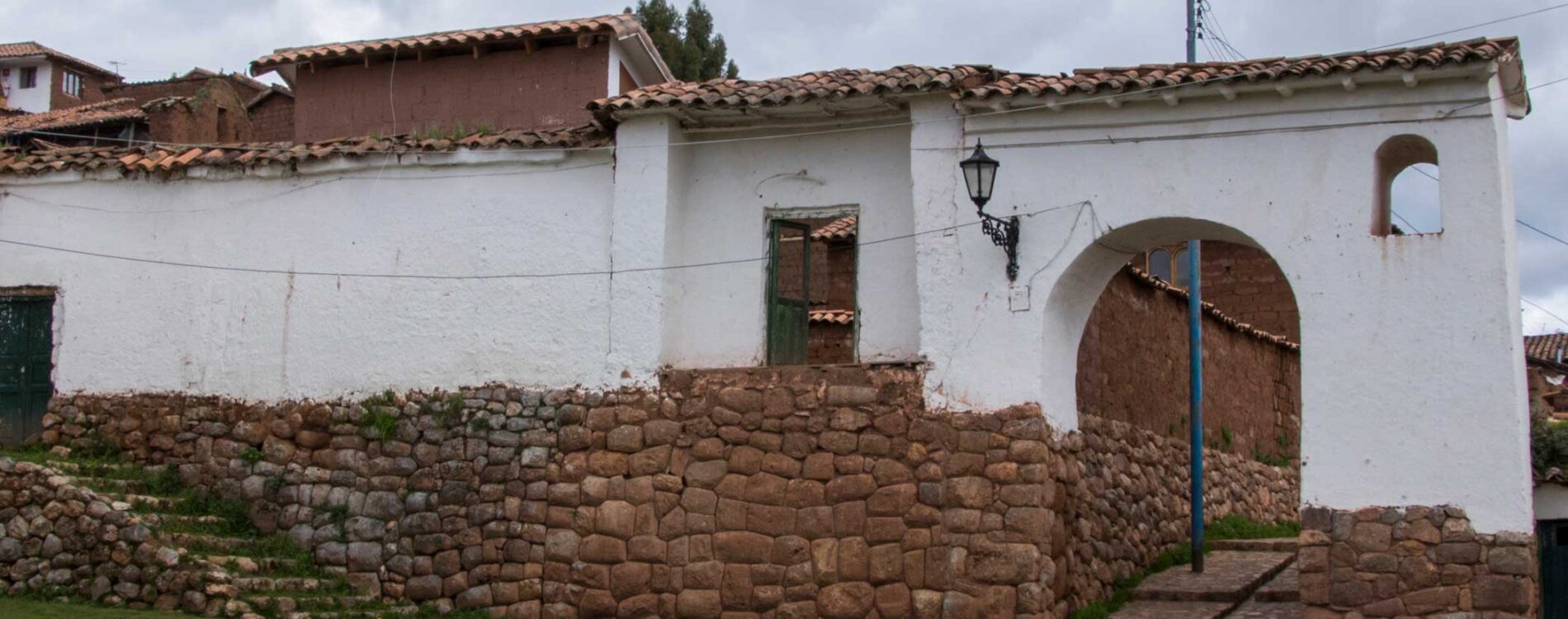
The Peruvian District of Chinchero is one of seven districts in the Province of Urubamba, in the Department of Cusco, and is administered by the Regional Government of Cusco.
Historical Data
Officially, the district of Chinchero was created on September 9, 1905, through Law No. 59, given under the government of President Jos Pardo and Barreda.
Here is what, in Inca times, was the royal hacienda of Tupac Inca Yupanqui, and a colonial temple built on this civilization, especially the typical doors or windows: wider at the bottom, narrower at the top, a feature of Inca architecture.
The capital is the town of Chinchero, located at 3,754 meters above sea level, 28 kilometers from Cuzco. The Sunday market originated as a market focused on the exchange of goods between the area’s inhabitants. It is currently a tourist attraction that offers handicrafts and textiles made in the pre-Columbian style.
Chinchero’s archaeological complex is located north of the city. It was the capital of a regional state, and its urban planning is similar to that of the puma city of Cusco.
Some of these ruins’ spaces are still used to hold communal assemblies.
This site presents unique linguistic expressions due to the monumentality and development of its architecture. Tupac Inca Yupanqui built it in 1480. It comprised a set of architectural spaces: pre-Columbian mural structures, enclosures, Andenes as staircases, and shrines, among others.
The temple is located in the main square. Stands on the Inca ruins of the palace of Tupac Yupanqui. The temple’s dimensions testify to the importance of the city’s curacas since colonial times. Chinchero is also an excellent example of the richness of the churches in Cusco’s villages. Its construction was completed in 1607.
The church comprises Inca stone structures that served as the foundations for colonial construction, shaping the design. Its entrance door leads to the Plaza de Armas and is on one side of the wall; the interior walls and ceiling are covered with mural paintings with watermarks and religious motifs.
On the sidewall is a large, centered picture of the Virgin of Monserrate, with an exciting town view. Francisco Chihuantito painted the canvas in 1693. The church only opens on Sundays for morning mass.
The murals: The temple of Chinchero’s murals also express the region’s great importance. The cover stands out: the Virgin of Monserrate, the procession of the cacique Pumacahua, and the defeat of Tupac Amaru. Interestingly, in the sky, one observes the fight between two mythological beings: a cougar bites the neck of a dragon or Amaru. These are the heroic emblems of the rival caudillos.
Pumacahua wanted to emphasize the ancestral character of the struggle to quell the rebellious moods of the settlers. The allegories of the puma and the dragón are not simple decorations, but, as Paul Macera says, they could quickly identify, by the memory of the surnames, the main protagonists of the drama: the cougar to the cacique Of Chinchero, Mateo Pumacahua, and the significant drag no Amaru Verde to the cacique of Ink, Jos Gabriel Condorcanqui, Tupac Amaru II.
The Hacienda House of Mateo Pumacahua: In front of Huayocari is the hacienda Urquillos. I belonged to the curaca of Chinchero, Mateo Pumacahua, Peru’s most potent Indian leader during the eighteenth century, born in 1748 in the bosom of a noble Indian family. Although initially identified with the Spanish regime (by 1780, he was captain of the Noble Indians of the Region), he actively favored the Indian cause in the uprising led by the Angulo brothers in 1814.
The unsuccessful revolution ended with the deaths of its leaders. Pumacahua was judged and beheaded in Sicuani in 1815, and his remains were dismembered.
The unsuccessful revolution ended with the deaths of its leaders. Pumacahua was judged and beheaded in Sicuani in 1815, and his remains were dismembered and exhibited in Arequipa, Cusco, and other regions. Pumacahua reunited one of the great fortunes of the Andean south, but his descendants lost everything when the cacique decided to rise against the crown.
Chinchero Fair: The colorful handicraft fair of Chinchero is held on Sundays in the Plaza de Armas, in front of the colonial church. Early in the morning, vendors, mainly from Chinchero and neighboring villages, arrive to sell their handicrafts.
The market, which has existed since immemorial times, is located at the end of the village and is one of the few places where the primitive system of buying and selling, called “barter,” is still practiced. It involves exchanging the area’s products for products, utensils, and articles drawn from neighboring regions.
The Chincherinos’ sellers mainly offer potato, chuño, white chicha, pork chicharron, and chancaca. From Urubamba come sellers of coca leaves, coffee, and lemons. From Maras, you can find coca, bananas, and oranges. From Yucay, people arrive with Nisperos, corn, coca leaves, cabbage, and hot peppers. Traders coming from Ayarmaka bring onions, tarhui, potatoes, and goose. From Huayllabamba come rocoto and lemons.
Most buyers and sellers are women. In addition, the merchants are primarily the same producers, although intermediaries from different regions, such as Cusco, Maras, Urubamba, and Yucay, are also present.
La Laguna Piuray is located at kilometer 2. Piurayy Lagoon has supplied water to the city of Cusco since the Tahuantinsuyo period. The Incas brought their water to the imperial city through underground aqueducts.
Stones carved: On the town’s outskirts, there are great sculpted rocks.
The town of Chinchero retains a traditional religious spirit that reveals the syncretism of Spanish Catholicism and the Andean worldview. Its main celebrations revolve around its patroness, the Virgin of the Natividad, and the Lord of Coyllur Riti. The parties involve the whole town and are characterized by their unique color.
The Cruz Velacuy (May 2 and 3). As with all the Andean peoples, the Inca huacas, or shrines, were replaced by crosses. The Cross in Chinchero begins on May 2 with the Velada de la Cruz, during songs, prayers, and music. The next day, their stewards lower the crosses from their altars for special ceremonies.
The Coyllur Riti (June 14, 15, and 16). The devotees of Chinchero join some 50,000 Peruvian and foreign pilgrims and walk to worship the lonely Se or del Coyllur Riti, on top of the snowy mountains of Sinacara and Ausangate, in the district of Ocongate, province of Quispicanchis. This pilgrimage is the hardest of all in Peru. The devotees ascend to 5,000 meters above sea level and endure temperatures of at least -4 °C.
Corpus Christi: Following the pilgrimage to Coyllur Riti, the dancers participate in the Corpus Christi of Chinchero. This busy religious festival begins on Thursday with the celebration of the feast’s mass. Subsequently, the procession of the Saints takes place, featuring the Mamacha Natividad, San Isidro, San Miguel, San Antonio, and the Purified Virgin, among others.
Once the tour is over, the professional dancers compete in a colorful parade. Each comparsa exhibits its best choreography and colorful costumes before a qualifying jury. In the afternoon, the cacharpari begins as mayordomos entertain visitors with drinks and traditional chiri uchu.
Virgen Natividad (September 8) is the most crucial celebration in Chinchero, honoring the district’s patroness and mayor. Every September 8, the festivities begin with a mass in honor of the Virgin of the Nativity. Towards midday, a traditional procession is held, with dances and colorful comparsas accompanying the image. There is a beauty contest in the afternoon, serenades, music, and fireworks at night.