Ausangate Trek 6 Days: The Sacred Circuit at a Relaxed Pace


The same sacred Ausangate circuit, spread over an extra day with hot springs at both ends.
The Ausangate Trek 6 Days covers the same sacred circuit around Ausangate (6,384 m) as our Ausangate Trek 5 Days, but at a more relaxed daily pace — shorter distances each day, spread across an extra day on the trail. This isn’t about extra acclimatization (the entire route sits above 4,300 m throughout, so there’s no lower-altitude buffer to adjust in) — it’s simply a gentler rhythm for trekkers who prefer not to push 8-9 hour days back to back.
Day 1 brings a bonus the 5-day route doesn’t include: a soak in the natural hot springs of Upis, right at the start of the trek. From there, the route follows familiar high points — Arapa Pass, an optional extension to a Rainbow Mountain viewpoint on Day 3, and Palomani Pass (5,200 m / 17,060 ft), the highest point of the entire circuit — before finishing with a soak in Pacchanta’s hot springs on the way out.
Kondor Path Tours runs this tour with its own local team in Cusco, fully licensed and permit-holding — no resellers in between. No government permit is required, and this trek operates March through December.
| 🥾 Duration | 6 days / 5 nights (100% camping) |
| 📏 Distance | ~70 km total across 6 trekking days |
| ⛰️ Max altitude | 5,200 m / 17,060 ft — Palomani Pass |
| 🚐 Trailhead | Tinqui, reached by private transport from Cusco |
| ♨️ Hot springs | Included twice: Upis (Day 1) and Pacchanta (Day 5) |
| 🌈 Optional extension | Rainbow Mountain viewpoint, Day 3 |
| 💪 Difficulty | Challenging |
| 📅 Season | March to December |
| 👥 Group size | 1–10 hikers (scalable pricing) |
| 🔞 Minimum age | 16, with prior high-altitude hiking experience recommended |
| 💲 Price | Scalable from $704 USD per person (groups of 1–10) |





The Ausangate Trek 6 Days makes the most of 6 days – Soak in Upis natural hot springs on Day 1, right at the start of the trek – Cross Arapa Pass and Palomani Pass (5,200 m) — the two major passes of the circuit – Optional Rainbow Mountain extension, Day 3, reached from a quieter angle than the standard day-trip crowds – Walk past glacial lagoons of red, green, and turquoise tones throughout the route. The Ausangate Trek 6 Days delivers on every one of these.
The Ausangate Trek 6 Days follows the same demanding circuit as our 5-Day Ausangate Trek — but stretched over an extra day, with shorter daily distances and a gentler overall rhythm. It’s still a serious high-altitude camping expedition: the entire route sits above 4,300 m, and Palomani Pass at 5,200 m remains the toughest single climb of the trip. What changes is the pacing, not the difficulty of any individual day.
| Feature | Ausangate Trek 5 Days | Ausangate Trek 6 Days |
|---|---|---|
| Daily pace | Longer days (up to 9-10 hrs) | Shorter, more relaxed days |
| Hot springs | Pacchanta only, end of trek | Upis (Day 1) and Pacchanta (Day 5) |
| Max altitude | 5,200 m (Palomani Pass) | 5,200 m (Palomani Pass) — same |
| Rainbow Mountain extension | Optional, Day 3 | Optional, Day 3 |
| Best for | Trekkers comfortable with longer daily distances | Trekkers who prefer a gentler day-to-day rhythm |
Both treks reach the same maximum altitude and cover essentially the same circuit — the choice comes down to pacing preference, not difficulty level.
This 6-day version covers the same sacred circuit around Ausangate as the 5-day trek — Arapa Pass, Palomani Pass, and the option to extend to Rainbow Mountain — but spreads the route over an extra day for a noticeably gentler pace, with hot springs stops at both Upis on Day 1 and Pacchanta on the final day.
The extra day fundamentally changes the acclimatization curve: rather than climbing steadily toward Palomani Pass (5,200 m) over four days, this version adds rest and adjustment time throughout, particularly around the Ausangate Qocha area on Days 3 through 5, before the pass crossing. That additional buffer at altitude is what makes the 6-day version a meaningfully easier way to reach the same 5,200 m high point, with Day 6’s return through Pacchanta’s hot springs offering a relaxed close to the trip.


Your guide picks you up from your hotel in Cusco at 06:00 AM for the scenic drive south, passing through colonial and Inca-era towns as the Andean landscape unfolds. The drive ends at the community of Tinqui, where the muleteers and pack animals are waiting.
Once the equipment is loaded, the trek begins — a moderate first stretch of about 3 hours, deliberately paced to let the group adjust gradually to the altitude. A second 2-hour section leads to Upis, where a soak in the community’s natural hot springs makes for a memorable first-day reward. Bring a swimsuit — few things compare to a hot spring at 4,450 m surrounded by the Andes.
Day 1 stats

1L, 1D

Intense

12km (7.5 miles)

5-6 Hrs.

Tinqui: 3,950m (12,960 ft)
Upis Town: 4,300m (14,108 ft)
Upis Hot Spring: 4,450m (14,600 ft)


Nights on the Ausangate circuit are cold, so an early layer-up is part of the daily routine. Today brings the first major climb of the trek: Arapa Pass (4,850 m / 15,915 ft), reached with a steady, gradual ascent that rewards the effort with sweeping panoramic views — glaciers, snow-capped peaks, and the contrast between high Andean terrain and distant valleys.
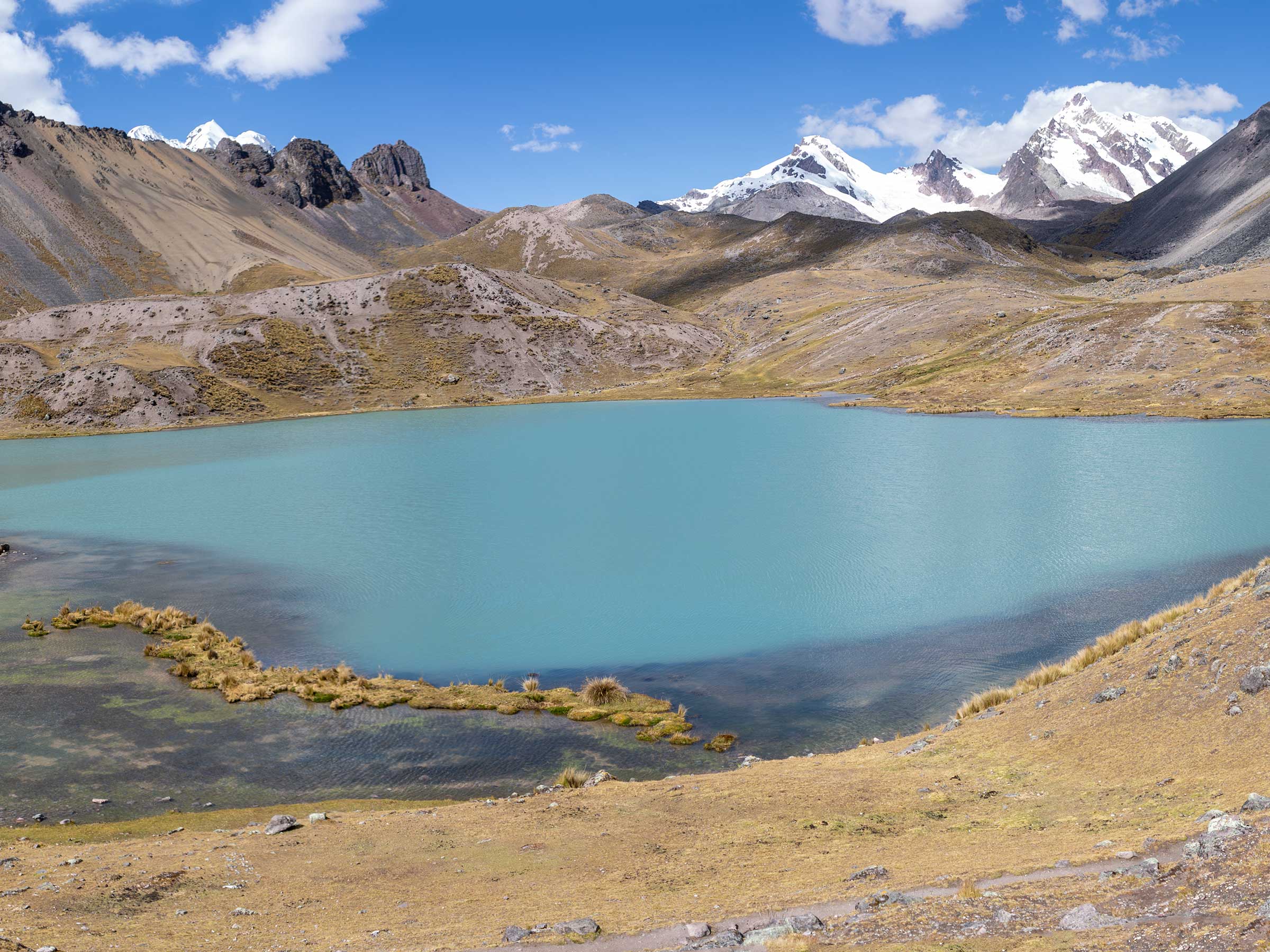
From the top and along the descent, the trail passes several lagoons in strikingly different tones — reddish, green, and turquoise — fed by the headwaters of rivers that eventually reach the Amazon basin. The day ends at Ananta (4,650 m), the lunch and camp area.
Day 2 stats
1B, 1L, 1D.
Challenging
12km (7.4 miles)
6-7 Hrs.
Upis Hot Spring: 4,450m (14,600 ft)
Ananta: 4,650m (15,256 ft)
Arapa Pass: 4,800m (15,478 ft)


This is the longest and most rewarding day of the trek. An optional extension — about 1.5 hours each way from the trail — leads to a Rainbow Mountain viewpoint (~5,050 m), reached from a quieter approach than the standard day-trip crowds who arrive from Cusco. Seeing Vinicunca’s mineral stripes from this remote angle is a highlight many trekkers rate above the classic Rainbow Mountain day trip itself.
After returning to the main trail, the group continues for about 3 hours to Ausangate Qocha (4,700 m), with constant views of the Ausangate glacier’s different faces. From there, the trail climbs to Palomani Pass (5,200 m / 17,060 ft) — the highest point of the entire circuit — before descending to the remote campsite at Huchuy Pinaya (~4,650 m), a small community along the route.
Day 3 stats
1B, 1BL, 1D.
Challenging
15km (9 miles)
8-9 Hrs.
Ananta: 4,650m (15,256 ft)
Rainbow Pass: 5,100m (16,732 ft)
Huchuy Pinaya: 5,550m (18,208 ft)


The day climbs steadily to Jampa Pass (5,150 m / 16,896 ft), accompanied by the silence and scale typical of this remote part of the Andes. Herds of alpacas are a constant companion along this stretch, grazing freely across the high plains.
From Jampa Pass, the trail descends for about 2 hours to Pampacancha (4,050 m), then climbs again for roughly 3 hours to reach the base camp at Jampa (4,300 m).
Day 4 stats
1B, 1L, 1D.
Challenging
11km (6.8 miles)
5 Hrs
Huchuy Pinaya: 5,550m (18,208 ft)
Jampa Pampa: 4,700m (15,420 ft)
Jampa Pampa: 4,700m (15,420 ft)


The trek is nearing its end. A roughly 1-hour walk in the morning leads near the base of the Ausangate glacier — one of the most important sources of freshwater in this part of the Andes, feeding rivers that flow across Peru and beyond. It’s a fitting spot for a final group photo.
In the afternoon, the trail descends for about 5 hours around Q’omer Qocha lagoon, reaching the final campsite at Pacchanta — an Andean community with its own natural hot springs, the ideal way to soothe tired legs after five days of trekking.
Day 5 stats
1B, 1L, 1D.
Intense
13km (8 miles)
6-7 Hrs.
Jampa Pampa: 4,700m (15,420 ft)
Pacchanta: 4,350m (14,271 ft)
Jampa Pass: 5,080m (16,667 ft)
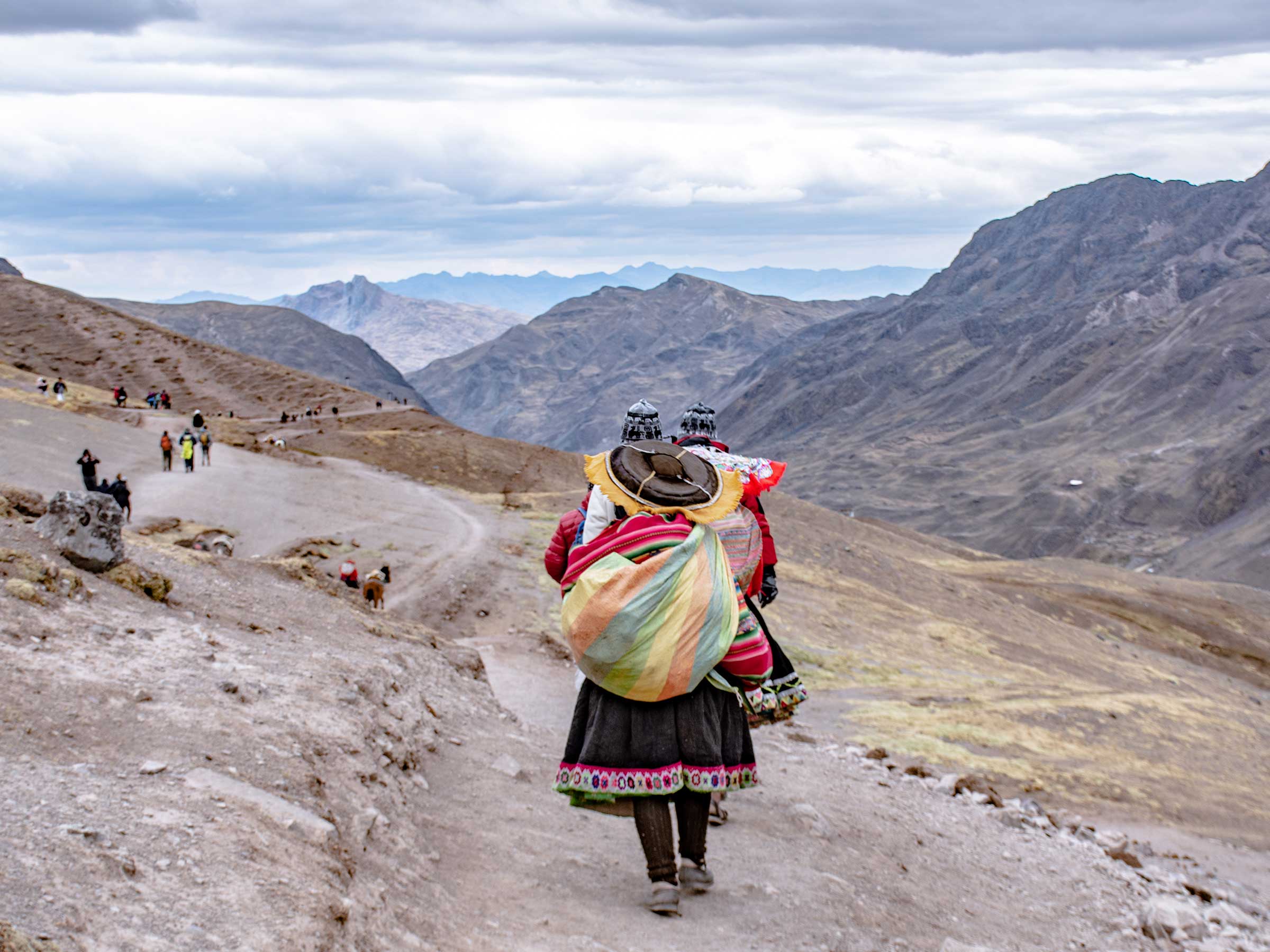
The final stretch is a straightforward 3-hour walk back to Tinqui, closing the loop around Ausangate. In Tinqui, the group shares a farewell lunch and says goodbye to the horse team before the drive back to Cusco.
Day 6 stats
1B, 1L.
Intense
7km (4.3 miles)
3 Hrs.
Pacchanta: 4,350m (14,271 ft)
Tinqui: 3,950m (12,960 ft)
None
Looking for something different in duration or pace? Compare it with our Ausangate Trek 5 Days.
No additional paid upgrades apply to this tour beyond the standard inclusions.
A 6-day, 5-night camping expedition circling Ausangate mountain — the same circuit as our 5-Day Trek, but spread across an extra day for a more relaxed daily pace, plus a soak in Upis hot springs on Day 1.
Both treks cover the same circuit and reach the same maximum altitude (Palomani Pass, 5,200 m).
The 6-Day version simply spreads the distance across an extra day, meaning shorter daily hiking times, and adds a stop at Upis hot springs on Day 1 that the 5-Day doesn’t include.
It’s rated Challenging throughout — the entire route sits above 4,300 m, with two major passes above 4,800 m (Arapa and Jampa) and Palomani Pass at 5,200 m. The extra day makes the daily pace gentler, but it doesn’t reduce the overall altitude challenge.
Palomani Pass, at 5,200 m (17,060 ft), crossed on Day 3. This is not the summit of Ausangate mountain itself (6,384 m), which is a technical mountaineering objective, not part of this trekking circuit.
No. The Ausangate Trek does not require a government permit.
We recommend travelers be 16 or older, ideally with some high-altitude hiking experience already.
Yes — twice. Upis hot springs on Day 1, and Pacchanta hot springs near the end of the trek on Day 5.
Yes, as an optional side trip on Day 3 — a quieter approach to a Vinicunca viewpoint, avoiding most of the crowds that gather at the standard day-trip entrance.
This trek is 100% camping — five nights in tents (2 people per tent), with a professional cook and full kitchen/dining support.
Cargo horses carry up to 8 kg (17.6 lb) of personal items per traveler.
March through December, with the driest, clearest conditions typically between May and September.
The 7 Lakes Trek is a full-day hike with no camping.
This 6-day trek is a complete, multi-day circumnavigation of Ausangate with camping, reaching a higher maximum altitude and covering far more ground.
Alpaca herds are common throughout the route, along with occasional sightings of vicuñas.

| Persons | Price (p/p) | |
| 2 | $ 1 079.00 USD |