Q’eswachaka Inca Bridge Tour — The Last Living Inca Tradition (Full Day)

Q’eswachaka Inca Bridge Tour — The Last Living Inca Tradition (Full Day)

Price from:
$ 62.00 USD
Q’eswachaka Inca Bridge Tour — The Last Living Inca Tradition (Full Day)
Tour Type
Scenic Walking Tours
Q’eswachaka Inca Bridge Tour — The Last Living Inca Tradition (Full Day)
Maximun Altitude
3,644m (11,955 ft.)
Q’eswachaka Inca Bridge Tour — The Last Living Inca Tradition (Full Day)
Physical Level
Easy
Q’eswachaka Inca Bridge Tour — The Last Living Inca Tradition (Full Day)
Recommended Season
April to December

Q’eswachaka Inca Bridge Tour — The Last Living Inca Tradition (Full Day)

Price from: $ 62.00 USD

The last surviving Inca rope bridge in the world — suspended 28 meters across the sacred Apurímac River, rebuilt every June by four Quechua communities using exactly the same techniques their Inca ancestors used 500+ years ago. UNESCO Intangible Cultural Heritage of Humanity (2013). The only tour in our catalog where you witness Inca knowledge still actively practiced today — not ruins, not reconstructions, but living tradition. Box lunch + entrance ticket INCLUDED. Flexible 05:20 AM pickup. Hotel or Cusco airport. From $62 USD per person (group of 10).

Tour Plan: Cusco | Pitumarca | Qeswachaka

Breathtaking Qeswachaka Rope Bridge Tour

The Q’eswachaka Inca Rope Bridge Tour is unique in our entire catalog. Every other tour shows you what the Incas left behind — citadels, terraces, roads, ruins. This one shows you what they still do.

The Q’eswachaka bridge crosses the sacred Apurímac River in the Canas province, 156 km south of Cusco. It is the last surviving Inca rope bridge in the world — built and rebuilt continuously for over 500 years by four Quechua communities (Huinchiri, Chaupibanda, Choccayhua, and Ccollana Quehue) who are direct descendants of the original Inca builders. Every June they gather and reconstruct it entirely from scratch using only ichu grass, no nails, no metal, no modern tools — exactly the same techniques their ancestors used during the Inca empire.

In 2013, UNESCO inscribed the bridge — and the knowledge of how to build it — as Intangible Cultural Heritage of Humanity.

Five reasons travelers choose the Q’eswachaka over (or in addition to) the famous archaeological tours:

1. The only living Inca tradition in active use today. Sacred Valley shows Inca ruins. Machu Picchu shows the Inca citadel. Q’eswachaka shows Inca knowledge still being practiced. The communities you meet are not reenactors or museum staff — they are real Quechua families practicing real ancestral engineering. No other tour in Peru offers this kind of authenticity.

2. Two bridges, two civilizations, one day. The tour visits two bridges with completely different historical meanings. The Inca Bridge of Pitumarca Checacupe is the only bridge in Peru where you can see three superimposed historical layers in one structure: original Inca stone foundation + Spanish colonial arches built atop + Republican-era modifications. The Q’eswachaka is the purest surviving Inca engineering — woven entirely from natural grass, suspended over a deep canyon. Together they tell the full story of Andean bridge-building across 500+ years.

3. Box lunch + entrance tickets INCLUDED. Unlike our other day tours (where we keep tickets and lunch separate for transparency), the Q’eswachaka tour includes both: a full box lunch prepared by us, and the community entrance ticket to the bridge (purchased on your behalf by your guide directly at the community gate). You don’t need to manage cash for entrance fees at the bridge — we handle it. This simplifies your day given the remote location.

4. Flexible pickup — 05:20 AM standard, but adaptable. Most operators run a fixed 04:30 AM pickup. We start at 05:20 AM standard (already gives you significant additional rest) and can adapt the pickup time to 06:00, 06:30, 07:00, or 07:30 AM if your group prefers. Later pickup compresses the schedule but is feasible for travelers who can’t manage a 05:20 start. Discuss at booking.

5. Cross the bridge yourself — bridge crossing fee INCLUDED. The bridge is fully functional and walkable (except during the 3-day annual renewal in June). At 28 meters long and approximately 6 meters above the Apurímac River, walking across is the experiential highlight for most travelers. The community charges a small crossing fee — we include it in the tour price. You decide on-site whether you want to cross or view from the riverbank.

From $62 USD per person (group of 10) · Full day · Group size 1-10 · Daily departures year-round · Hotel OR Cusco airport pickup · Box lunch + entrance tickets included.

QUICK FACTS BAR

⏱️ Duration: Full day (~12-13 hours)
🕐 Pickup time: 05:20 AM standard (flexible: 06:00, 06:30, 07:00, 07:30 AM on request)
📍 Pickup: Your Cusco hotel OR Cusco airport
📍 Drop-off: Your Cusco hotel
🚗 Distance: 156 km each way (3h 32min driving each way)
🏛️ Default sites: Inca Bridge Pitumarca Checacupe + Q’eswachaka Rope Bridge
🎁 Optional sites: Pabellones miniature volcano + Pomacanchis Lagoon (if time + request)
✅ Box lunch: INCLUDED
✅ Entrance tickets: INCLUDED (Kondor Path Tours buys at site for you)
🍳 Breakfast: NOT included (hotel breakfast/to-go/optional roadside stop)
⛰️ Bridge altitude: 3,700 m
💪 Difficulty: Easy (long drive is the main demand)
📅 Departures: Daily — year-round
👥 Group size: 1-10 travelers
💲 From: $62 USD per person (group of 10)
🎓 Recommended age: 10-75 years
🌍 UNESCO status: Intangible Cultural Heritage of Humanity (2013)

Trending Tour
Price From
$ 62.00 USD
Trip Length: 1-Day
Q’eswachaka Inca Bridge Tour — The Last Living Inca Tradition (Full Day)
Tour Type
Scenic Walking Tours
Q’eswachaka Inca Bridge Tour — The Last Living Inca Tradition (Full Day)
Maximun Altitude
3,644m (11,955 ft.)
Q’eswachaka Inca Bridge Tour — The Last Living Inca Tradition (Full Day)
Group Size
1 to 10 people
Q’eswachaka Inca Bridge Tour — The Last Living Inca Tradition (Full Day)
Physical Level
Easy
Q’eswachaka Inca Bridge Tour — The Last Living Inca Tradition (Full Day)
Recommended Season
April to December
Q’eswachaka Inca Bridge Tour — The Last Living Inca Tradition (Full Day)
Duration
1-Day

Take a journey back in time on a one-day tour of the incredible Qeswachaka Bridge, the last remaining Inca bridge in the world!

Overview

Qeswachaka Tour Full Day Overview

The Q’eswachaka Inca Bridge Tour is the most authentic cultural experience in our entire catalog — and the only tour where you witness living Inca tradition in active use today rather than ruins or reconstructions.

Who specifically benefits from this tour:

(1) Cultural travelers who already did the famous archaeological circuit. If you’ve done Sacred Valley, Machu Picchu, and Cusco City Tour, you’ve seen what the Incas built. Q’eswachaka shows you what they still do — the only Inca engineering tradition that has continued uninterrupted for 500+ years, practiced by direct descendants of the original builders.

(2) UNESCO Intangible Cultural Heritage seekers. UNESCO inscribed “the knowledge, skills and rituals associated with the annual renewal of the Q’eswachaka bridge” as Intangible Cultural Heritage of Humanity in 2013. Only 700+ traditions worldwide hold this designation — and very few are this accessible to tourists. The bridge is the rare living UNESCO site.

(3) History enthusiasts interested in Inca engineering. The Q’eswachaka is one of approximately 200 rope bridges the Incas built across their Qhapaq Ñan road network. After the Spanish conquest, all the others fell into disrepair. This is the only one continuously maintained for 500+ years — a remarkable act of cultural continuity by communities who chose to preserve ancestral knowledge that the colonial government tried to replace with stone bridges.

(4) Off-the-beaten-path travelers (real ones). Most “off-the-beaten-path” tours in Cusco are well-trodden by tourism. Q’eswachaka actually qualifies — 156 km from Cusco, requiring full-day commitment, few tourists at any given visit. Many days you’ll be one of only 5-15 visitors at the bridge.

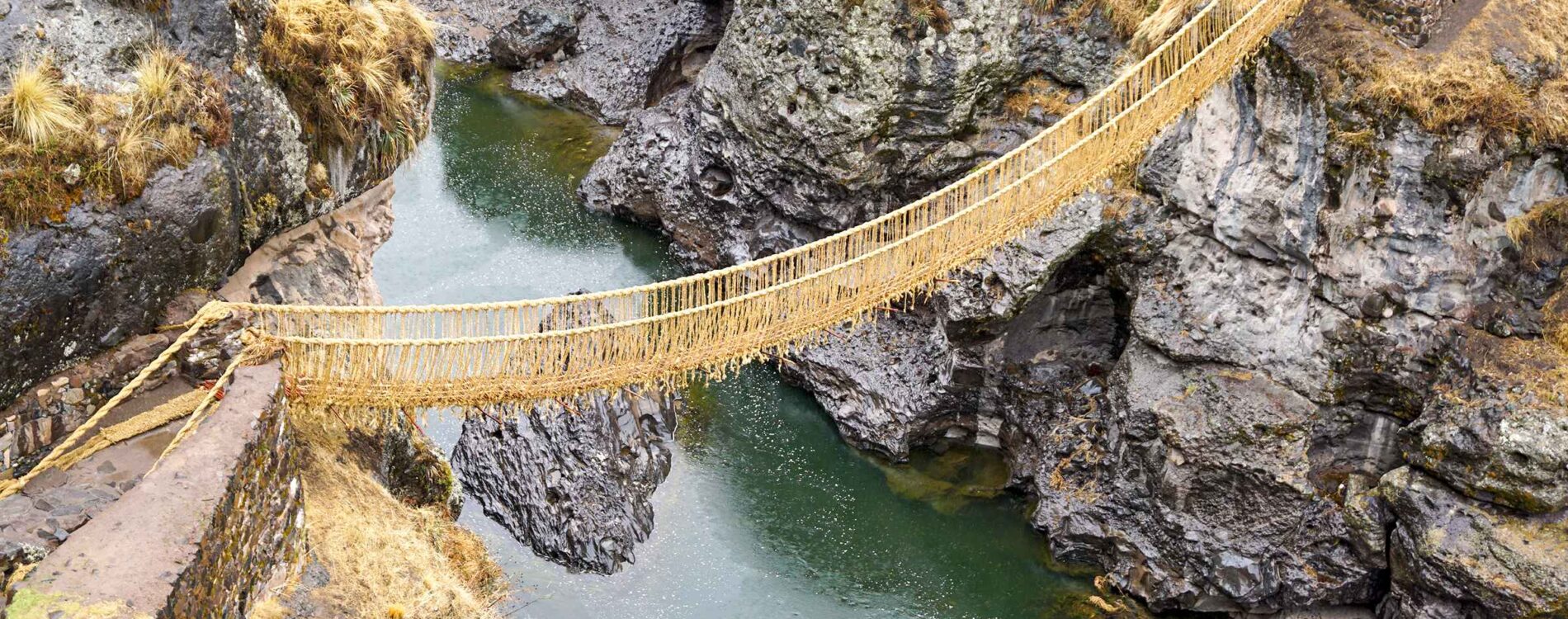
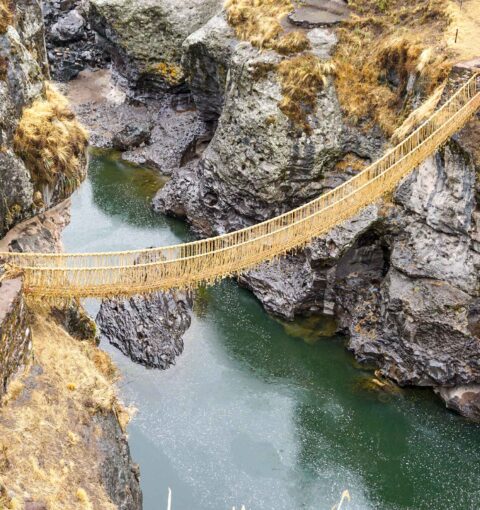
(5) Photography enthusiasts. The visual contrast is unforgettable: a golden ichu grass bridge suspended over the clear blue Apurímac River in a deep canyon walled by dramatic cliffs. Wide-angle shots from the riverbank, mid-shots crossing the bridge, intimate close-ups of the weaving technique — multiple distinct compositions in one location.

(6) Adventure travelers who want to cross. Walking across a 500-year-old grass bridge swaying 6 meters above a deep river canyon is a genuine experiential moment — not engineered for tourism, but a real functional bridge that locals use daily. The bridge crossing is included in the tour (the community charges a crossing fee that we cover).

(7) Bridge and engineering enthusiasts. The Q’eswachaka is an active example of suspension bridge engineering predating modern steel-cable suspension bridges by centuries. Modern engineers have tested the bridge — it supports up to 4 tons through tension distribution along braided cables. The same principle modern bridges use, achieved 500 years before steel.

(8) Travelers continuing to Puno. The Q’eswachaka is on the route south to Puno (the road from Cusco to Puno passes near Yanaoca). For travelers heading to Lake Titicaca after Cusco, the Q’eswachaka makes sense as the final Cusco-area tour day before the Puno bus.

How This Tour Compares to Our Other Cusco Day Tours

Critical context for travelers comparing options. This tour is NOT competing with archaeological tours — it serves a completely different cultural purpose:

FeatureQ’eswachaka (this tour)Sacred ValleySouth ValleyRainbow Mountain
What you seeLiving Inca traditionInca ruins (Pisac/Ollantaytambo)Wari + Inca + ColonialInca sacred landscape
UNESCO statusIntangible Heritage 2013(Inca Trail is Cultural Heritage)
Distance from Cusco156 km60 km40 km100 km
Duration~12-13 hours10 hours5-6 hours~12 hours
Box lunch includedSometimesSometimes
Tickets included
Tourist crowdsVery lowHeavyLowHeavy (most popular sites)
Best forAuthenticity-seekers + HeritageFirst-time Inca circuitPre-Inca + foodieIconic landscape
From$62 USD$50-70 USD$24 USD$44 USD

Translation:

  • First-time Cusco visitor → Sacred Valley first
  • Already did the classics + want an authentic experienceQ’eswachaka
  • Pre-Inca + cuisine → South Valley
  • Iconic landscape → Rainbow Mountain

Why Book Direct with Kondor Path Tours

  • 🏢 Direct local operator in Cusco — DIRCETUR licensed, source price
  • 🛬 Airport pickup capability — useful for cruise/extended travelers
  • 🕐 Flexible pickup time — 05:20 AM standard or later (06:00, 06:30, 07:00, 07:30) on request
  • ✅ Box lunch INCLUDED — prepared by us
  • ✅ Entrance tickets INCLUDED — your guide handles community entrance fee at site
  • 🎓 Certified bilingual guides with Andean cultural studies background
  • 🗣️ Quechua-speaking guides available on request — valuable for community interaction
  • 🚐 Private transportation with portable oxygen and first-aid kit (long drive comfort)
  • 💲 Source pricing — $62 USD is the actual operator price for this remote destination
  • ⭐ TripAdvisor 5.0verified reviews
  • 🌐 Daily departures — book even with short notice

Top Highlights of the Q’eswachaka Inca Bridge Tour

  • 🌉 Q’eswachaka Inca rope bridge — the last surviving Inca suspension bridge in the world (500+ years continuous renewal)
  • 🏆 UNESCO Intangible Cultural Heritage of Humanity (2013) — one of only 700+ traditions worldwide with this designation
  • 🌉 Inca Bridge of Pitumarca Checacupe — the only bridge in Peru with three superimposed historical layers (Inca + Colonial + Republican)
  • 🌊 Crossing the bridge — walk 28 meters across the Apurímac River canyon, 6 meters above the sacred river (crossing fee included)
  • ⛰️ The Apurímac River canyon — sacred Inca river, geological source of the Amazon, dramatic deep gorge
  • 🏘️ Quechua community interaction — meet direct descendants of the original Inca bridge builders
  • 🌾 Living engineering tradition — see exactly how Inca masons built rope bridges using only natural ichu grass
  • 🌋 Optional Pabellones miniature volcano (Yanaoca district — smallest known volcano, 4 meters diameter) — if time and request
  • 🏞️ Optional Pomacanchis Lagoon viewpoint — high Andean lake observation — if time and request
  • 📸 Photography opportunities — wide-angle landscape + bridge engineering details + cultural context
  • Box lunch INCLUDED in tour price
  • Community entrance tickets INCLUDED — your guide handles purchase at site
  • 🛬 Pickup from your Cusco hotel OR Cusco airport
  • 🕐 Flexible pickup time — 05:20 AM standard or later
  • 🚐 Private vehicle with portable oxygen and first-aid kit
  • 🎓 Certified bilingual guide with cultural anthropology expertise (Quechua-speaking on request)
  • 🏢 Direct operator from Cusco — DIRCETUR licensed, source price

Itinerary

Full Day Itinerary — 156 km Each Way to the Last Inca Bridge

Why this tour is a full-day commitment. Q’eswachaka is 156 km from Cusco — significantly farther than the Sacred Valley (60 km) or even Rainbow Mountain (100 km). The drive takes 3 hours 32 minutes each direction, which is the main physical demand of the day. The early 05:20 AM pickup exists specifically so you can complete the round-trip drive + meaningful bridge visit + lunch + return at a reasonable hour.

DAY 1

Pickup — Hotel or Cusco Airport (05:20 AM Standard — Flexible Options)

Standard pickup: 05:20 AM — recommended timing. Allows arrival at Q’eswachaka around 09:00 AM with good morning light for photography, full visit time before midday, and return to Cusco around 18:00 PM.

Flexible alternative pickup times (request at booking):

  • 06:00 AM: arrival at bridge ~09:30 AM, return ~18:30 PM
  • 06:30 AM: arrival ~10:00 AM, return ~19:00 PM
  • 07:00 AM: arrival ~10:30 AM, return ~19:30 PM
  • 07:30 AM: arrival ~11:00 AM, return ~20:00 PM

Why most travelers prefer 05:20 AM: morning light at the bridge is significantly better, fewer other visitors at the site (most arrive midday), and you return to Cusco at a reasonable evening hour for dinner.

Hotel pickup: your driver/guide arrives at your Cusco hotel reception 5 minutes before agreed time. Identified with Kondor Path Tours sign.

Cusco airport pickup: your driver/guide waits at the airport arrivals waiting area with a Kondor Path Tours sign. The vehicle accommodates luggage. Common scenarios:

  • Morning arrival + same-day Q’eswachaka tour: book 07:00 or 07:30 AM pickup to align with morning flight arrival
  • Pre-Puno departure: after the Q’eswachaka tour, we can drop you at Cusco bus terminal for evening departure to Puno

Breakfast options before departure:

  • Your hotel breakfast: most Cusco hotels start breakfast at 06:00 AM — request early breakfast at 05:00 AM if doing 05:20 pickup (many hotels accommodate)
  • Hotel breakfast to-go: ask the hotel to prepare a breakfast box the night before — bring it in the vehicle
  • Optional roadside stop: we can stop at a tourist restaurant in route (Combapata typically) for breakfast — discuss with your guide at pickup (adds ~30 min to the day)
  • Eat early: if you prefer, eat a quick breakfast in your hotel room before pickup

En Route to Q’eswachaka (05:20 AM – 09:00 AM)

The drive south from Cusco follows the Cusco-Puno highway for the first 130 km (the same well-maintained paved road used for Cusco-to-Puno transfers), then turns into the Canas province at Yanaoca for the final 26 km to the bridge.

Sections of the drive:

(1) Cusco → San Salvador → Combapata (0-130 km, ~2h 30min)

  • Departure through Cusco’s southern outskirts
  • Climb to the high Andean plateau at approximately 3,500-3,800 m
  • Cross the Vilcanota Valley with views of distant glaciated peaks
  • Pass through traditional Andean villages — Andahuaylillas, Urcos, Sicuani
  • First Inca Bridge stop: just before Combapata, brief stop at the Inca Bridge of Pitumarca Checacupe (see Stop 1 below)

(2) Combapata → Yanaoca (130-150 km, ~45min)

  • Turn off the main Cusco-Puno highway into the Canas province
  • Regional paved road through smaller Quechua communities
  • Higher altitude plateau with traditional alpaca and llama herds
  • Possible optional photo stop at Pomacanchis Lagoon viewpoint if time and you request

(3) Yanaoca → Q’eswachaka (150-156 km, ~15min)

  • Final approach on regional road that becomes gravel for the last 6-10 km
  • Possible optional stop at Pabellones miniature volcano (Yanaoca district — see Optional Sites)
  • Arrival at the Q’eswachaka community gate where your guide handles entrance ticket purchase

Stop 1 — Inca Bridge of Pitumarca Checacupe (~30 minutes)

Approximately 2.5 hours into the drive (before Combapata), we stop at one of Peru’s most unique bridges — the Inca Bridge of Pitumarca Checacupe.

What makes this bridge unique:

This is the only bridge in Peru where you can see three superimposed historical periods in one functioning structure:

  • Original Inca foundation — stone abutments and lower structural elements built during the Inca empire (15th century)
  • Spanish Colonial arch — Catholic-era stone arches built atop the Inca foundation (16th-17th century) when Spanish engineers replaced the original Inca rope bridge with a stone version
  • Republican-era modifications — adjustments made during the Peruvian Republican period (19th-20th century) for vehicular traffic

Your guide explains:

  • How the original Inca bridge at this location was a rope bridge similar to Q’eswachaka (your guide gives you an architectural preview of what you’ll see later)
  • Why the Spanish replaced it with stone (they considered rope bridges inferior for military and commercial transport)
  • How the three layers tell the story of Andean infrastructure evolution from Inca → Colonial → Republican Peru
  • The strategic importance of this specific bridge location for the Cusco-Collao corridor

Photography opportunity: the three historical layers are visible from the riverbank below the bridge. Walk down ~5 minutes to the river level for the best view showing all three architectural styles.

This stop is brief but conceptually important — it sets up your understanding of why Q’eswachaka is unique (the rope bridge tradition that the Spanish tried to eliminate, but that one community kept alive).


Stop 2 — Q’eswachaka Rope Bridge (~2-2.5 hours) ⭐ Main Destination

A 1-hour drive from Pitumarca Checacupe brings us to the Q’eswachaka community.

Arrival logistics:

Your guide handles the community entrance ticket at the community gate (we include this in your tour price). You walk approximately 15 minutes from the parking area down to the bridge viewpoint via a gentle dirt path with some stones.

What you’ll experience at the Q’eswachaka bridge:

Section 1 — The first view from the rim (~15 minutes)

You arrive at the upper viewpoint looking down into the Apurímac canyon. The first impression is the scale: the bridge spans approximately 28 meters suspended over a deep canyon, with the clear blue Apurímac River flowing about 6 meters below the bridge floor. The dramatic cliff walls on both sides create a powerful sense of place.

This is the first iconic photography opportunity — wide-angle shot of the golden ichu grass bridge against the canyon and river below.

Section 2 — The descent to bridge level (~10 minutes)

A path descends from the upper viewpoint to the bridge platform. Some sections are steep with loose stones — your guide leads the group at appropriate pace.

Section 3 — Bridge construction explanation (~30-40 minutes)

At the bridge platform, your guide gives the detailed explanation of how the bridge is built. The explanation is the educational core of the visit:

  • The material: only ichu grass (Stipa ichu), a tough Andean grass that grows in the surrounding highlands. Communities harvest tons of it for each annual renewal.
  • The process: women braid the grass into thin ropes (~1 cm diameter), then bundle and twist them into thicker cables. Six master cables (q’eswas) are woven — four form the bridge floor and two form the side handrails.
  • The engineering: the cables are pulled across the canyon using ancestral techniques, anchored to stone abutments dating from the Inca era. Cross-pieces are woven into the floor. Handrails are tied to the bridge structure.
  • The strength: modern engineering tests confirm the bridge supports up to 4 tons through tension distribution along the braided cables — the same principle modern suspension bridges use, achieved 500 years before steel cables existed.
  • The renewal: every June, four neighboring Quechua communities (Huinchiri, Chaupibanda, Choccayhua, Ccollana Quehue) gather for a 3-day ceremony to rebuild the bridge entirely from scratch — using only hands, ropes, and ancestral knowledge.
  • The UNESCO heritage: in 2013, UNESCO inscribed “the knowledge, skills and rituals” associated with the annual renewal as Intangible Cultural Heritage of Humanity — recognizing not just the bridge but the entire 500-year tradition.
  • The cultural continuity: the communities maintaining the bridge are direct descendants of the original Inca builders. The same families have done this for over 20 generations.

Section 4 — Optional bridge crossing (~10-15 minutes)

The bridge is fully functional and walkable. Walking across is the experiential highlight for most travelers — a genuine moment that distinguishes Q’eswachaka from any other archaeological site.

The crossing experience:

  • 28 meters across — takes 1-2 minutes at a careful pace
  • The bridge sways gently as you walk — Inca engineering deliberately allows this for shock absorption
  • The slats feel uneven under your feet — woven ichu cross-pieces create a natural irregular surface
  • The view from the middle of the bridge is unforgettable — looking down into the Apurímac flowing 6 meters below, canyon walls towering on both sides
  • Crossing protocol: one person at a time on the way across (for the most authentic experience), return immediately
  • Community members staff both ends to ensure safe crossing protocol

Bridge crossing fee is INCLUDED in your tour price. You decide on-site whether you want to cross — many travelers cross, some prefer to view from the riverbank, both are valid choices.

Travelers with fear of heights: the bridge is safe but the sway can be intense for sensitive travelers. View from the riverbank gives excellent photography without the crossing.

Section 5 — Riverbank exploration and photography (~20-30 minutes)

After crossing (or instead of crossing), explore the riverbank. The Apurímac River up close is a powerful experience — Quechua for “Speaking God”, considered sacred by the Incas as the geological source of the Amazon River.

Photography opportunities:

  • The bridge from below (looking up against the sky)
  • The bridge from the far side (showing community structures)
  • The bridge from the middle distance with canyon walls
  • Close-ups of the weaving technique (the ichu cables are fascinating in detail)
  • Possible interaction with community members at the bridge (with permission)

Lunch — Box Lunch INCLUDED (~30-45 minutes)

After the Q’eswachaka visit, we provide your box lunch at a scenic spot in the area or back at the parking area, depending on weather and conditions.

Box lunch contents (typical):

  • Sandwich or wrap with Andean ingredients (alpaca, chicken, or vegetarian)
  • Andean snacks (cancha — toasted corn, fresh fruit)
  • Andean dessert (alfajor, chocolate, or fresh fruit)
  • Bottled water
  • Hot tea or coffee in thermos (we provide)

Vegetarian and gluten-free options available with 48-hour advance notice at booking.

Why we include the box lunch (unlike our other day tours where lunch is your free choice): the remote location means no restaurants near the bridge. The closest restaurants are in Yanaoca village (15 km away) which would add significant time to the day. The box lunch lets you eat on-site or at a scenic stop without breaking the flow of the visit.


Optional Stops on Return Drive (If Time and You Request)

If schedule allows and you request, we can include one or both of these optional sites on the return drive:

Optional A: Pabellones Miniature Volcano (~15-20 minutes)

Located in the Yanaoca district near the main road. The smallest known volcanic formation — only 4 meters in diameter. The formation is geologically curious (not an active volcano, but a small cinder cone-like feature).

When to add: travelers interested in unique geological features. The Pabellones formation is photogenic and the brief visit doesn’t significantly extend the day.

Optional B: Pomacanchis Lagoon Viewpoint (~10-15 minutes)

High Andean lake visible from a roadside viewpoint near Combapata. You don’t visit the lake itself (no time for a proper visit), but observe from a panoramic viewpoint showing the lagoon in its mountain setting.

When to add: travelers who want extra Andean landscape photography. Pomacanchis is one of several high-altitude lagoons in the region — the viewpoint stop gives context to the Andean ecosystem.

Request at booking so we factor the optional stops into the day’s timing. Default itinerary focuses on the two bridges without optional stops.


Return to Cusco

The drive back follows the same route in reverse — Q’eswachaka → Yanaoca → Combapata → Sicuani → Urcos → Cusco. ~3 hours 30 minutes total.

Most travelers sleep or rest during the return drive — the day is long and the morning excitement at the bridge typically leaves people quietly satisfied.

Drop-off at your Cusco hotel. For travelers continuing to Puno, we can drop you at the Cusco bus terminal (terminal terrestre) instead — the route to Puno goes back through the same area, so it’s a natural connection if you have an evening or next-day bus to Lake Titicaca.

Total tour stats

  • ⏱️ Total duration: ~12-13 hours (pickup to drop-off)
  • 🚗 Total driving: ~7 hours (3h 32min each way)
  • 🚶 Total walking: ~1 km (path to bridge + crossing if you cross)
  • ⛰️ Altitude: Cusco 3,350 m → bridge area 3,700 m
  • 💪 Physical effort: Easy (long drive is the main demand)
  • 🍽️ Meals: Box lunch INCLUDED (breakfast NOT included)
Food

Box Lunch

Physical Level

Easy

Walking Distance

A light walk

Hiking Time

25-minutes

Starting Altitude

Cusco: 3,350m (10,990 ft)

Minimun Altitude

Qeswachaka Road: 3,644m (11,955 ft)

Highest Altitude

Qeswachaka Bridge: 3,644m (11,955 ft)

Inclusions

What’s Included in the Q’eswachaka Inca Bridge Tour

Transport

  • Private pickup at your Cusco hotel OR Cusco airport
  • Private vehicle (van or minibus) for the full-day round-trip
  • All vehicles equipped with first-aid kit and portable oxygen tank
  • Private drop-off at your Cusco hotel (or bus terminal if continuing to Puno)
  • ~7 hours total driving time over the day (comfortable seating, climate-controlled)

Guides

  • Certified bilingual guide (English-Spanish) for the full day
  • Andean cultural anthropology expertise — most guides hold specialized training in living indigenous traditions
  • Quechua-speaking guides available on request (valuable for community interaction)
  • Extended explanation at both bridges (Pitumarca Checacupe + Q’eswachaka)
  • Cultural context throughout the drive about the regions you pass through

Entrance & Activities

  • Q’eswachaka community entrance fee INCLUDED — your guide purchases on your behalf at the community gate
  • Bridge crossing fee INCLUDED — if you choose to walk across
  • All visits to optional sites (Pabellones volcano, Pomacanchis lagoon viewpoint) if you request

Meals

  • Box lunch INCLUDED — prepared by us, eaten at the bridge area or scenic spot
  • Bottled water during the drive
  • Hot tea/coffee in thermos (we provide)

Other

  • All local Peruvian taxes
  • On-site assistance from Cusco operations team
  • WhatsApp confirmation and 24/7 contact support
  • Portable oxygen tank in vehicle for any altitude needs

What’s NOT Included

Meals not included:

  • Breakfast: most travelers eat hotel breakfast before pickup, or hotel can prepare breakfast to-go. Optional roadside breakfast stop available on request (~$5-10 USD per person at typical tourist restaurant).
  • Dinner: tour ends in the evening at your Cusco hotel — eat dinner at your preferred Cusco restaurant after drop-off.

Other items not included:

  • Hotel accommodation in Cusco
  • Tips for guide and driver (suggested 10-15% combined — they work a very long day)
  • Travel insurance (recommended for long-distance tours)
  • Personal expenses (souvenirs at the bridge, additional drinks)
  • Restroom fees at some stops (S/1-2 each)
  • Photography permits if you bring drone equipment (requires community permission — request through us at booking)

Why We INCLUDE Box Lunch + Entrance Tickets (Different from Our Other Tours)

You may have noticed that our other day tours (Cusco Half Day, Full Day, Maras Moray, South Valley) don’t include lunch or entrance tickets — keeping them separate for transparency.

The Q’eswachaka tour is different for two operational reasons:

(1) The remote location. Q’eswachaka is 156 km from Cusco in a sparsely-populated area. There are no restaurants near the bridge — the closest are in Yanaoca village 15 km away, which would add significant time and disruption. Pre-prepared box lunch lets you eat on-site without breaking the visit flow.

(2) Community entrance management. The Q’eswachaka community entrance is not a government ticket office — it’s managed directly by community members at the bridge gate. Cash-only, soles only, with informal hours. Your guide handles the purchase so you don’t need to manage cash for entrance fees at a remote community gate.

For both these reasons, including box lunch + entrance tickets simplifies the day significantly. Total cost transparency: tour price ($62 USD group of 10) + tips (suggested $10-15 USD) = ~$72-77 USD per person all-in.

Packing List for the Qeswachaka Rope Bridge Tour

Explore the remarkable ancient feat of engineering that crosses the Apurimac River—the Qeswachaka Bridge in Peru. Visit and learn why it’s one-of-a-kind.

  • A good daypack
  • Lighter hiking boots.
  • One pair of hiking pants
  • Rain jacket or poncho.
  • A warm winter jacket
  • Sun protection cream
  • Reusable water container

Travelers Who Benefit from This Full-Day Tour

Primary audience:

  • Cultural travelers who already did the famous archaeological circuit
  • UNESCO Intangible Cultural Heritage seekers
  • History enthusiasts interested in living Inca traditions
  • Off-the-beaten-path travelers seeking genuine authenticity
  • Photography enthusiasts wanting unique landscape + cultural content
  • Adventure travelers who want to cross a 500-year-old rope bridge
  • Bridge and engineering enthusiasts
  • Travelers continuing to Puno (route naturally connects)
  • Repeat Cusco visitors who’ve already done multi-day MP programs
  • Travelers with 3+ days in Cusco beyond Machu Picchu requirements
  • Quechua language enthusiasts (request Quechua-speaking guide)

Travelers Who Should NOT Book This Tour

Honest disclosure:

  • First-time Cusco visitors with limited time — do Sacred Valley + Machu Picchu first. Q’eswachaka is Day 4-5+ content.
  • Travelers who cannot manage early pickup — even with flexible options (06:00-07:30 AM), the tour requires earlier start than most
  • Travelers prone to motion sickness — 7+ hours total driving on winding mountain roads. Bring medication if susceptible.
  • Travelers with severe altitude sensitivity — bridge at 3,700 m. Acclimatize to Cusco for 2+ days first.
  • Travelers with serious fear of heights — the canyon and bridge sway can be intense. You can skip the crossing, but the bridge area itself is exposed.
  • Children under 10 — the long day, early pickup, and altitude exposure are challenging for young children. For families with kids under 10, consider South Valley Tour (shorter, gentler, similar cultural depth).
  • Wheelchair users with severe mobility limitations — the path to the bridge involves dirt and stones, not wheelchair accessible. Consider Accessible Peru Tours for alternative experiences.

Travel Guide

FAQs about the Q’eswachaka Inca Bridge Tour (2026)

Everything you need to know about our Q’eswachaka Inca Rope Bridge Tour — the journey to the last surviving Inca suspension bridge still built every year using 500-year-old ancestral techniques. Below are the most up-to-date answers for 2026, including the UNESCO heritage status, the annual June renewal ceremony, how the bridge is woven from ichu grass, and why this tour is one of the most authentic cultural experiences available from Cusco.

The Q’eswachaka Inca Rope Bridge Tour is a full-day cultural journey to the last surviving Inca-era suspension bridge in Peru, located over the sacred Apurímac River in the Canas province, 156 km south of Cusco. The 28-meter bridge has been continuously rebuilt every year for over 500 years by four Quechua communities using only natural ichu grass and ancestral techniques.

The tour includes pickup from your Cusco hotel OR Cusco airport, a stop at the Inca Bridge of Pitumarca Checacupe (the only bridge in Peru showing Inca + Colonial + Republican layers in one structure), the main visit to the Q’eswachaka bridge with detailed explanation of construction technique, optional bridge crossing, box lunch (INCLUDED), and return to Cusco. The bridge was inscribed as UNESCO Intangible Cultural Heritage of Humanity in 2013. Total duration: ~12-13 hours.

Q’eswachaka is a Quechua compound word: q’eswa means “braided rope” and chaka means “bridge”. The literal translation is “braided rope bridge”. The single quotation mark (apostrophe) represents a glottal stop — a subtle pause sound common in Quechua. Pronunciation: roughly “kess-wah-CHA-kah” with emphasis on the third syllable. Alternative spellings include Qeswachaka, Keswachaka, or Q’iswa Chaka — locals and our guides use them interchangeably.

In 2013, UNESCO inscribed “the knowledge, skills and rituals associated with the annual renewal of the Q’eswachaka bridge” on the Representative List of the Intangible Cultural Heritage of Humanity. The recognition honors not just the bridge itself but the entire 500-year-old communal tradition of rebuilding it every year. Four neighboring Quechua communities — Huinchiri, Chaupibanda, Choccayhua, and Ccollana Quehue — gather every June and reconstruct the bridge from scratch using only ichu grass and ancestral knowledge.

This is the only surviving practical example of the Inca Qhapaq Ñan road system’s rope bridge engineering, still actively maintained by direct descendants of the original builders. UNESCO Intangible Heritage status puts the Q’eswachaka in extraordinary company — fewer than 700 traditions worldwide hold this designation.

Standard pickup: 05:20 AM. This is the recommended timing for the optimal balance between getting to the bridge with good morning light and returning to Cusco at a reasonable evening hour.

Flexible alternative pickup times available (request at booking):

  • 06:00 AM: arrival at bridge ~09:30 AM
  • 06:30 AM: arrival ~10:00 AM
  • 07:00 AM: arrival ~10:30 AM
  • 07:30 AM: arrival ~11:00 AM

Later pickups compress the day but are viable for travelers who genuinely cannot manage a 05:20 AM start. Discuss timing preference at booking — we adapt to your group’s needs.

The bridge is 156 km southeast of Cusco via the Cusco-Puno highway with a turnoff into Canas province at Yanaoca. Driving time: 3 hours 32 minutes each direction (so approximately 7 hours total driving over the day).

The drive route:

  • First 130 km: well-maintained paved Cusco-Puno highway (the same road used for Cusco-to-Puno transfers)
  • Next 20 km: regional paved road through smaller Quechua communities
  • Final 6 km: gravel access road to the bridge community

The drive itself is part of the experience — high Andean plateaus at 3,500-3,900 m, traditional Quechua villages, alpaca herds, and dramatic mountain panoramas with distant glaciated peaks.

The box lunch is included in the tour price — prepared by us and given to you for eating at the bridge area or a scenic spot.

Typical box lunch contents:

  • Sandwich or wrap with Andean ingredients (choice of alpaca, chicken, or vegetarian)
  • Andean snacks: cancha (toasted corn), fresh fruit
  • Andean dessert: alfajor, chocolate, or fresh seasonal fruit
  • Bottled water
  • Hot tea or coffee in thermos (provided by us)

Vegetarian, vegan, and gluten-free options available with 48-hour advance notice at booking. Allergies and dietary restrictions accommodated — mention at booking.

Why we include box lunch: there are no restaurants near the bridge — the closest are 15 km away in Yanaoca village. Pre-prepared box lunch lets you eat on-site without breaking the visit flow.

Breakfast is NOT included but we have several flexible options:

Option 1 — Hotel breakfast before pickup (most common): Most Cusco hotels start breakfast at 06:00 AM. If you’re doing 05:20 AM pickup, request your hotel to start your breakfast at 05:00 AM (many hotels accommodate). If pickup is 06:00+ AM, standard hotel breakfast works.

Option 2 — Hotel breakfast to-go: Ask your hotel the night before to prepare a breakfast box to take with you. Most Cusco hotels accommodate this — typical contents: pan, fruit, juice, yogurt, granola.

Option 3 — Roadside breakfast stop in route: We can stop at a tourist restaurant in Combapata or Sicuani in route for breakfast (~$5-10 USD per person). Adds ~30 minutes to the day. Request at pickup if interested.

Option 4 — Eat quick before pickup: If you prefer, eat a quick breakfast in your hotel room before pickup using snacks you bring (fruit, granola bars, etc.).

Yes — entrance fees are INCLUDED in your tour price. This is different from our other day tours (Cusco Half Day, Full Day, Maras Moray, South Valley) where we keep tickets separate for transparency. The Q’eswachaka tour is different because:

(1) The community entrance is not a standard ticket office. It’s managed directly by community members at the bridge gate — cash-only, soles only, with informal hours.

(2) Your guide handles the purchase on your behalf. This simplifies the day given the remote location — you don’t need to manage cash for entrance fees at a community gate 156 km from Cusco.

The included fees cover:

  • Q’eswachaka community entrance fee (~S/15)
  • Bridge crossing fee if you choose to walk across (~S/15-20)

The fees support the four communities that maintain the bridge and fund the annual renewal materials, ceremonial offerings, and community development projects.

Yes — and the crossing fee is INCLUDED in your tour price. The bridge is fully functional and walkable year-round (except during the brief 3-day renewal period in mid-June when reconstruction is happening).

The crossing experience:

  • 28 meters across — takes 1-2 minutes at a careful pace
  • The bridge sways gently as you walk — Inca engineering deliberately allows this for shock absorption
  • The slats can feel uneven under your feet — woven ichu cross-pieces create a natural irregular surface
  • You’re approximately 6 meters above the Apurímac River at low water
  • The view from the middle is unforgettable — sacred river below, canyon walls on both sides
  • Crossing protocol: one person at a time on the way across, return immediately
  • Community members staff both ends to ensure safe crossing protocol

Walking across is safe — the bridge supports up to 4 tons through tension distribution along the braided cables. But travelers with serious fear of heights may prefer to view from the riverbank — the bridge sway can be intense for sensitive travelers.

Modern engineering tests have confirmed the bridge can support up to 4 tons of load and approximately 56 adult human beings simultaneously. In practice, the bridge is used daily by the local communities (people, sometimes light animals like llamas) and has never failed in its 500+ years of continuous renewal.

The Inca engineering principle — twisted braided cables under tension — distributes weight along the length of the bridge rather than at single points, similar to modern suspension bridges using steel cables. The Incas achieved this engineering 500 years before modern steel suspension bridges existed.

The communities renew the bridge every year during the second week of June, traditionally beginning the second Sunday of June. The exact date varies slightly each year — for 2026, the ceremony is expected to take place around June 7-10.

The 3-day renewal:

  • Day 1 (women’s day): Quechua women braid thin ropes from ichu grass collected from the surrounding hills
  • Day 2 (men’s day): men weave the thin ropes into six massive q’eswa cables and rebuild the bridge using only hands, ropes, and ancestral techniques — no modern tools or materials
  • Day 3 (festival day): celebration with traditional music, dance, food, ceremonial offerings to the Apus (sacred mountains), and the formal inauguration of the new bridge

Important: we do NOT offer special multi-day tours for the June renewal ceremony. Our standard day tour operates year-round visiting the bridge between renewals. During the renewal week itself, the bridge area is busy with community activity and not accessible for standard tourist visits — we suspend tours during these dates.

If your priority is witnessing the renewal ceremony, other specialized operators in Cusco offer ceremony-week tours — we can recommend contacts at booking.

Default sites included:

(1) Inca Bridge of Pitumarca Checacupe — brief stop on the drive. The only bridge in Peru with three superimposed historical layers (Inca + Colonial + Republican) in one functioning structure.

(2) Q’eswachaka Rope Bridge — main destination. The last surviving Inca rope bridge in the world. UNESCO Intangible Heritage.

Optional sites (if time and you request at booking):

(A) Pabellones miniature volcano (Yanaoca district): the smallest known volcanic formation — only 4 meters in diameter. Geological curiosity. ~15 min visit.

(B) Pomacanchis Lagoon viewpoint: high Andean lake observed from a panoramic roadside viewpoint (you don’t visit the lake itself — too time-consuming). ~10-15 min stop.

Request optional sites at booking so we factor them into the day’s timing. Default itinerary focuses on the two bridges without optional stops.

Three concrete differences:

(1) The cultural content: every other tour in our catalog shows you what the Incas LEFT BEHIND — citadels (Machu Picchu), ruins (Sacred Valley), terraces, roads, archaeological sites. Q’eswachaka shows you what the Incas STILL DO — the only ancestral engineering practice continuously maintained for 500+ years.

(2) The remoteness and effort: most Cusco day tours are 30-100 km from the city. Q’eswachaka is 156 km away — significantly farther. This makes the experience genuinely off-the-beaten-path with very few tourists at the site at any given time.

(3) The inclusions structure: where our other tours keep tickets and lunch separate for transparency, Q’eswachaka includes both because of the remote location (no restaurants near the bridge, informal community ticket gate). Simplifies the day operationally.

No — we strongly recommend acclimatizing in Cusco for at least 2 full days before the Q’eswachaka Tour. Reasons:

(1) Early pickup: 05:20 AM (or 06:00-07:30 AM flexible) is challenging after a recent international flight.

(2) Long day: 12-13 hours total with 7 hours of driving is exhausting after sea-level-to-altitude transition.

(3) Altitude: bridge at 3,700 m is manageable but not ideal for first-day arrivals.

(4) The drive route: passes through high plateaus at 3,500-3,900 m for extended periods.

Recommended itinerary placement: Day 3, 4, or 5 in Cusco — after Sacred Valley and Cusco City Tour, ideally after Machu Picchu as a “different perspective” cultural day.

Travelers with severe altitude sensitivity should consult their doctor before booking — the day involves sustained altitude exposure.

Recommended age: 10+ years old. Younger children would struggle with:

  • The very early pickup (05:20-07:30 AM)
  • 7+ hours total in the vehicle
  • Altitude exposure at 3,700 m
  • Long 12-13 hour day
  • Conceptual content (UNESCO heritage, engineering history) that requires some maturity to appreciate

For families with kids 10+ who enjoy history and cultural experiences, the bridge is genuinely magical — children find the ancient construction technique fascinating and the bridge crossing thrilling.

For families with younger children (under 10), consider the South Valley Tour instead — shorter (5-6 hours), gentler altitude, similar cultural depth (includes pre-Inca Wari city + colonial church).

Bring tablets, books, or games for the long drive. Children get any applicable discounts on community fees through our included pricing.

With caveats. Seniors in good health (up to 75 years old per our standard policy) regularly complete the Q’eswachaka Tour. But the 12-13 hour day and 7 hours of total driving are physically demanding.

Recommendations for senior travelers:

  • Be well-acclimatized — at least 2-3 days in Cusco before booking
  • Active seniors only — accustomed to long days and full-day commitments
  • Consider private tour for extra rest stops and customized pacing
  • Bring neck pillow for the long drive
  • Skip the bridge crossing if knees are sensitive — viewing from the riverbank is excellent

Senior-friendly aspects:

  • The walking is minimal (~1 km total)
  • The bridge area is mostly accessible from the upper viewpoint without descending to river level
  • Box lunch eliminates restaurant logistics
  • Comfortable vehicle with multiple stops

Mention any mobility concerns at booking — we adjust the visit format to your needs.

Limited accessibility — honest assessment:

NOT accessible:

  • Path from parking to bridge: dirt path with stones, ~15 minutes descent, not wheelchair accessible
  • Bridge crossing: woven ichu floor with uneven surface, not wheelchair safe
  • Riverbank exploration: requires walking on stones and dirt

Partially accessible:

  • ⚠️ Upper rim viewpoint: vehicle can drop off near the upper viewpoint area, limited but possible wheelchair access for the panoramic view of the bridge from above
  • ⚠️ Inca Bridge of Pitumarca Checacupe: can be observed from the road/upper level with some support

Recommendation: for wheelchair travelers, this tour offers very limited experiential value. Consider Accessible Peru Tours which is designed specifically for wheelchair users with 2 dedicated guides for lifting assistance, or contact us to discuss whether a customized private version focusing on accessible areas can work for your specific needs.

Primary languages: English and Spanish. Most departures have bilingual English-Spanish guides automatically.

Other languages on request (private tours only):

  • French, German, Italian, Portuguese: 48-hour advance notice
  • Japanese, Mandarin, Russian: 1-week advance notice
  • Other languages: contact us directly

Special: Quechua-speaking guides available on request. Several of our guides speak Quechua fluently — particularly valuable on this tour for interpreting interactions with Huinchiri community members at the bridge, who often speak Quechua as their first language. Request a Quechua-speaking guide at booking (1 week ahead) if you want deeper community interaction.

All guides certified by Peruvian Ministry of Tourism (DIRCETUR) with tourism degrees plus cultural anthropology training.

Year-round operation with seasonal considerations:

May-September (Dry Season):

  • ✅ Clear skies, sharp shadows
  • ✅ Vivid contrast between golden ichu grass bridge and blue river
  • ✅ Best photography conditions
  • ✅ Dry roads, reliable travel timing
  • ❌ Most tourist density (still low compared to Sacred Valley)

April & October (Shoulder Season):

  • ✅ Lush green landscapes around the canyon
  • ✅ Fewer visitors at the bridge
  • ✅ Reliable weather mostly
  • ⚠️ Occasional rain possible

November-March (Green Season / Rainy Season):

  • ✅ Apurímac River at high water — dramatic rushing water under the bridge
  • ✅ Vibrant green countryside
  • ✅ Fewest visitors
  • ⚠️ Daily afternoon rain possible
  • ⚠️ Access road can be muddy
  • ⚠️ Some bridge area sections slippery when wet

Avoid mid-June (renewal week): bridge not accessible for standard tourist visits during the 3-day renewal ceremony.

Clothing:

  • Warm layered clothing — early morning drive can be near freezing in June/July, midday at the bridge can be warm and sunny, late afternoon windy
  • Sturdy walking shoes with grip for the path to the bridge and (if you cross) for the woven bridge floor
  • Windproof jacket + warm hat + gloves for the early morning drive
  • Sun hat for midday
  • Light rain poncho (December-March)

Bring:

  • Passport or ID
  • Camera/phone + spare batteries (cold drains batteries faster)
  • Reusable water bottle (we provide bottled water, refill from your bottle reduces plastic)
  • Snacks for the long drive (in addition to the box lunch we provide)
  • Motion sickness medication if prone (winding mountain roads for 7 hours total)
  • Neck pillow for vehicle comfort
  • Small daypack for the above
  • Cash in Peruvian soles: S/80-120 for tips + small purchases (community textiles, postcards). No ATMs near the bridge — withdraw cash in Cusco before departure.

Don’t bring: heavy luggage (we hold any luggage in the vehicle if needed).

Not the same day — the Q’eswachaka is a full-day commitment (12-13 hours).

Common multi-day combinations:

Pattern A — Cultural depth itinerary:

Pattern B — Off-beaten-path itinerary:

  • Day 1: Arrival Cusco + rest
  • Day 2: Cusco Half Day City Tour
  • Day 3: South Valley Tour (pre-Inca + colonial)
  • Day 4: Q’eswachaka Inca Bridge Tour (living Inca tradition)
  • Day 5: Machu Picchu

Pre-Puno departure pattern:

  • Last Cusco day: Q’eswachaka Tour
  • We drop you at Cusco bus terminal after the tour for evening bus to Puno
  • The Q’eswachaka route partially overlaps with the Cusco-Puno route — natural connection

We build complete custom itineraries — request a quote.

Yes — airport pickup is available. Right as you step into the Cusco airport arrivals lobby, our local guide will greet you holding a laminated Kondor Path Tours welcome board printed with your name — positioned prominently near the meet-and-greet zone opposite the baggage carousel exit. The vehicle accommodates your luggage.

Common scenarios:

  • Morning arrival + same-day tour: book 07:00 or 07:30 AM pickup to align with morning flight arrival (08:30-09:00 AM landing typical from Lima)
  • Pre-Puno departure: after the Q’eswachaka tour, we can drop you at the Cusco bus terminal for evening departure

Booking requirement: confirm airport pickup at least 48 hours in advance. Provide flight number — we monitor for delays.

Important caveat: same-day arrival + Q’eswachaka is operationally feasible but not ideal due to altitude exposure. If your priority is the Q’eswachaka experience, book it for Day 2+ in Cusco. Same-day works best for travelers who’ve previously visited Cusco and have prior acclimatization.

Recommended cash in Peruvian soles: S/80-120 ($22-33 USD) per person.

ExpenseCost in soles
Tips for guide and driverS/30-50
Small purchases at the bridge (textiles, postcards, salt)S/15-30
Restroom fees along routeS/5-10
Optional breakfast at roadside restaurantS/15-25
Reserve cashS/15-20
Total recommendedS/80-120

No ATMs near the bridge — withdraw cash in Cusco before departure. ATM locations in Cusco: Plaza de Armas has multiple ATMs (Scotiabank, BCP, Interbank). Your guide can recommend the closest one to your hotel.

Credit cards: not accepted at the community gate or at the bridge community sales stalls. Cash only at these remote locations.

Cancellations 72+ hours before departure: full refund.

Cancellations 24-72 hours before: 50% refund.

Cancellations within 24 hours: non-refundable, but can be rescheduled within 6 months at no extra cost (subject to availability).

Force majeure cancellations (extreme weather, strikes, road closures, government emergencies): full refund or free reschedule.

Why we’re flexible: no pre-purchased non-refundable items for standard tours.

Rescheduling: free up to 48 hours before departure, subject to availability (slightly stricter than other tours due to long-distance logistics coordination).

Travel insurance recommended for any long-distance Cusco tour given the remoteness of the destination.

Pricing

2026 Pricing for the Q’eswachaka Inca Bridge Tour

Transparent group-size pricing.

PersonsPrice (p/p)
1$ 270.00 USD
2$ 159.00 USD
3$ 121.00 USD
4$ 99.00 USD
5$ 92.00 USD
6$ 82.00 USD
7$ 75.00 USD
8$ 70.00 USD
9$ 65.00 USD
10$ 62.00 USD

What’s included in the price: tour + transport + guide + box lunch + entrance tickets + bridge crossing fee + bottled water + oxygen kit.

Booking & payment:

Booking timeline:

  • High season (May-September): book 2-3 weeks ahead
  • Shoulder season (April, October): 1 week ahead
  • Low season (November-March): 3-5 days ahead
  • Airport pickup: book 48 hours minimum
  • Quechua-speaking guide: book 1 week ahead

Sample total cost (group of 10):

ItemCost per person
Tour price (includes lunch + tickets)$62 USD
Breakfast (optional roadside stop or hotel)~$5-10 USD
Tips for guide + driver~$8-12 USD
Total per person~$75-84 USD

Compare to bundled operators: typically $100-130 USD per person (35-65% markup for the same tour). You save $25-45 USD per person by booking direct.

Contact Us

Customize Your Qeswachaka Tour Full Day

Contact form Tour
Qeswachaka Tour Full Day

Qeswachaka Tour Full Day

Qeswachaka Tour Full Day

Qeswachaka Tour Full Day

Qeswachaka Tour Full Day

Qeswachaka Tour Full Day

Need help? Speak with us