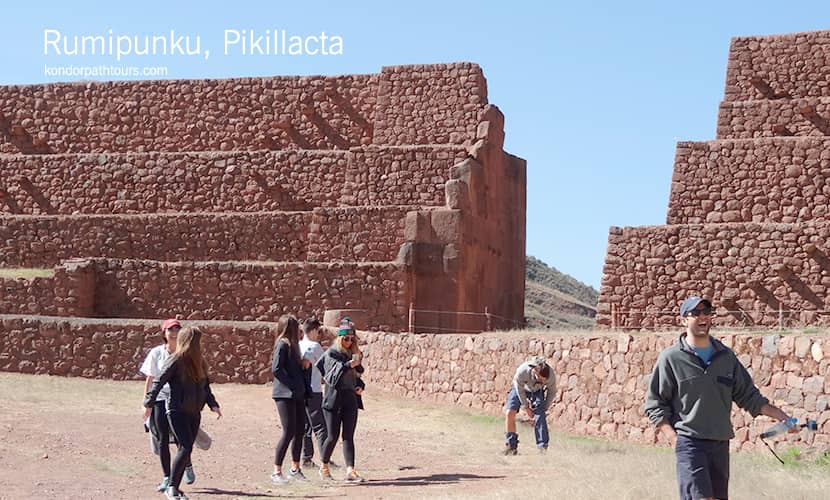
South Valley Tour Cusco — Tipón + Pikillaqta


Tipón, Pikillacta, and Andahuaylillas — the lesser-visited South Valley beyond the Sacred Valley.
The South Valley Tour Cusco is the most overlooked tour in our catalog — and that’s exactly why you should book it. While every traveler crowds into the Sacred Valley north of Cusco, the South Valley sits in relative quiet with three sites that exist nowhere else in Peru.
Five reasons travelers choose the South Valley over (or in addition to) the Sacred Valley:
1. The 3 unique sites tell a different cultural story. Sacred Valley shows you Inca civilization at its peak. South Valley shows you the foundations: the Wari pre-Inca empire that ruled here 400 years before the Incas existed (Pikillaqta), the most refined Inca hydraulic engineering that survives anywhere (Tipón), and the most extraordinary colonial church in the Americas (Andahuaylillas). Three civilizations, three sites, one focused day.
2. Tipón — the Inca water temple that still flows. Tipón is not just terraces and ruins — it’s the most sophisticated water management system surviving from the Inca civilization. Twelve agricultural terraces fed by an intricate network of stone canals and fountains, all engineered by Inca masons 500 years ago and still functioning perfectly today. The centerpiece is the Templo del Agua (Water Temple), where four parallel water channels emerge from carved stone fountains in perfect symmetry. This is engineering, not just archaeology.
3. Pikillaqta — the only Wari city in the Cusco region open to visitors. Pikillaqta covers approximately 50 hectares with over 700 buildings built by the Wari Empire between 550 and 1100 AD — making it at least 400 years older than the Inca Empire. The Wari were the cultural and technological predecessors of the Incas (they built the first Andean road system that the Incas later expanded into the famous Qhapaq Ñan). Pikillaqta is the only place in the Cusco region where you can walk through a pre-Inca city — most Wari sites are in the Ayacucho region 600 km away.
4. Andahuaylillas — the “Sistine Chapel of America.” A modest 17th-century Quechua village church from outside, but inside: walls and ceiling covered floor-to-ceiling in Renaissance-Andean fusion frescoes, two pipe organs from 1626 (the oldest surviving organs in the Americas), a Mudejar-style gold-leaf main altar, and the famous Andean angels — angelic figures dressed as Spanish military officers but with Andean facial features. The church was comprehensively restored 2006-2008 with World Monuments Fund support.
5. Flexible timing + airport pickup + transparent pricing. Morning, afternoon, or any hour your group prefers. We can collect you from your Cusco hotel or the airport directly. Entrance fees (Boleto Turístico Parcial Circuit 2 + Andahuaylillas S/17) are NOT bundled — you pay directly in soles at each site for transparency, saving 25-30% versus operators that hide markups.
| ⏱️ Duration | 5-6 hours (with lunch break) |
| 🕐 Timing flexibility | Morning, afternoon, or your preferred hour |
| 📍 Pickup | Your Cusco hotel OR Cusco airport |
| 📍 Drop-off | Your hotel or chosen location |
| 🏛️ Sites visited (default) | Tipón + Pikillaqta + Andahuaylillas |
| 🎁 Optional add-on | Rumi Punku (stone gate) on request |
| 🍽️ Lunch | NOT included — your free choice (cuy/trucha/chicharrón in route) |
| 🎫 Entrance tickets | NOT included — purchase in soles at each site (~$24 USD total) |
| ⛰️ Max altitude | 3,560 m (Tipón) — gentler than most Cusco tours |
| 💪 Difficulty | Easy to moderate (short walks, some terrace climbing) |
| 📅 Departures | Daily — year-round |
| 👥 Group size | 1-10 travelers |
| 💲 From | $26 USD per person (group of 10) |
| 🎓 Ideal for | Travelers who have already done Sacred Valley, history enthusiasts, foodies, families |





The South Valley Tour Cusco makes the most of 1 day. – Tipón Water Temple — the most refined Inca hydraulic engineering surviving anywhere. – Tipón’s twelve agricultural terraces with intricate Inca canal network — an engineering masterpiece. – Pikillaqta Wari city — the only pre-Inca city in the Cusco region open to visitors (550-1100 AD). – Pikillaqta’s geometric grid layout with 700+ buildings in strict planned arrangement — extremely rare. The South Valley Tour Cusco delivers on every one of these.
The South Valley Tour Cusco is the most overlooked product in our catalog — and the one travelers who book it consistently rate as the unexpected favorite of their Peru trip. While the Sacred Valley north of Cusco gets all the tourist attention (Pisac, Ollantaytambo, Chinchero), the South Valley sits in relative quiet with three extraordinary sites that exist nowhere else.
Who specifically benefits from this tour:
(1) Travelers who already did Sacred Valley and want something different. If your Peru itinerary includes Sacred Valley + Machu Picchu + Cusco City Tour, you’ve missed the most culturally diverse day available in the region. The South Valley fills exactly this gap — three civilizations in one day (Wari pre-Inca + Inca + Colonial Spanish).
(2) History enthusiasts interested in pre-Inca cultures. The Wari Empire ruled most of the central and southern Peruvian Andes from approximately 550 to 1100 AD — 400+ years before the Inca Empire existed. Their road network, terraced agriculture, and planned cities were the technological foundation the Incas later built on. Pikillaqta is the only Wari city in the Cusco region open to visitors — most others are 600 km away in Ayacucho.
(3) Travelers fascinated by Inca engineering. Tipón is not just another set of ruins — it’s the most refined Inca hydraulic engineering surviving anywhere. Twelve agricultural terraces fed by stone canals that still flow perfectly 500 years later. The Templo del Agua (Water Temple) with four parallel ceremonial channels is unique in Inca architecture.
(4) Cultural/religious travelers interested in colonial Andean fusion. Andahuaylillas is one of the most extraordinary churches in the Americas — covered floor-to-ceiling in Cusqueña School (Andean-Christian fusion) frescoes, with two pipe organs from 1626 (the oldest surviving in the Americas), a Mudejar gold-leaf main altar, and Latin/Quechua inscriptions side by side. The Sistine Chapel of America nickname is earned, not marketing.
(5) Off-the-beaten-path travelers. The South Valley sees dramatically fewer tourists than the Sacred Valley in all seasons. At many sites you’ll be the only visitor, or share with 5-10 other travelers maximum. This is the closest you get to an authentic, uncrowded Andean cultural experience in the Cusco region.
(6) Foodies interested in regional Andean cuisine. The South Valley is famous for its food. Tipón has the Cusco region’s most renowned cuy (guinea pig) restaurants — far better than tourist-oriented cuy in Cusco city. Saylla is the village renowned for chicharrón (slow-fried pork). Lucre specializes in fresh trout from the highland lagoons. Your guide recommends based on your preferences.
(7) Families with children 5+. The geometric Wari city at Pikillaqta engages kids who like exploring structured spaces. The colorful Andahuaylillas frescoes capture attention. Tipón’s flowing water channels are kid magnets. The 5-6 hour duration is manageable for young attention spans.
(8) Senior travelers. Lower altitudes (Tipón 3,560 m max, Andahuaylillas 3,120 m — both lower than Cusco’s 3,350 m), gentle walking on relatively flat terrain, and shorter total walking distance make this one of our most senior-friendly tours.
Critical context for travelers comparing options. This tour is NOT competing with the Sacred Valley Tour — it serves a completely different cultural focus:
| Feature | South Valley (this tour) ✓ | Sacred Valley Full Day |
|---|---|---|
| Duration | 5-6 hours | 10 hours |
| Direction from Cusco | South | North |
| Sites | Tipón + Pikillaqta + Andahuaylillas | Pisac + Ollantaytambo + Chinchero |
| Cultures presented | Wari + Inca + Colonial | Only Inca |
| Pre-Inca content | ✅ Pikillaqta Wari city | ❌ |
| Hydraulic engineering focus | ✅ Tipón Water Temple | ❌ |
| Colonial church highlight | ✅ Andahuaylillas frescoes | ❌ |
| Max altitude | 3,560 m (gentler) | 3,800 m+ |
| Tourist crowds | Significantly less | Heavy crowds |
| Best for | History + cuisine + off-beaten-path | Classic Inca circuit |
| From | $26 USD | $50-70 USD |
Translation: do BOTH tours if you can. They cover completely different cultural ground. If you only have time for one, choose based on interest:
This tour explores the lesser-visited South Valley, reaching the Inca agricultural engineering site of Tipón, the pre-Inca Wari citadel of Pikillaqta, and the colonial church at Andahuaylillas, often called the “Sistine Chapel of America” — a genuinely different cultural angle from the more famous Sacred Valley circuit to the north.
Tipón, the tour’s highest stop, sits at roughly 3,560 m, slightly below Cusco’s own elevation, meaning this route asks relatively little in terms of altitude adjustment beyond what travelers already need for Cusco itself. The tour’s pace is comparably gentle, with the main physical activity being moderate walking around each archaeological site.
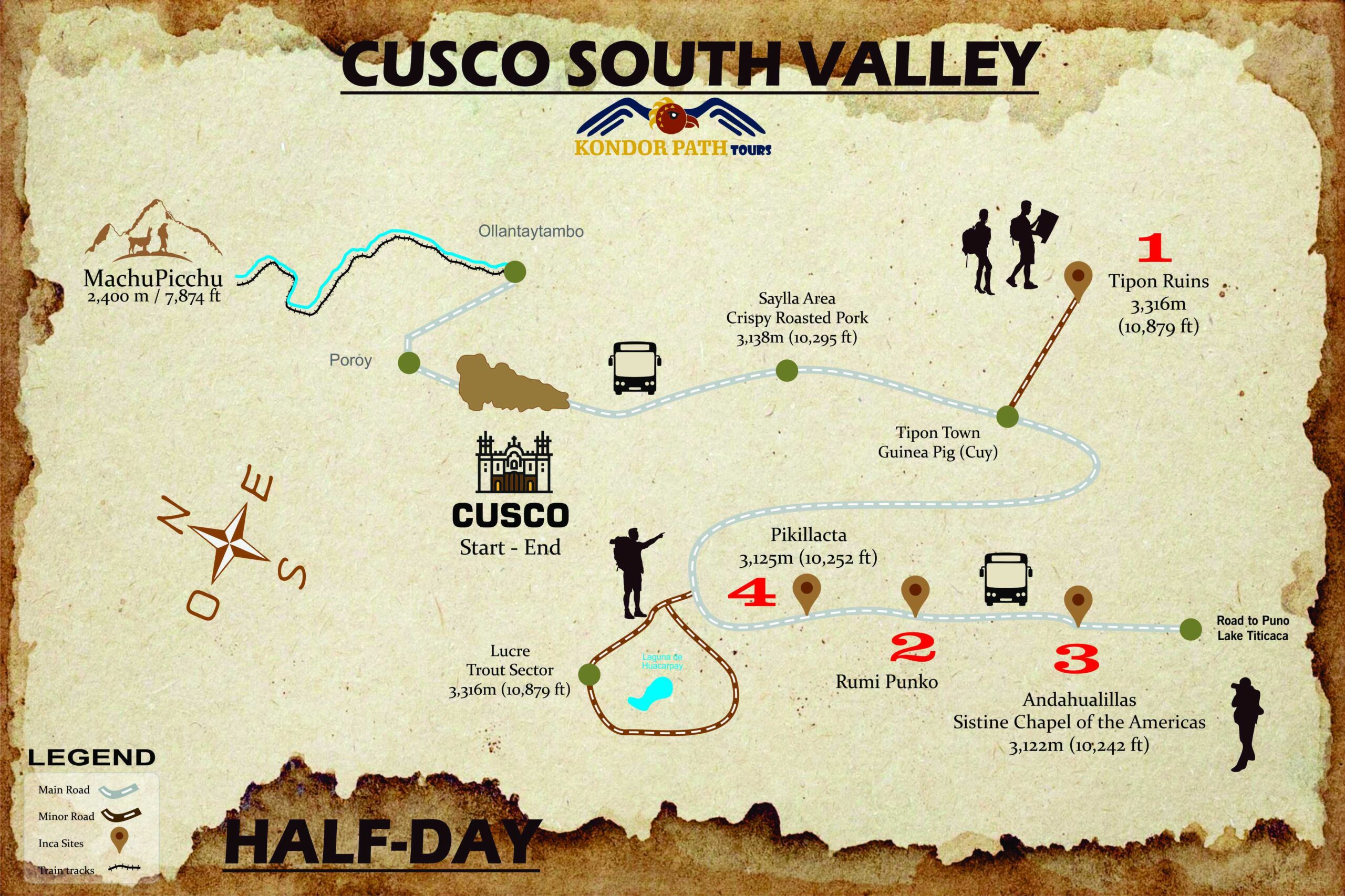
Why this order: we drive south from Cusco passing through Saylla and Lucre toward Tipón first (highest altitude site at 3,560 m), then progressively descend through Pikillaqta (3,250 m) toward Andahuaylillas (3,120 m). The descending altitude profile makes this a gentler day than most Cusco tours. The geographic order also makes lunch logistics convenient — you pass the famous food villages naturally.


Hotel pickup: your driver/guide arrives at your Cusco hotel reception 5 minutes before agreed time. Identified with Kondor Path Tours sign.
For airport pickups, your driver waits in the arrivals area with a Kondor Path Tours sign showing your name. The vehicle accommodates your luggage. Common scenarios:
For airport pickup: book 48 hours minimum so we allocate the driver.
A 40-minute drive south from Cusco through the Lucre valley brings us to Tipón at 3,560 m — the highest altitude site of the tour and the most architecturally significant.
What you’ll experience here:
Tipón is NOT just terraces and ruins — it’s the most sophisticated water management system surviving from the Inca civilization. Most archaeologists believe Tipón was a royal estate dedicated to water worship (the Inca god Mayu), possibly built by Inca Wiracocha or his successors as a personal retreat and ceremonial center.
In your 90 minutes you’ll cover three architectural sections:
Section 1 — The lower agricultural terraces (15-20 minutes)
You enter the site at the base of 12 magnificent agricultural terraces descending the hillside. These weren’t ordinary growing terraces — they served both agricultural and ceremonial functions. The Incas may have used them for crop experimentation similar to Moray, but at a different scale and with a focus on water-intensive crops.
Section 2 — The water canal system (25-30 minutes)
This is the engineering centerpiece. Walking up between the terraces, you’ll see:
The most remarkable detail: all of this still works perfectly 500 years later. No modern engineering has been added. The water flows today exactly as the Inca masons designed it.
Section 3 — The Water Temple / Templo del Agua (30-40 minutes)
The site’s ceremonial heart. Four parallel water channels emerge from carved stone fountains in perfect symmetry, each producing a slightly different sound as the water flows. The space has the feel of a sanctuary — quiet, contemplative, with the constant gentle sound of water as background.
Your guide explains:
Optional photography break at the upper terraces with panoramic views over the Lucre valley below.
A 20-minute drive northwest from Tipón brings us to Pikillaqta at 3,250 m. The drive itself is scenic — you cross the valley floor and approach the site from the road that originally was a Wari road later expanded by the Incas.
What you’ll experience here:
Pikillaqta is the only Wari city in the Cusco region open to visitors — and one of the most important pre-Inca archaeological sites in all of Peru. The Wari Empire ruled from approximately 550 to 1100 AD, controlling most of the central and southern Peruvian Andes at least 400 years before the Inca Empire existed. The Wari were the cultural and technological predecessors of the Incas — their road network, terraced agriculture, and planned cities were the foundation that the Incas later expanded into the famous Tahuantinsuyu.
In your 90 minutes you’ll walk through approximately 1.5 km of the city, covering:
Section 1 — The outer walls and gate (15-20 minutes)
You enter through the original Wari city gate. The massive outer walls — some still standing 6-8 meters high after 1,400 years — show the Wari approach to urban defense and administration. The geometric precision is the most striking detail: straight walls, right-angled streets, planned blocks — extremely rare in Andean architecture (most pre-Inca and Inca sites grow organically, following terrain).
Section 2 — The residential blocks (40-45 minutes)
The bulk of the visit is walking through the residential city. Over 700 buildings arranged in a strict geometric grid across approximately 50 hectares. The Wari built:
The geometric grid layout suggests a centralized administrative state with bureaucratic urban planning — more comparable to medieval European cities than to other Andean settlements of the same era.
Section 3 — The elite zone and ceremonial buildings (25-30 minutes)
The center of the city contained the elite residences and ceremonial structures. Larger buildings with more elaborate masonry, including some with white plaster surfaces. Your guide explains:
Pikillaqta is the closest you get to walking through a planned ancient city in the Cusco region. Most Inca and pre-Inca sites grew organically; this one was designed and built as a unit.
After Pikillaqta, we stop for lunch in one of the South Valley’s famous food villages — this is one of the highlights for foodies. Lunch is NOT included in the tour price because we want you to choose what interests you most. Your guide recommends based on your preferences:
🐷 Cuy (Guinea Pig) in Tipón — the most traditional Andean dish:
Tipón village is Cusco region’s most renowned cuy specialty zone. Local families have prepared cuy for generations and the quality is dramatically better than tourist-oriented cuy in Cusco city. Two main preparations:
Cost: ~S/60-80 ($16-22 USD) per cuy serving. Often shared between 2 people.
🐟 Trout in Lucre — fresh from highland lagoons:
Lucre village specializes in fresh trout from the Andean highland lagoons — typically grilled, fried, or in ceviche-style preparations. The trout is caught the morning of your meal. Cost: ~S/30-45 ($8-12 USD) per plate.
🥓 Chicharrón in Saylla — Cusco’s pork tradition:
Saylla village is the most famous chicharrón destination in the Cusco region. Slow-fried pork, served with cancha (toasted corn), mote (boiled corn), and salsa criolla. The Saylla chicharrón is considered by Cusqueños to be the regional benchmark. Cost: ~S/20-35 ($5-9 USD) per plate.
🥗 Vegetarian/vegan options: available in all three villages but with less specialization. Quinoa soup, vegetable stir-fries, or Andean grain plates available. Mention preferences at booking.
🍽️ Return-to-Cusco option: if you prefer to eat after the tour, we can return you to Cusco for lunch at any restaurant of your choice. Just let your guide know.
Time allocated for lunch: ~60 minutes (built into the 5-6 hour tour duration).
A 20-minute drive from the lunch villages brings us to Andahuaylillas at 3,120 m — the lowest altitude point of the tour.
What you’ll experience here:
The Iglesia de San Pedro Apóstol de Andahuaylillas was completed in 1580 in this small Quechua village. From outside it looks like an ordinary colonial parish church — modest adobe construction, simple bell tower, traditional plaza out front. Locals call this the “deception” of the church: nothing prepares you for the interior.
Inside the church (35-40 minutes guided visit):
The walls and ceiling are covered floor-to-ceiling in Renaissance-Andean fusion frescoes, painted in the early 1600s by artists of the Cusqueña School (Escuela Cusqueña) — a unique post-conquest artistic movement that combined Spanish Renaissance technique with Andean iconography.
Specific elements you’ll see:
Your guide explains:
Important: photography inside the church is strictly forbidden (no exceptions). This protects the 400-year-old pigments from flash and humidity. Exterior photography is permitted and the facade + plaza make beautiful photos.
Entry fee: S/17 (~$5 USD) — purchased directly at the church entrance from the parish staff. Not included in the Boleto Turístico (Andahuaylillas is administered by the Jesuit parish, not the regional government).
If you specifically request, we can add a visit to Rumi Punku (“Stone Gate” in Quechua) — the Inca pyramidal stone portal that marks the southern entry to the imperial Cusco zone. The site is small (~15-20 minute visit) but architecturally significant: fine Inca imperial-style masonry on a pyramidal structure, with a channel at the top that originally carried water to Pikillaqta.
When to add Rumi Punku:
Request at booking — we route through Rumi Punku without extending the total tour duration significantly (~15-20 minutes addition).
Not included in the standard itinerary, so unless you specifically request, we focus on the 3 main sites (Tipón + Pikillaqta + Andahuaylillas).
A 60-70 minute drive returns you to Cusco. Drop-off at your hotel, restaurant, Plaza de Armas, or back at Cusco airport (your choice). For travelers continuing to Puno by bus, we can drop you at the Cusco bus terminal (terminal terrestre) instead — the route to Puno passes the South Valley sites you’ve just seen, so it’s a natural connection.
Total tour stats

None

Easy

A light walks

5 to 25 minutes

Cusco: 3,350 m (10,990 ft.)
Andahuaylillas: 3,120 m (10,236 ft.)
Tipón: 3,560 m (11,680 ft.)
Transport
Guides
Other
Entrance fees — buy in soles at each site:
We intentionally don’t bundle entrance fees. Other agencies typically bundle tickets with a 25-30% markup built in — we keep them separate so your costs stay lower and discounts apply cleanly.
| Ticket | Cost in Soles | USD equivalent | What it covers |
|---|---|---|---|
| Boleto Turístico Parcial Circuit 2 | S/70 | ~$19 USD | Tipón + Pikillaqta + Cusco museums (valid 1 day) |
| Boleto Turístico Integral | S/130 | ~$35 USD | 16 sites across Cusco region including Tipón + Pikillaqta (valid 10 days) |
| Andahuaylillas Church entrance | S/17 | ~$5 USD | Church visit + brief parish staff introduction |
Recommended ticket combination:
How to pay: your guide takes you to the ticket offices at each site:
Cash in Peruvian soles preferred at all sites — bring S/100-120 in soles to cover entrance fees + lunch + small expenses. ATMs available in central Cusco before the tour.
Discounts apply directly at ticket offices:
Lunch — NOT included (your free choice):
We don’t include lunch because we want you to choose:
You pay directly at the restaurant. Your guide and driver also take their break — they don’t expect you to pay for them.
Other items NOT included:
As a direct local operator, we refuse to hide markups inside bundled tour pricing. You pay actual rates in soles at each ticket office:
Total cost with us (Half Day tour + entrance fees + lunch at $26 USD group rate): ~$61-72 USD per person. Total cost with bundled operators: typically $90-110 USD per person (40-60% markup).
You save $30-50 USD per person by booking with transparent pricing.
Primary audience:
Secondary audience — Acclimatization use case:
The South Valley has the lowest maximum altitude of any Cusco day tour we offer (3,560 m at Tipón, descending from there). This makes it an excellent choice for:
Honest disclosure:
Everything you need to know about our South Valley Tour Cusco — the comprehensive full-day exploration of the four extraordinary archaeological and colonial sites south of Cusco that most travelers miss entirely.
The South Valley Tour Cusco is a 5-6 hour guided tour visiting 3 unique sites south of Cusco: Tipón (Inca hydraulic engineering masterpiece with the Water Temple), Pikillaqta (the only pre-Inca Wari city in the Cusco region open to visitors), and Andahuaylillas (the colonial
church nicknamed “Sistine Chapel of America”).
The tour includes private transportation, certified bilingual guide for the full 5-6 hours, pickup from your Cusco hotel OR Cusco airport directly, bottled water, and drop-off at your chosen location. Optional Rumi Punku add-on available on request.
Entrance fees (Boleto Turístico Parcial Circuit 2 + Andahuaylillas S/17) and lunch are NOT included — purchase in soles directly at each site, and choose your lunch from famous food villages along the route.
Three concrete differences:
(1) Different cultures: Sacred Valley shows only Inca civilization (Pisac, Ollantaytambo, Chinchero). South Valley shows three civilizations — Wari pre-Inca (Pikillaqta), Inca (Tipón), and Colonial Spanish-Andean fusion (Andahuaylillas).
(2) Fewer crowds: Sacred Valley is the most touristic day-trip from Cusco. South Valley sees dramatically fewer visitors — at many sites you might be the only group, or share with a handful of others.
(3) Different intellectual content: Sacred Valley focuses on iconic Inca architecture and agriculture. South Valley focuses on pre-Inca foundations, water engineering, and colonial cultural fusion.
Best combination: do BOTH tours if you have time. They cover completely different cultural ground and complement each other. If you only have time for one, choose based on interest — iconic Inca → Sacred Valley; pre-Inca + engineering + colonial + cuisine + fewer crowds → South Valley.
Tipón is an Inca archaeological complex 23 km southeast of Cusco at 3,560 m, famous for the most sophisticated water management system surviving from the Inca civilization.
The site features 12 magnificent agricultural terraces fed by an intricate network of stone canals, aqueducts, and fountains — all still functional 500 years after construction.
The centerpiece is the Templo del Agua (Water Temple) — a ceremonial space where four parallel water channels emerge from carved stone fountains in perfect symmetry, each producing a slightly different sound as the water flows.
Most archaeologists consider Tipón a royal Inca estate dedicated to water worship (the Inca god Mayu), possibly built by Inca Wiracocha or one of his successors.
Some theories also suggest it was used as an agricultural laboratory for water-intensive crops, similar to Moray’s role with altitude-variant crops.
What makes Tipón unique: not just that the engineering was sophisticated for its era, but that it still works perfectly today. No modern restoration of the water system — Inca masons calibrated everything precisely 500 years ago and it has functioned uninterrupted ever since.
Pikillaqta (Quechua for “Place of the Flea”) is one of the most important pre-Inca archaeological sites in the Andes — a vast urban complex built by the Wari Empire between approximately 550 and 1100 AD, roughly 400+ years before the Inca Empire existed.
The site covers approximately 50 hectares with more than 700 buildings arranged in a strict geometric grid — a true planned city, extremely rare in Andean architecture (most pre-Inca and Inca settlements grew organically following terrain).
Why this matters historically: the Wari were the cultural and technological predecessors of the Incas. Their road network became the foundation for the Inca Qhapaq Ñan.
Their terraced agriculture techniques were inherited by the Incas. Their administrative centralization influenced Inca imperial organization.
Why Pikillaqta is unique in Cusco region: it’s the only Wari city in the Cusco region open to visitors. Most Wari sites are 600 km away in Ayacucho. If you want to see pre-Inca civilization in the Cusco area, this is the only place.
The Wari (or Huari) were an Andean empire that flourished from approximately 550 to 1100 AD, centered in modern-day Ayacucho. They controlled most of the central and southern Peruvian Andes at least 400 years before the Inca Empire emerged as a major power.
Key Wari contributions that the Incas later inherited and expanded:
example)
Differences from the Incas:
with staffs); Incas focused on Inti (sun) and Pachamama (earth)
The Inca Empire (1438-1533 AD) absorbed Wari knowledge and infrastructure as it expanded — much of what we consider “Inca” is actually Wari with Inca modifications.
Andahuaylillas is the colonial Iglesia de San Pedro Apóstol, completed in 1580 in a small Quechua village 40 km southeast of Cusco.
Despite its modest exterior (simple adobe construction, ordinary parish bell tower), the interior is covered floor-to-ceiling in murals, gold-leaf carved altars, and Renaissance-Andean fusion frescoes — earning it the nickname Capilla Sixtina de América.
Specific highlights inside:
occasionally played)
officers but with clearly indigenous Andean facial features
The church and its frescoes were comprehensively restored 2006-2008 with funding from the U.S. State Department and the World Monuments Fund, restoring colors that had faded for centuries.
The “Sistine Chapel of America” nickname is earned, not marketing. When you walk in from the modest exterior, the interior visual impact genuinely stops travelers in their tracks.
The murals were created in the early 1600s by artists of the Cusqueña School (Escuela Cusqueña) — a unique post-conquest artistic movement that combined Spanish Renaissance technique with Andean iconography.
The principal artist at Andahuaylillas is believed to be Luis de Riaño, a Spanish-trained master who integrated indigenous symbols into Catholic imagery.
The “Andean Angels” — angelic figures dressed as Spanish military officers but with clearly indigenous facial features — are an iconic example of this cultural fusion.
Why this style emerged: after the Spanish conquest, the Catholic Church needed to convert indigenous populations.
The Cusqueña School developed as a deliberate strategy to make Catholic religious imagery more accessible to Andean populations by incorporating familiar elements (indigenous facial features, Andean landscapes, native flora and fauna into biblical scenes).
The Andahuaylillas frescoes are considered one of the best-preserved examples of Cusqueña School work in Peru. Many other colonial churches had similar decoration but lost it to fires, earthquakes, or modern “restoration” that painted over the originals.
Andahuaylillas survived intact, and the 2006-2008 restoration was conservative — cleaning and protecting rather than overpainting.
No — lunch is NOT included, and that’s intentional. We give you the freedom to choose where to eat in the famous food villages along the route:
🐷 Cuy in Tipón: ~S/60-80 ($16-22 USD). The most traditional Andean dish. Tipón is Cusco region’s most renowned cuy specialty zone — far better than tourist-oriented cuy in Cusco city.
🐟 Trucha in Lucre: ~S/30-45 ($8-12 USD). Fresh trout from Andean highland lagoons, caught the morning of your meal.
🥓 Chicharrón in Saylla: ~S/20-35 ($5-9 USD).
Slow-fried pork — Saylla is the most famous chicharrón destination in the Cusco region.
🥗 Vegetarian options: available but with less specialization. Quinoa soup, vegetable plates, Andean grain dishes. Mention preferences at booking.
🍽️ Return to Cusco for lunch: if you prefer, we can return you to Cusco for lunch at any restaurant of your choice. Just let your guide know.
Time allocated: ~60 minutes (built into the 5-6 hour tour). You pay directly at the restaurant. Your guide and driver take their break — they don’t expect you to pay for them.
Here’s why we’re upfront about pricing:
(1) Cost transparency. Most operators add 25-30% markup when bundling tickets. You’d pay $30-35 USD for what should cost $24 USD (S/70 + S/17). Keeping costs itemized means you always see what you’re actually paying.
(2) Discounts apply directly. ISIC student cards (50% off Boleto + reduced Andahuaylillas), Andean Community citizens (promotional rate), and children under 10 (50% off Boleto) get reduced rates at the official ticket offices — not at bundled tour prices.
(3) Easy purchase in soles. Your guide takes you to the ticket offices at each site (Tipón, Pikillaqta, Andahuaylillas) where you pay directly in soles. Takes 2 minutes per site. Cash in soles preferred.
Recommendation: bring S/100-120 in soles to cover both entrance fees + lunch + small expenses. ATMs available in central Cusco before the tour.
Transparent group-size pricing.
| Persons | Price (p/p) | |
| 1 | $ 158.00 USD | |
| 2 | $ 99.00 USD | |
| 3 | $ 71.00 USD | |
| 4 | $ 55.00 USD | |
| 5 | $ 46.00 USD | |
| 6 | $ 39.00 USD | |
| 7 | $ 35.00 USD | |
| 8 | $ 31.00 USD | |
| 9 | $ 28.00 USD | |
| 10 | $ 26.00 USD |
With Rumi Punku add-on: contact us for current pricing — a small additional fee for the extra site.