Q’eswachaka Inca Bridge Tour — Full Day


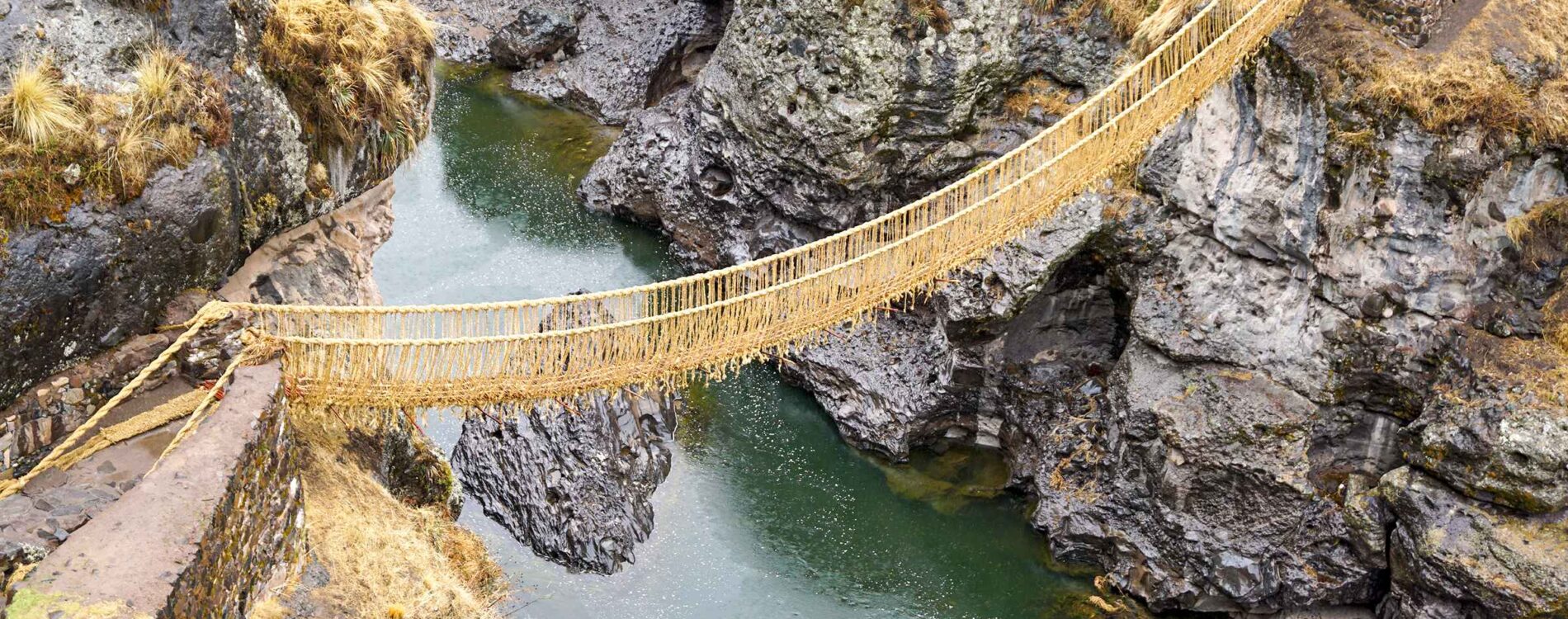
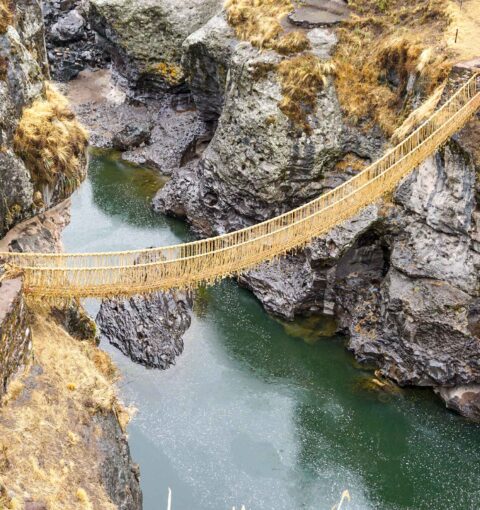
The last surviving hand-woven Inca rope bridge, rebuilt annually using ancestral techniques.
The last surviving Inca rope bridge in the world — suspended 28 meters across the sacred Apurímac River, rebuilt every June by four Quechua communities using exactly the same techniques their Inca ancestors used 500+ years ago. UNESCO Intangible Cultural Heritage of Humanity (2013). The only tour in our catalog where you witness Inca knowledge still actively practiced today — not ruins, not reconstructions, but living tradition.
The Q’eswachaka Inca Rope Bridge Tour is unique in our entire catalog. Every other tour shows you what the Incas left behind — citadels, terraces, roads, ruins. This one shows you what they still do.
The Q’eswachaka bridge crosses the sacred Apurímac River in the Canas province, 156 km south of Cusco. It is the last surviving Inca rope bridge in the world — built and rebuilt continuously for over 500 years by four Quechua communities (Huinchiri, Chaupibanda, Choccayhua, and Ccollana Quehue) who are direct descendants of the original Inca builders. Every June they gather and reconstruct it entirely from scratch using only ichu grass, no nails, no metal, no modern tools — exactly the same techniques their ancestors used during the Inca Empire.
In 2013, UNESCO inscribed the bridge — and the knowledge of how to build it — as Intangible Cultural Heritage of Humanity.
Five reasons travelers choose the Q’eswachaka over (or in addition to) the famous archaeological tours:
1. The only living Inca tradition in active use today. Sacred Valley shows Inca ruins. Machu Picchu shows the Inca citadel. Q’eswachaka shows Inca knowledge still being practiced. The communities you meet are not reenactors or museum staff — they are real Quechua families practicing real ancestral engineering. No other tour in Peru offers this kind of authenticity.
2. Two bridges, two civilizations, one day. The tour visits two bridges with completely different historical meanings. The Inca Bridge of Pitumarca Checacupe is the only bridge in Peru where you can see three superimposed historical layers in one structure: original Inca stone foundation + Spanish colonial arches built atop + Republican-era modifications. The Q’eswachaka is the purest surviving Inca engineering — woven entirely from natural grass, suspended over a deep canyon. Together they tell the full story of Andean bridge-building across 500+ years.
3. Box lunch + entrance tickets INCLUDED. Unlike our other day tours (where we keep tickets and lunch separate for transparency), the Q’eswachaka tour includes both: a full box lunch prepared by us, and the community entrance ticket to the bridge (purchased on your behalf by your guide directly at the community gate). You don’t need to manage cash for entrance fees at the bridge — we handle it. This simplifies your day given the remote location.
4. Flexible pickup — 05:20 AM standard, but adaptable. Most operators run a fixed 04:30 AM pickup. We start at 05:20 AM standard (already gives you significant additional rest) and can adapt the pickup time to 06:00, 06:30, 07:00, or 07:30 AM if your group prefers. Later pickup compresses the schedule but is feasible for travelers who can’t manage a 05:20 start. Discuss at booking.
5. Cross the bridge yourself — bridge crossing fee INCLUDED. The bridge is fully functional and walkable (except during the 3-day annual renewal in June). At 28 meters long and approximately 6 meters above the Apurímac River, walking across is the experiential highlight for most travelers. The community charges a small crossing fee — we include it in the tour price. You decide on-site whether you want to cross or view from the riverbank.
| ⏱️ Duration | Full day (~12-13 hours) |
| 🕐 Pickup time | 05:20 AM standard (flexible: 06:00, 06:30, 07:00, 07:30 AM on request) |
| 📍 Pickup | Your Cusco hotel OR Cusco airport |
| 📍 Drop-off | Your Cusco hotel |
| 🚗 Distance | 156 km each way (3h 32min driving each way) |
| 🏛️ Default sites | Inca Bridge Pitumarca Checacupe + Q’eswachaka Rope Bridge |
| 🎁 Optional sites | Pabellones miniature volcano + Pomacanchis Lagoon (if time + request) |
| ✅ Box lunch | INCLUDED |
| ✅ Entrance tickets | INCLUDED (Kondor Path Tours buys at site for you) |
| 🍳 Breakfast | NOT included (hotel breakfast/to-go/optional roadside stop) |
| ⛰️ Bridge altitude | 3,700 m |
| 💪 Difficulty | Easy (long drive is main demand) |
| 📅 Departures | Daily — year-round |
| 👥 Group size | 1-10 travelers |
| 💲 From | $69 USD per person (group of 10) |
| 🎓 Recommended age | 10-75 years |
| 🌍 UNESCO status | Intangible Cultural Heritage of Humanity (2013) |





The Q’eswachaka Inca Bridge Tour begins with a promise: 1 day of genuine discovery. – Q’eswachaka Inca rope bridge — the last surviving Inca suspension bridge in the world (500+ years continuous. – UNESCO Intangible Cultural Heritage of Humanity (2013) — one of only 700+ traditions worldwide with this. – Inca Bridge of Pitumarca Checacupe — the only bridge in Peru with three superimposed historical layers (Inca. – Crossing the bridge — walk 28 meters across the Apurímac River canyon. This is what the Q’eswachaka Inca Bridge Tour is really about.
The Q’eswachaka Inca Bridge Tour is the most authentic cultural experience in our entire catalog — and the only tour where you witness living Inca tradition in active use today rather than ruins or reconstructions.
Who specifically benefits from this tour:
(1) Cultural travelers who already did the famous archaeological circuit. If you’ve done Sacred Valley, Machu Picchu, and Cusco City Tour, you’ve seen what the Incas built. Q’eswachaka shows you what they still do — the only Inca engineering tradition that has continued uninterrupted for 500+ years, practiced by direct descendants of the original builders.
(2) UNESCO Intangible Cultural Heritage seekers. UNESCO inscribed “the knowledge, skills and rituals associated with the annual renewal of the Q’eswachaka bridge” as Intangible Cultural Heritage of Humanity in 2013. Only 700+ traditions worldwide hold this designation — and very few are this accessible to tourists. The bridge is a rare living UNESCO site.
(3) History enthusiasts interested in Inca engineering. The Q’eswachaka is one of approximately 200 rope bridges the Incas built across their Qhapaq Ñan road network. After the Spanish conquest, all the others fell into disrepair. This is the only one continuously maintained for 500+ years — a remarkable act of cultural continuity by communities who chose to preserve ancestral knowledge that the colonial government tried to replace with stone bridges.
(4) Off-the-beaten-path travelers (real ones). Most “off-the-beaten-path” tours in Cusco are well-trodden by tourism. Q’eswachaka actually qualifies — 156 km from Cusco, requiring full-day commitment, few tourists at any given visit. Many days you’ll be one of only 5-15 visitors at the bridge.
(5) Photography enthusiasts. The visual contrast is unforgettable: a golden ichu grass bridge suspended over the clear blue Apurímac River in a deep canyon walled by dramatic cliffs. Wide-angle shots from the riverbank, mid-shots crossing the bridge, intimate close-ups of the weaving technique — multiple distinct compositions in one location.
(6) Adventure travelers who want to cross. Walking across a 500-year-old grass bridge swaying 6 meters above a deep river canyon is a genuine experiential moment — not engineered for tourism, but a real functional bridge that locals use daily. The bridge crossing is included in the tour (community charges a crossing fee that we cover).
(7) Bridge and engineering enthusiasts. The Q’eswachaka is an active example of suspension bridge engineering predating modern steel-cable suspension bridges by centuries. Modern engineers have tested the bridge — it supports up to 4 tons through tension distribution along braided cables. The same principle modern bridges use was achieved 500 years before steel.
(8) Travelers continuing to Puno. The Q’eswachaka is on the route south to Puno (the road from Cusco to Puno passes near Yanaoca). For travelers heading to Lake Titicaca after Cusco, the Q’eswachaka makes sense as the final Cusco-area tour day before the Puno bus.
Critical context for travelers comparing options. This tour is NOT competing with archaeological tours — it serves a completely different cultural purpose:
| Feature | Q’eswachaka (this tour) ✓ | Sacred Valley | South Valley | Rainbow Mountain |
|---|---|---|---|---|
| What you see | Living Inca tradition | Inca ruins (Pisac/Ollantaytambo) | Wari + Inca + Colonial | Inca sacred landscape |
| UNESCO status | ✅ Intangible Heritage 2013 | (Inca Trail is Cultural Heritage) | ❌ | ❌ |
| Distance from Cusco | 156 km | 60 km | 40 km | 100 km |
| Duration | ~12-13 hours | 10 hours | 5-6 hours | ~12 hours |
| Box lunch included | ✅ | Sometimes | ❌ | Sometimes |
| Tickets included | ✅ | ❌ | ❌ | ✅ |
| Tourist crowds | Very low | Heavy | Low | Heavy (most popular sites) |
| Best for | Authenticity-seekers + Heritage | First-time Inca circuit | Pre-Inca + foodie | Iconic landscape |
| From | $69 USD | $60-80 USD | $26 USD | $65 USD |
Translation:
This full-day tour visits the last surviving example of a truly living Inca tradition: the Q’eswachaka rope bridge, rebuilt by hand every year by local communities using techniques unchanged since Inca times, recognized as UNESCO Intangible Cultural Heritage.
The bridge site sits at roughly 3,700 m, comparable to Cusco’s own elevation, so the day doesn’t involve a significant altitude increase beyond what travelers have already adjusted to in the city. The tour’s activity level is moderate, centered on viewing and learning about the bridge rather than sustained physical exertion.
Why this tour is a full-day commitment. Q’eswachaka is 156 km from Cusco — significantly farther than Sacred Valley (60 km) or even Rainbow Mountain (100 km). The drive takes 3 hours 32 minutes each direction, which is the main physical demand of the day. The early 05:20 AM pickup exists specifically so you can complete the round-trip drive, a meaningful bridge visit, lunch, and return at a reasonable hour.
Standard pickup: 05:20 AM — recommended timing. Allows arrival at Q’eswachaka around 09:00 AM with good morning light for photography, full visit time before midday, and return to Cusco around 18:00 PM.
Flexible alternative pickup times (request at booking):
Why most travelers prefer 05:20 AM: morning light at the bridge is significantly better, fewer other visitors at the site (most arrive midday), and you return to Cusco at a reasonable evening hour for dinner.
Hotel pickup: your driver/guide arrives at your Cusco hotel reception 5 minutes before agreed time. Identified with Kondor Path Tours sign.
Cusco airport pickup: your driver/guide waits at the airport arrivals waiting area with a Kondor Path Tours sign. The vehicle accommodates luggage. Common scenarios:
Breakfast options before departure:
The drive south from Cusco follows the Cusco-Puno highway for the first 130 km (the same well-maintained paved road used for Cusco-to-Puno transfers), then turns into the Canas province at Yanaoca for the final 26 km to the bridge.
Sections of the drive:
(1) Cusco → San Salvador → Combapata (0-130 km, ~2h 30min)
(2) Combapata → Yanaoca (130-150 km, ~45min)
(3) Yanaoca → Q’eswachaka (150-156 km, ~15min)
Approximately 2.5 hours into the drive (before Combapata), we stop at one of Peru’s most unique bridges — the Inca Bridge of Pitumarca Checacupe.
What makes this bridge unique:
This is the only bridge in Peru where you can see three superimposed historical periods in one functioning structure:
Your guide explains:
Photography opportunity: the three historical layers are visible from the riverbank below the bridge. Walk down ~5 minutes to the river level for the best view showing all three architectural styles.
This stop is brief but conceptually important — it sets up your understanding of why Q’eswachaka is unique (the rope bridge tradition that the Spanish tried to eliminate, but that one community kept alive).
A 1-hour drive from Pitumarca Checacupe brings us to the Q’eswachaka community.
Arrival logistics:
Your guide handles the community entrance ticket at the community gate (we include this in your tour price). You walk approximately 15 minutes from the parking area down to the bridge viewpoint via a gentle dirt path with some stones.
What you’ll experience at the Q’eswachaka bridge:
Section 1 — The first view from the rim (~15 minutes)
You arrive at the upper viewpoint looking down into the Apurímac canyon. The first impression is the scale: the bridge spans approximately 28 meters suspended over a deep canyon, with the clear blue Apurímac River flowing about 6 meters below the bridge floor. The dramatic cliff walls on both sides create a powerful sense of place.
This is the first iconic photography opportunity — wide-angle shot of the golden ichu grass bridge against the canyon and river below.
Section 2 — The descent to bridge level (~10 minutes)
A path descends from the upper viewpoint to the bridge platform. Some sections are steep with loose stones — your guide leads the group at appropriate pace.
Section 3 — Bridge construction explanation (~30-40 minutes)
At the bridge platform, your guide gives the detailed explanation of how the bridge is built. The explanation is the educational core of the visit:
Section 4 — Optional bridge crossing (~10-15 minutes)
The bridge is fully functional and walkable. Walking across is the experiential highlight for most travelers — a genuine moment that distinguishes Q’eswachaka from any other archaeological site.
The crossing experience:
Bridge crossing fee is INCLUDED in your tour price. You decide on-site whether you want to cross — many travelers cross, some prefer to view from the riverbank, both are valid choices.
Travelers with fear of heights: the bridge is safe but the sway can be intense for sensitive travelers. View from the riverbank gives excellent photography without the crossing.
Section 5 — Riverbank exploration and photography (~20-30 minutes)
After crossing (or instead of crossing), explore the riverbank. The Apurímac River up close is a powerful experience — Quechua for “Speaking God”, considered sacred by the Incas as the geological source of the Amazon River.
Photography opportunities:
After the Q’eswachaka visit, we provide your box lunch at a scenic spot in the area or back at the parking area, depending on weather and conditions.
Box lunch contents (typical):
Vegetarian and gluten-free options available with 48-hour advance notice at booking.
Why we include the box lunch (unlike our other day tours where lunch is your free choice): the remote location means no restaurants near the bridge. The closest restaurants are in Yanaoca village (15 km away) which would add significant time to the day. The box lunch lets you eat on-site or at a scenic stop without breaking the flow of the visit.
If schedule allows and you request, we can include one or both of these optional sites on the return drive:
Located in the Yanaoca district near the main road. The smallest known volcanic formation — only 4 meters in diameter. The formation is geologically curious (not an active volcano, but a small cinder cone-like feature).
When to add: travelers interested in unique geological features. The Pabellones formation is photogenic and the brief visit doesn’t significantly extend the day.
High Andean lake visible from a roadside viewpoint near Combapata. You don’t visit the lake itself (no time for a proper visit), but observe from a panoramic viewpoint showing the lagoon in its mountain setting.
When to add: travelers who want extra Andean landscape photography. Pomacanchis is one of several high-altitude lagoons in the region — the viewpoint stop gives context to the Andean ecosystem.
Request at booking so we factor the optional stops into the day’s timing. Default itinerary focuses on the two bridges without optional stops.
The drive back follows the same route in reverse — Q’eswachaka → Yanaoca → Combapata → Sicuani → Urcos → Cusco. ~3 hours 30 minutes total.
Most travelers sleep or rest during the return drive — the day is long and the morning excitement at the bridge typically leaves people quietly satisfied.
Drop-off at your Cusco hotel. For travelers continuing to Puno, we can drop you at the Cusco bus terminal (terminal terrestre) instead — the route to Puno goes back through the same area, so it’s a natural connection if you have an evening or next-day bus to Lake Titicaca.
Total tour stats

Box Lunch

Easy

A light walk

25-minutes

Cusco: 3,350m (10,990 ft)
Qeswachaka Road: 3,644m (11,955 ft)
Qeswachaka Bridge: 3,644m (11,955 ft)
Transport
Guides
Entrance & Activities
Meals
Other
Meals not included:
Other items not included:
You may have noticed that our other day tours (Cusco Half Day, Full Day, Maras Moray, South Valley) don’t include lunch or entrance tickets — keeping them separate for transparency.
The Q’eswachaka tour is different for two operational reasons:
(1) The remote location. Q’eswachaka is 156 km from Cusco in a sparsely populated area. There are no restaurants near the bridge — the closest are in Yanaoca village 15 km away, which would add significant time and disruption. A pre-prepared box lunch lets you eat on-site without breaking the flow of the visit.
(2) Community entrance management. The Q’eswachaka community entrance is not a government ticket office — it’s managed directly by community members at the bridge gate. Cash-only, soles only, with informal hours. Your guide handles the purchase so you don’t need to manage cash for entrance fees at a remote community gate.
For both these reasons, including box lunch + entrance tickets simplifies the day significantly. Total cost transparency: tour price ($69 USD group of 10) + tips (suggested $10-15 USD) = ~$79-84 USD per person all-in.
Primary audience:
Honest disclosure:
Everything you need to know about our Q’eswachaka Inca Rope Bridge Tour — the journey to the last surviving Inca suspension bridge still built every year using 500-year-old ancestral techniques.
The Q’eswachaka Inca Rope Bridge Tour is a full-day cultural journey to the last surviving Inca-era suspension bridge in Peru, located over the sacred Apurímac River in the Canas province, 156 km south of Cusco.
The 28-meter bridge has been continuously rebuilt every year for over 500 years by four Quechua communities using only natural ichu grass and ancestral techniques.
The tour includes pickup from your Cusco hotel OR Cusco airport, a stop at the Inca Bridge of Pitumarca Checacupe (the only bridge in Peru showing Inca + Colonial + Republican layers in one structure), the main visit to the Q’eswachaka bridge with detailed explanation of construction technique,
optional bridge crossing, box lunch (INCLUDED), and return to Cusco.
The bridge was inscribed as UNESCO Intangible Cultural Heritage of Humanity in 2013. Total duration: ~12-13 hours.
Q’eswachaka is a Quechua compound word: q’eswa means “braided rope” and chaka means “bridge”. The literal translation is “braided rope bridge”. The single quotation mark (apostrophe) represents a glottal stop — a subtle pause sound common in Quechua.
Pronunciation: roughly “kess-wah-CHA-kah” with emphasis on the third syllable. Alternative spellings include Qeswachaka, Keswachaka, or Q’iswa Chaka — locals and our guides use them interchangeably.
In 2013, UNESCO inscribed “the knowledge, skills and rituals associated with the annual renewal of the Q’eswachaka bridge” on the Representative List of the Intangible Cultural Heritage of Humanity.
The recognition honors not just the bridge itself but the entire 500-year-old communal tradition of rebuilding it every year.
Four neighboring Quechua communities — Huinchiri, Chaupibanda, Choccayhua, and Ccollana Quehue — gather every June and reconstruct the bridge from scratch using only ichu grass and ancestral knowledge.
This is the only surviving practical example of the Inca Qhapaq Ñan road system’s rope bridge engineering, still actively maintained by direct descendants of the original builders.
UNESCO Intangible Heritage status puts the Q’eswachaka in extraordinary company — fewer than 700 traditions worldwide hold this designation.
Standard pickup: 05:20 AM. This is the recommended timing for the optimal balance between getting to the bridge with good morning light and returning to Cusco at a reasonable evening hour.
Flexible alternative pickup times available (request at booking):
Later pickups compress the day but are viable for travelers who genuinely cannot manage a 05:20 AM start. Discuss timing preference at booking — we adapt to your group’s needs.
The bridge is 156 km southeast of Cusco via the Cusco-Puno highway with a turnoff into Canas province at Yanaoca. Driving time: 3 hours 32 minutes each direction (so approximately 7 hours total driving over the day).
The drive route:
The drive itself is part of the experience — high Andean plateaus at 3,500-3,900 m, traditional Quechua villages, alpaca herds, and dramatic mountain panoramas with distant glaciated peaks.

Transparent group-size pricing.
| Persons | Price (p/p) | |
| 1 | $ 335.00 USD | |
| 2 | $ 195.00 USD | |
| 3 | $ 146.00 USD | |
| 4 | $ 118.00 USD | |
| 5 | $ 103.00 USD | |
| 6 | $ 92.00 USD | |
| 7 | $ 84.00 USD | |
| 8 | $ 78.00 USD | |
| 9 | $ 73.00 USD | |
| 10 | $ 69.00 USD |

Qeswachaka Tour Full Day

Qeswachaka Tour Full Day

Qeswachaka Tour Full Day